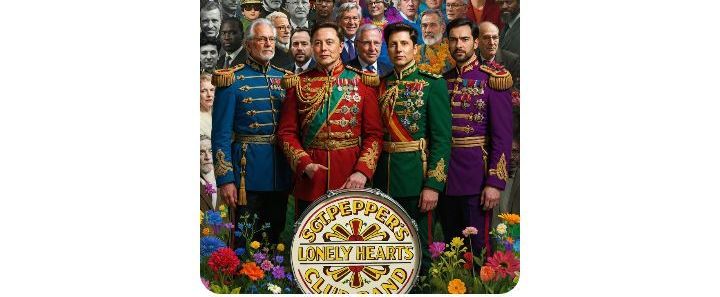
A visual manifesto for a new cultural epoch.The original 1967 album captured the 1960s fusion of art, music, Eastern mysticism, and countercultural rebellion — a “summer of love” humanism that celebrated expanded consciousness through psychedelics, creativity, and social upheaval.
Replacing the Beatles with Ray Kurzweil, Elon Musk, Sam Altman, and Demis Hassabis signals a profound shift: the new vanguard is technological and scientific, not artistic or mystical in the old sense. The Core philosophical themes
- Techno-Futurism as the new Romanticism / Futurism: Just as Italian Futurists (Marinetti et al.) in the early 20th century glorified speed, machines, industry, and the rejection of the past, today’s techno-optimists celebrate exponential progress, artificial intelligence, space expansion, and human enhancement. The crowded collage of inventors and coders behind the central four evokes a new “pantheon” — not saints or rock stars, but those accelerating the curve toward abundance, longevity, and cosmic expansion.
- The Singularity and the New Science: Kurzweil’s presence is especially symbolic. His philosophy of the Singularity (the point where AI surpasses human intelligence and merges with it) reframes existence itself. Traditional philosophy asked “What is the good life?” or “What is human nature?” The new science (AI, neuroscience, biotech, quantum computing) asks: “What will post-human intelligence create?” and “How do we steer the explosion of capability?” Altman and Hassabis represent the practical engine room of that shift — building the models that could rewrite biology, physics, and economics.
- Humanism 2.0 vs. Existential Risk: The image radiates optimism — vibrant colors, confident poses, flowers of abundance. Yet it quietly raises deep questions: Will this new “Lonely Hearts Club” solve scarcity and suffering, or amplify alienation and power concentration? Musk’s multi-planetary push adds a cosmic humanism: making consciousness multi-planetary to safeguard it. Philosophically, this echoes Enlightenment faith in reason and progress, updated with 21st-century tools — but tempered by awareness of black swans (AI alignment, engineered pandemics, value drift).
In short, the cover portrays techno-futurism as humanity’s next grand narrative: a secular quest for transcendence through intelligence amplification rather than divine grace or artistic revelation. It suggests the “new science” isn’t just instrumental — it’s becoming the arena for ultimate questions about meaning, creativity, and destiny. Whether this leads to a utopian flourishing or something more complex remains the open, exhilarating wager of our era. The image captures the vibe perfectly: same stage, radically different players, exponentially higher stakes.
Let us think
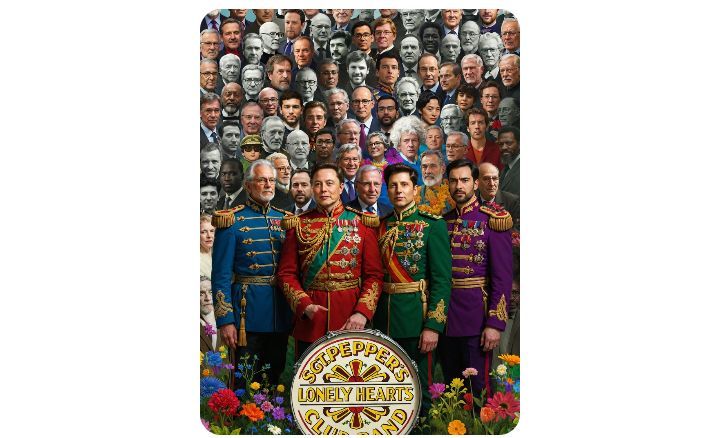
Credits: Chat GPT, protagonists Aldous Huxley, Technocracy*, Ray Kurzweil, Bill Joy, Mark Zuckerberg, Elon Musk and the Grok, Wikipedia …etc.

Technocracy is a form of government where decisions are made by experts and scientists using evidence-based, efficiency-focused methods rather than by elected officials. It is often contrasted with democracy because it prioritizes technical expertise over public participation. ebsco.com Wikipedia

