Preaching to the infirmed, disabled and those who care for them at one of Catholicism’s most iconic shrines, Pope Leo XIV said that “no human law should ever make you lose the certainty of your dignity.”
National Catholic Reporter
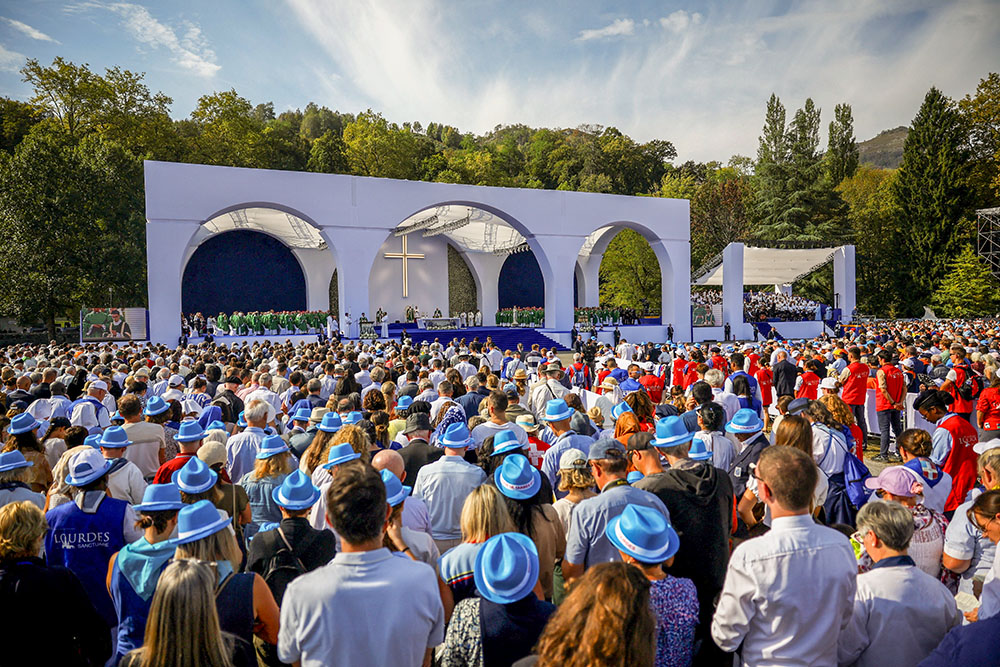
Pope Leo XIV celebrates Sunday Mass at the field alongside the Sanctuary of Our Lady of Lourdes, as part of his four-day apostolic journey to France, Sept. 27, 2026. (OSV News/Reuters/Stephane Mahe)
by Justin McLellan
National Catholic Reporter
Lourdes, France — September 27, 2026
Preaching to the infirmed, disabled and those who care for them at one of Catholicism’s most iconic shrines, Pope Leo XIV said that “no human law should ever make you lose the certainty of your dignity,” issuing an unusually direct rejection of assisted dying, which was recently legalized in France.
After two days in Paris in which the pope addressed the French government and the U.N.’s science agency, it was in Lourdes — where some Catholics believe the Virgin Mary appeared to a French peasant girl in 1858 —that Leo issued the most politically charged speech yet of his four-day trip through France.
“We must reject the temptation to cause death under the guise of false compassion,” Leo said at the Marian pilgrimage site, which draws millions each year who are seeking physical and spiritual healing. “It is impossible to regard causing death as something normal. What is legal is not necessarily moral.”
In July, France joined the Netherlands, Belgium, Switzerland and Canada in legalizing physician-assisted suicide for people with uncureable and painful conditions. The country’s Catholic bishops had voiced strong opposition to the law; when parliamentarians were debating the bill in June, the bishops issued a prayer to be read at parishes throughout France asking that God “enlighten their consciences” to respect human dignity.
In Leo’s Paris Mass, which drew surprisingly large crowds, six altar servers with Down Syndrome participated in the celebration, a move that underscored the pope’s pro-life message in the first country to enshrine a right to abortion in its constitution and where 84% of pregnancies in which prenatal testing diagnoses an embryo with Down syndrome result in abortion.
Advertisement
Meeting on Sunday with the staff of a healthcare facility that offers assistance and lodging for sick and disabled pilgrims at Lourdes, the pope directly called upon the healthcare community “to remember the profound meaning of your vocation, which is to care for a suffering person, not to eliminate that person.”
“Medicine must never become the servant of programmed death,” he said.
Earlier that morning, the pope met with France’s bishops and insisted that the church must insert its voice into the public square, “even if it is not always understood.”
“Even when her teaching is not followed, particularly on essential questions touching the foundations of civilization, it [the church] remains necessary.”
Drawing applause from the audience throughout his speech, Leo directed a message to the many infirmed people in the crowd, many in wheelchairs: “Dear brothers and sisters who are sick, I want to tell you that you are not a burden. You are the beating heart of our humanity and a precious treasure for the church.”
Celebrating Mass with some 150,000 pilgrims in a field alongside the shrine, with the front rows occupied by people in wheelchairs, the pope said that Lourdes is “a place for professing the beauty and sanctity of life.”
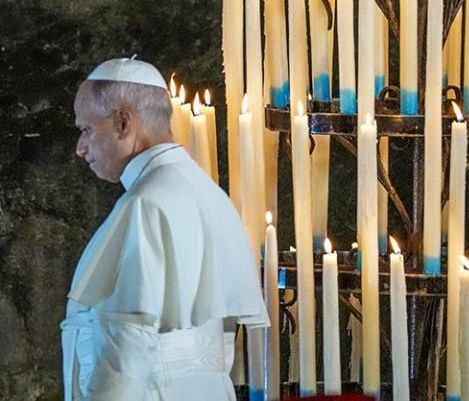
Pope Leo XIV visits the Grotto of the Apparitions at Massabielle at the Shrine of Our Lady of Lourdes in Lourdes, France, Sept. 26, 2026. (CNS/Lola Gomez)
Raquelle Ruiz from Miami attended Mass with the pope at Lourdes, where she has spent the last four years volunteering with sick pilgrims, an experience she said “humbles me.”
“It makes me think: There is someone here who still needs you. You may think you might not have enough to offer, but you do, everyone does,” she said.
Hundreds of thousands of pilgrims travel to Lourdes with sick people each year; some believe that immersing themselves in water from a spring at the site of the apparition can provide healing. The Catholic Church officially recognizes 72 healings out of more than 7,000 cases examined since 1858 as miraculous.
Pope Francis traveled to France on three separate occasions throughout his 12-year pontificate, he never dedicated a full-fledged papal tour of the country or visit Lourdes, though he did visit other sites associated with Marian apparitions, such as Fátima in Portugal and Guadalupe in Mexico.
Leo’s visit to France, and Lourdes in particular, continues a trend for the U.S.-born pope of checking off long-awaited trips that his predecessor never realized, such as Leo’s visits to Turkey and Spain in the past year.
Arriving in Lourdes the previous night, Leo prayed at the shrine’s grotto — the cave believed to be where the Marian apparitions occurred — and asked God that the “most disadvantaged and the poorest always be supported” and for the Virgin Mary to “obtain for France wise and generous leaders, ready to make sacrifices, capable of responding to challenges, and eager to serve the common good.”
The National Catholic Reporter’s Rome Bureau is made possible in part by the generosity of Joan and Bob McGrath.

