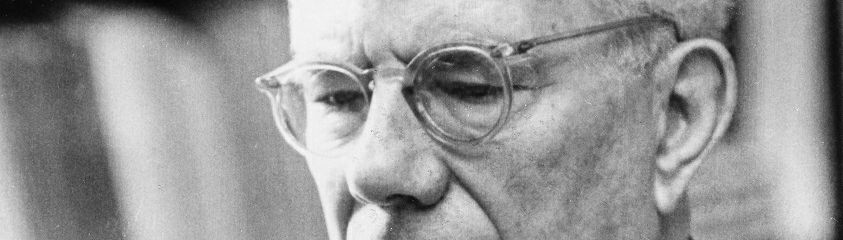
There is hardly a Progressivist Catholic theologian who hasn’t heard of Harvard’s late existentialist philospher and theologian, Paul Tillich, a man of considerable intellect and impact. Most remain in awe of him. Situation Ethics, which Tillich subscribed to, doubtless plays a role in that admiration.”The law of love is the ultimate law”.
In Situation Ethics it is the situation and not any traditional moral norm which dictates if an action is right or wrong.
“Situational ethics is a view of morality that says that the morality of an act is determined in context or, more specifically, that the rightness or wrongness of the act depends on meeting the needs of any particular situation. For example, under situational ethics, it may be acceptable to lie if the ultimate outcome is moral. Situational ethics differs from moral relativism in that the former acknowledges the existence of objective right and wrong but holds that right and wrong are characteristics of the outcome, or that the end justifies the means, whereas the latter denies the existence of objective right and wrong. Situational ethics contradicts absolute moral codes such as that of the Bible.
Situational ethics is often associated with liberalism. Since liberalism holds that having liberals win is the highest good, liberals consider themselves justified in jettisoning their stated principles, or in saying the opposite things to different voting blocs, to achieve that highest good.”—- Conservapedia
For Tillich God was not the Trinitarian Personal being of the Scriptures. For Tillich God was a mere metaphor for our “Ultimate Concern,” which is different for each person. It is Heidegger redux. It reminds one of John Lennon’s definition: “God is a concept by which we measure our pain“. This is all the death of serious theology and is in no small part responsible for the massive theological confusions we see about us everywhere today. Lennon followed Nietzsche in all of this. “The dream is over,” Lennon said. But the truth is far different. God is the one who is. And we cannot wish Him out of existence. He is existence in Himself. We are the contingent creation of the One who is. We are, only because he is. Being itself. Nothing ever can erase Him. — Stephen Hand
The Sexes: Paul Tillich and Wife Hannah
Monday, Oct. 08, 1973
“He had left me often, flirting with other women, leaving each one of them in turn for another at the succeeding dinner party. I had to take care of the spurned one, who came to me shamelessly complaining about Paulus’ faithlessness, which amused me … [Paulus] had a studio away from our ground-floor apartment, on the third floor under the roof. One evening he called the maid, a very attractive brunette, to bring some wine. Later, I found them standing before my bedroom in the middle of the night, talking in dark tones, she in a kimono of mine that I had given her.”
So writes Hannah Tillich … second wife of Paul Tillich, who died in 1965 properly honored as one of the century’s great theologians. Hannah’s reminiscences of Tillich [published in 1974] in a curious book called From Time to Time (Stein & Day; $7.95). The memoir barely mentions the theologian’s pioneering work in existential theology. Instead, interspersed with third-rate poetry and erotic fantasy, it hovers between bitterness and love for a husband whose passion for life seemed to express itself often in the courtship of other women.

As Hannah writes it, life with Paulus (as he was known in German) was something like Cabaret played out in a seminary drawing room—or bedroom.
In a way, the Tillichs were the Zelda and Scott Fitzgerald of Germany’s intellectual set, bouncing from Berlin to Marburg to Dresden on a wave of popularity amid the desperate decadence of the Weimar Republic. Both had been married before. Tillich’s first wife was carrying another man’s child when Paulus, a front-line chaplain, returned from the disasters of World War I. Hannah was still married to her first husband and was carrying his child when she packed up and left to be with Tillich.
Even after marrying Paulus in 1924, Hannah did not exactly become a paragon of virtue herself. She dallied with their male friends and an academic assistant, and even got Tillich’s explicit permission for one liaison. Hannah also experimented with—and rejected—lesbianism and at times unsuccessfully tried to interest Paulus in a joint sexual arrangement with another couple.
A menage a quatre may have been too limiting for Paulus. From the beginning he had established his independence. On the evening of his wedding to Hannah he went off to revel with a bachelor friend, winding up the night —talking, he said—in a strange girl’s room. Tillich acknowledged his “demons,” but gave them rather free rein.
On a Canadian vacation, shortly after the Tillichs’ 1933 move to the U.S., a friend who had accompanied them found his wife, nude, with Paulus on the roof of their lodgings. Some liaisons were more lasting; one of Tillich’s more permanent paramours lived across the street from the couple in Manhattan…. Continue
© 2019 TIME USA, LLC.
Held in awe. But was there no theologian to point the Lutheran Tillich to the Catholic Church and to the Confessional where he could have embarked on a new life in the forgiveness of sins? I hope someone at least tried.
+ Biographer blames L’Arche Jean Vanier’s sex abuse of women on ‘pathology’ caused by Church teaching

“Carnal vices destroy the judgment of reason” (Thomas Aquinas, Summa Theologiae II-II.53.6, via Edward Feser.)

