Dr. Marcus Peters | New Oxford Review | Jul-Aug 2026.
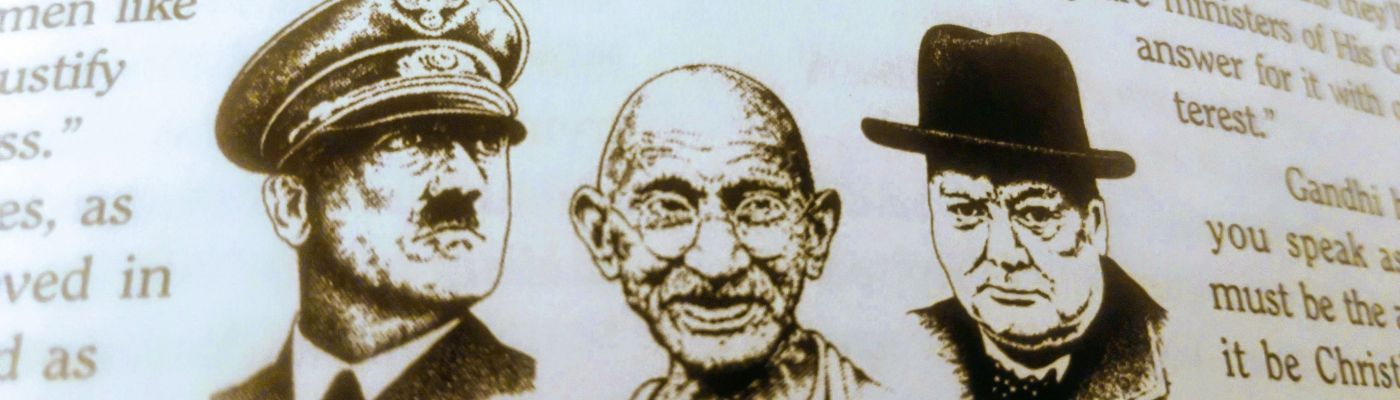
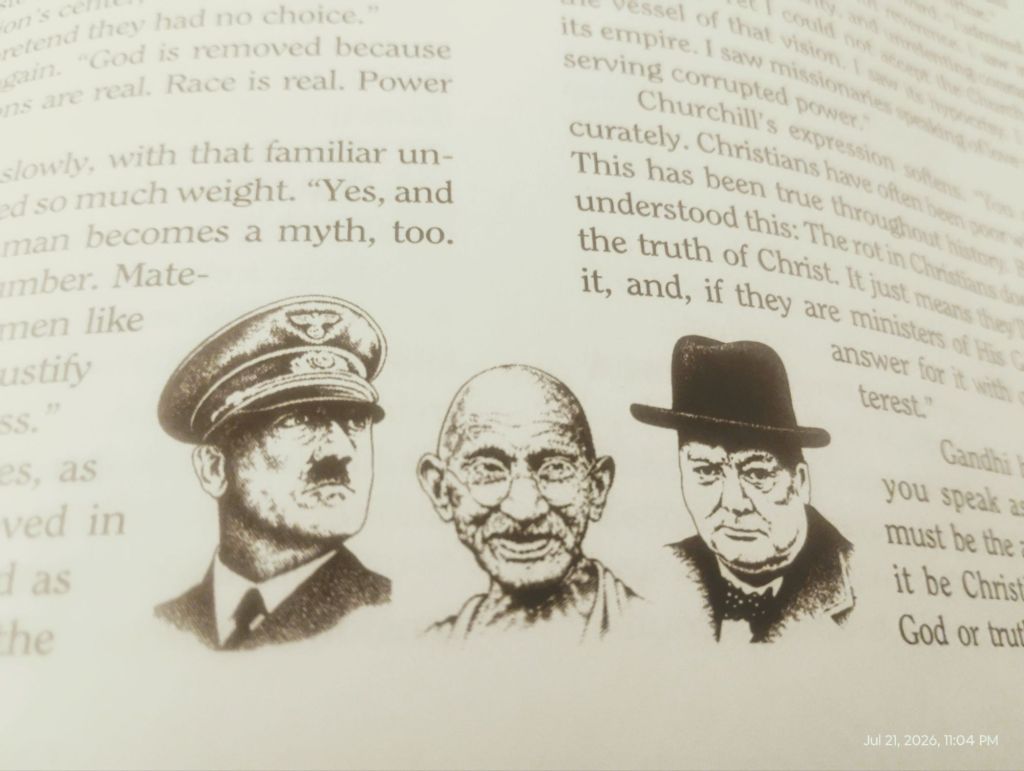
January 30 is a strange combination of historical anniversaries. It is the anniversary of Mohandas Gandhi’s assassination, when the Indian proponent of nonviolence fell to a bullet fired at point-blank range. It is the anniversary of Adolf Hitler’s inauguration into power, when German political office became a kind of altar, and a nation offered up its religious conscience for the promise of national-socialist rebirth. It is also the anniversary of Winston Churchill’s funeral, when Great Britain buried a man whose words had stiffened a civilization’s spine in its darkest hour. These events sit together on the calendar as warnings on top of warnings, and history waits to see whether men will learn.
The following trialogue between the three men takes place in a fictional locale that resembles the shadowy threshold C.S. Lewis describes at the beginning of The Great Divorce, a realm between death and the particular judgment before the throne of Christ, a fictional limbo of sorts.
Gandhi, Hitler, and Churchill find themselves in a shadowy, lifeless place — no sun, no stars, no comforting scenery. There is only a dark, neutral expanse, as if the world had been drained of ornament so that nothing remained except what each man had become. They stand three paces apart, and they all know the same thing without saying it: Death had ended the era of their speeches and begun their time of reckoning.
Churchill is the first to speak. His voice carries the old steadiness, though it lacks the swagger of his wartime broadcasts. He had never been a man of easy devotion, yet he had lived close enough to Christian truth to know what it kept from collapsing.
“So,” he says, looking from one to the other, “this is where celebrated men are reduced to the size of their souls.”
Gandhi’s eyes are calm, observant. “It is also where the noise ends. In life, the noise confuses. Here, all that noise is finally gone.”
Hitler’s posture remains rigid, as if he were still standing before an audience whose applause he desired to stoke. “Don’t pretend this makes us equals. This is weakness, that’s all. Just weakness after death. And I reject this weakness.”
Churchill holds his gaze. “Weakness after death is an odd complaint from a man who demanded so much worship in life.”
Hitler’s jaw clenches. “I demanded discipline. I demanded unity. I demanded destiny. You don’t build a people by letting them drift and rot. You forge them. You lift them out of humiliation.”
“And in your furnace,” Churchill says, “you burned the very idea that a man answers to anything higher than the state.”
Gandhi interjects gently. “You see, accountability is the heart of politics. If you remove it, then politics becomes nothing more than a contest of force.”
Hitler laughs once, harshly. “Politics is force. It always has been. All your sermons are mere decoration. A nation survives by sheer power of the will.”
Churchill answers with a dry steadiness. “Yes, and a wolf pack survives by sheer power of the will, too.”
Gandhi tilts his head toward Churchill quizzically. “And yet, you speak as if you never used force.”
Churchill doesn’t flinch. “Of course I used force. Evil doesn’t surrender because you ask it politely. I used force with grief, not with delight. And anyway, the question is never whether force exists. The question is whether that force answers to justice.”
Hitler’s eyes flash. “Justice is whatever the victors say it is.”
Churchill’s voice tightens. “That’s the slogan men repeat when they’re afraid of judgment. Yes, history may be written by victors, but history itself is not the Judge.”
Gandhi nods faintly. “So, you believe there is a Judge beyond history.”
“I’ve never been able to dismiss it,” Churchill answers. “Call it God. Call it moral law. Call it the court above the court. I didn’t always live as a man mastered by the Lordship of Christ, but I never doubted this: Once you remove God, you eventually make the human person disposable. You make him a thing you can spend or, worse, destroy.”
Hitler’s lip curls. “Christianity nearly destroyed Germany with its decadence. It teaches compassion for the weak. It dilutes resolve. Its priests use guilt as a chain to control men. My movement freed Germans from religious shackles.”
Churchill steps forward. “No. You claimed to free men, but you did it by silencing their consciences, and then you called it liberation. That’s the oldest tyranny in the book, and you know it.”
Hitler’s voice rises. “I gave my people meaning! A nation must have a sense of myth, sacrifice, and blood; otherwise, it dissolves into nothing.”
Gandhi’s face tightens at the word blood. “Meaning that demands blood is a cruel meaning.”
Hitler spins toward him. “And you? You stirred masses with the language of sacrifice!”
“Sacrifice, yes; blood, no,” Gandhi answers. “A man may offer himself. He may refuse to offer his neighbor. That is the line.”
Churchill glances toward Gandhi. “And that line is one which should be crossed only in extreme need. What’s more, history shows that once God is removed from a nation’s center, that line gets crossed quickly, and men pretend they had no choice.”
Hitler laughs again. “God is removed because God is a myth. Nations are real. Race is real. Power is real.”
Churchill replies slowly, with that familiar understatement that carried so much weight. “Yes, and if God is a myth, then man becomes a myth, too. He becomes a tool. A number. Material. And once you treat men like material, the strong can justify anything and call it progress.”
Gandhi lowers his eyes, as if turning inward. “I believed in God, though I spoke of God as truth. I believed that truth is the highest law.”
Churchill nods. “I understand that instinct. But you know as well as I that truth, when it becomes only a principle, can be bent by the man who speaks most beautifully and knows how to charm and sway the crowd.”
Hitler smirks. “Truth is whatever builds the nation.”

