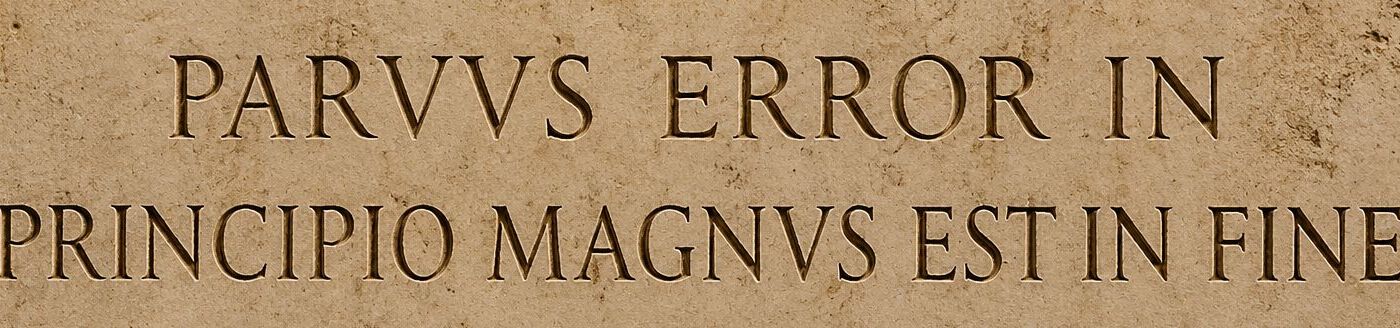
— from the very opening of De Ente et Essentia — On Being and Essence, in the Prologue:
The Latin is often given as:
Parvus error in principio magnus est in fine.
“a small error in the beginning becomes an enormous error in the end…”
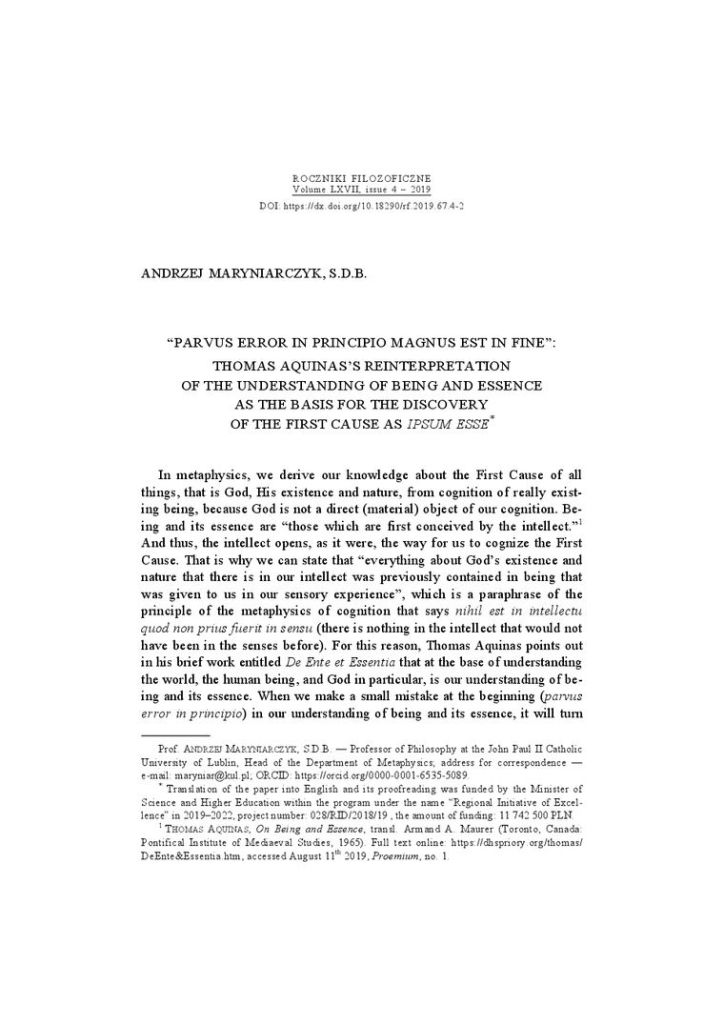
“Thomas Aquinas, in his brief work entitled De Ente et Essentia, proved that at the base of understanding the world, the human being, and God in particular, there is our understanding of being and its essence. When we make a small mistake at the beginning (parvus error in principio) in our understanding of being and its essence, it will turn to be a big one in the end (magnus in fine). And what is “at the end” of our knowledge is the discovery of the First and Ultimate Cause of all things, known as: Ipsum Esse, God, the Absolute, The Most Perfect Substance, on whom everything depends, and who depends not on anything else.
These present inquiries about the proper understanding of being and its essence are aimed at formulating proof of the necessity of existence of a Being that is the First Cause, and which, existing as Ipsum Esse, is the source and reason of existence of all beings. Without these inquiries, the proof itself would be incomprehensible, and more importantly it would be a purely a priori one (i.e., ontological). Furthermore, without the existential conception of being, which Thomas first formulated, one could not discover the First Cause which, as Ipsum Esse, is the source of the existence of every being.”
Annals of Philosophy is one of the oldest philosophical journals in Poland (since 1948). It is published four times per year in both the online and traditional ways. The journal aims to publish the best original research papers in philosophy, as well as translations, reviews, accounts and polemics.
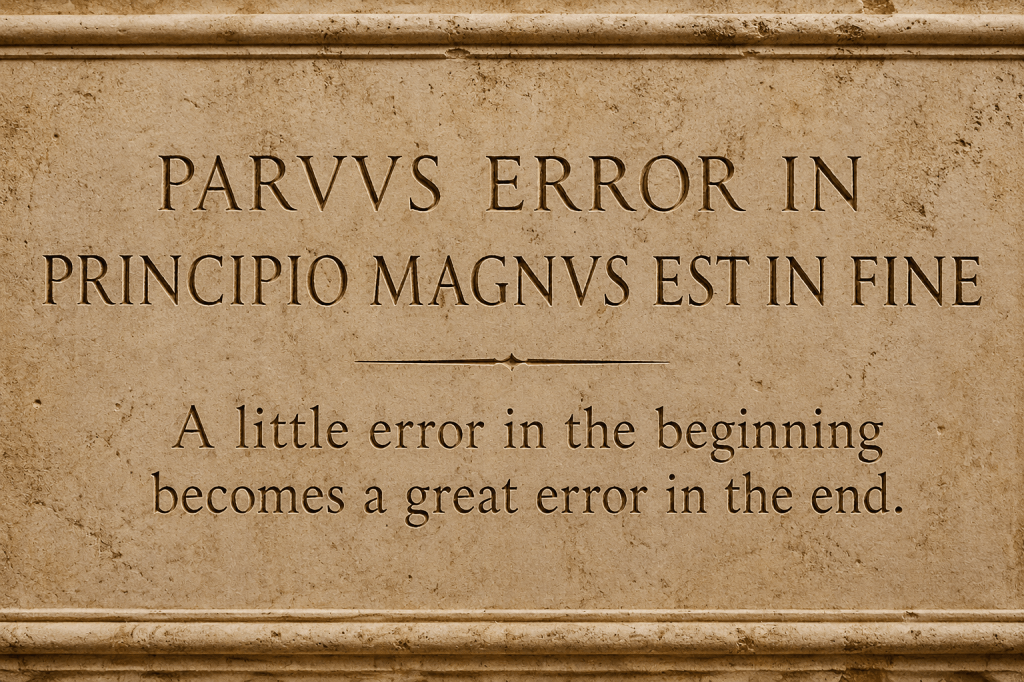
St. Thomas Aquinas echos Aristotle, especially De Caelo / On the Heavens, where Aristotle says that a tiny initial deviation from truth can multiply greatly later. Aquinas also comments on this idea in his Commentary on Aristotle’s De Caelo, Book I, lecture 9
Being and Nothingness. The Great philosopher-theologian, Reginald Garrigou Lagrange said a thing can only be what it is, as Created by God. It can never be what it is not.
Sources: Annals of Philosophy, Philosophy Documentation Center, JSTOR, Wikipedia, ChatGpt.
A correct answer presupposes a reasonably knowledgeable and correctly formulated question.
Catholic Critique.com

