No, Churchill Was Not the Villain.
Andrew Roberts.
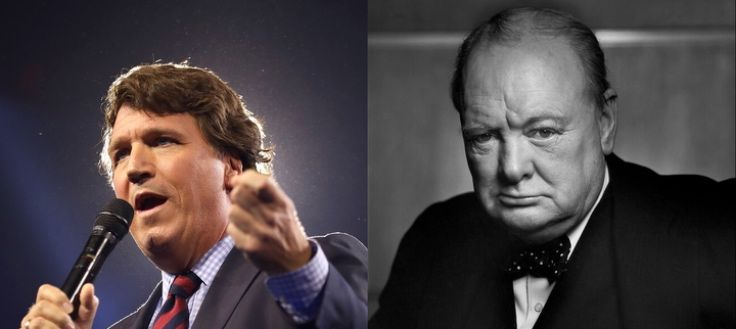
The historian Darryl Cooper has argued in an interview on Tucker Carlson’s show that Winston Churchill “was the chief villain of World War II,” which would be both interesting and indeed shocking were his thesis not based on such staggering ignorance and disregard for historical fact that it is safe to disregard completely.
Cooper’s first argument was that Churchill “was primarily responsible for that war becoming what it did, something other than an invasion of Poland.” Yet in the moment that Adolf Hitler invaded Belgium, Holland, and Luxembourg at dawn on May 10, 1940, Winston Churchill was not even prime minister. Unless Mr. Cooper is arguing that from his position as First Lord of the Admiralty—the head of Britain’s navy—Churchill was somehow able to force Hitler to unleash Blitzkrieg in the West, his first argument falls to the ground.
Hitler had planned his surprise attack through the Ardennes—the “Sickle-cut” maneuver—with senior generals such as Erich von Manstein, Erwin Rommel, and Gerd von Rundstedt several months before the attack took place. They bear responsibility “for that war becoming what it did,” not Churchill. Furthermore, they also bear full responsibility for the unprovoked invasion of neighboring Poland itself, about which Cooper and Carlson were silent.
In April 1939, when Churchill was not even in the cabinet, the British government guaranteed Poland’s security, so Hitler had no right to be surprised when Britain went to war with Germany when he flagrantly disregarded that guarantee.
Cooper’s next egregious error was to blame Operation Barbarossa on Hitler’s perception of a threat from Stalin, or a Soviet plan to capture Romanian oilfields, completely ignoring the genuine reason, which was the Nazi demand for Lebensraum—”living space” in Eastern Europe, especially in Belarus and Ukraine. One wonders whether Cooper has ever read Mein Kampf, in which Hitler’s ultimate intentions were made plain. Elsewhere in the interview he makes the outlandish claim that Hitler “no longer thought of Russia as an international Communist movement,” which contradicts all the evidence of Hitler’s public and private statements prior to unleashing Barbarossa.
Cooper next claimed that the millions of Soviet prisoners of war who died in German captivity did so because the Nazi leadership “had no plans for POWs,” ignoring the obvious fact, well supported by the sources, that in fact the deaths of millions of Soviet POWs were the deliberate Nazi plan for what to do with them.
Cooper goes on to castigate Churchill for not accepting Hitler’s peace proposals during the Phoney War from October 1939 to May 1940, stating that Hitler “didn’t want to fight France or Britain.” Yet by then he had invaded Poland, and had no intention of disgorging it, so the original casus bellum remained.
“The war was over and the Germans won by the fall of 1940,” Cooper states. Not so. The Germans had indeed forced the British from the Continent at Dunkirk by June 1940, but it is to Churchill’s everlasting and untarnishable glory that he kept Britain in the war until Nazi evil was extirpated. The war at sea was continuing, as was the war on the North African littoral. Greece came into the conflict in April 1941, drawing German forces south two months before Barbarossa. The battle was lost by Britain, true, but the war was far from won by Hitler.
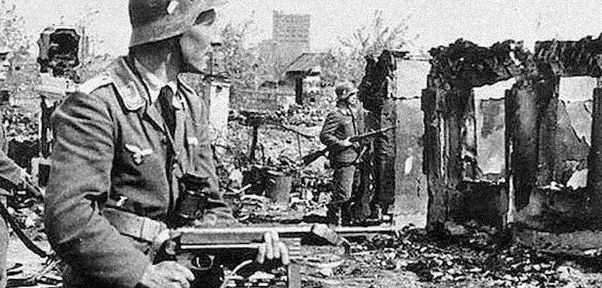
Cooper’s wailing that Churchill rejected Hitler’s peace offers also fails to take into account the fact that had Britain made an ignoble peace in 1940, Hitler would have been able to concentrate all his forces on the East in his invasion of Russia in June 1941. Instead, he was forced to keep 30 percent of the Luftwaffe and considerable land forces in the western part of Europe. It was perhaps Churchill’s greatest act of statesmanship, that of a hero rather than “the chief villain of World War II.”
When Cooper blames Churchill for “demonizing [Neville] Chamberlain” in 1940, he is presumably ignorant of the fact that Churchill in fact asked Chamberlain to join his War Cabinet, where he worked closely and cordially with him, and then gave one of his greatest speeches as his eulogy to Chamberlain in November 1940.
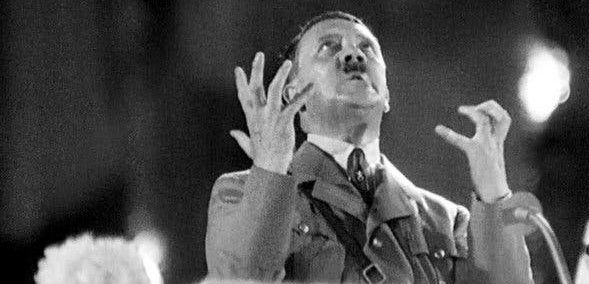
“Churchill wanted a war,” claimed Cooper. “He wanted to fight Germany.” Not so. From the moment Hitler came to power in Germany, Churchill warned of the threat the Nazis posed to world peace, and how weak the West was militarily, but his solution was to rearm, not to monger war. He had fought in the trenches in the Great War and had lost too many friends in it to want another war, but he was willing to undergo it if the only alternatives were disgrace and dishonor.
Cooper then alleged, again without any evidence, that Churchill wanted war because “the long-term interests of the British Empire were threatened by the rise of a power like Germany.” Again, not so. All senior British policymakers recognized that the threats to the Empire came from Japan in the Far East, Fascist Italy in northeast Africa, and Russia in the Near East. Germany had no contiguous borders with the British Empire anywhere. A glance at a map would have shown Cooper that…. Continue
+ See also Blóodlands: Europe Between Hitler and Stalin Feb. 24, 2013

