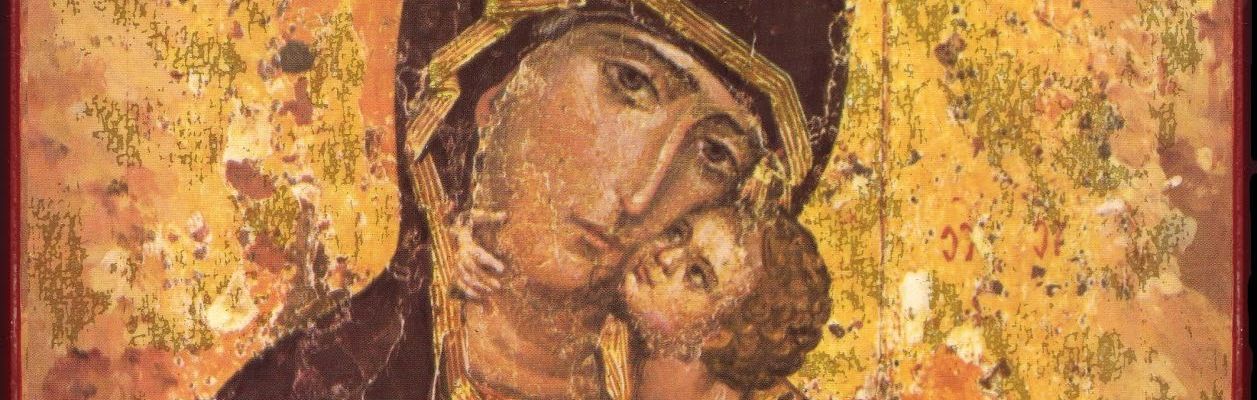
Excerpted from Sacred Scripture and the writings of Dr. Mark Miravalle, professor of theology at Franciscan University, Steubenville.
Rev. 12: A great sign appeared in heaven: a woman clothed with the sun, with the moon under her feet and a crown of twelve stars on her head. 2 She was pregnant and cried out in pain as she was about to give birth. 3 Then another sign appeared in heaven: an enormous red dragon with seven heads and ten horns and seven crowns on its heads. 4 Its tail swept a third of the stars out of the sky and flung them to the earth. The dragon stood in front of the woman who was about to give birth, so that it might devour her child the moment he was born. 5 She gave birth to a son, a male child, who “will rule all the nations with an iron scepter.” And her child was snatched up to God and to his throne. 6 The woman fled into the wilderness to a place prepared for her by God…
Patristic Sources on Mary, as Mediatrix
By Dr. Mark Miraville
… Gen 3:15 – Old Testament Prophecy of the Coredemptrix The first revelation of Mary’s intimate cooperation with the Redeemer is contained in the first great prophecy of the redemption found in the “First Gospel” (Protoevangelium), the book of Genesis.
The Second Vatican Council tells us:
“The books of the Old Testament describe the history of salvation, by which the coming of Christ into the world was slowly prepared. The earliest documents, as they are read in the Church and are understood in light of a further and full revelation, bring the figure of a woman, Mother of the Redeemer, into a gradually clearer light. Considered in this light, she is already prophetically foreshadowed in the promise of victory over the serpent which was given to our first parents after their fall into sin” (cf. Gen 3:15).22
The Mother of the Redeemer and her providential role in redemption is prophetically foreshadowed in the promise of the future Saviour revealed in the inspired book of Genesis.
Following the sin committed by our first parents in the garden, God addresses the serpent: “I will put enmity between you and the woman, and between your seed and her seed; he shall crush your head and you shall lie in wait for his heel” (Gen 3:15). The sacred text reveals a crucial struggle, singular and absolute, between the tempter Satan and the future redeemer, Jesus Christ. This revealed struggle will end in triumph for the “seed of the woman.”23 The “woman” foreshadows the mother of the redeemer, who intimately shares in the same struggle and same victory as the future redeemer against the serpent of evil. For it was God’s manifest will that the Woman share in the same “enmity” between herself and the serpent as does her redeeming seed (cf. Gen 3:15).
This struggle and victory over the serpent foreshadows the great work of redemption effected by the Saviour of the world, as well as the Mother of the Redeemer’s intimate cooperation in this saving act. Mary is indeed
“prophetically foreshadowed in the promise of victory over the serpent which was given to our first parents after their fall into sin.”24
Pope Pius IX explained Mary’s “intimate and indissoluble” union with Jesus Christ in his redemptive triumph over Satan which was prophesied in Genesis 3:15 in the apostolic letter which infallibly defined the Immaculate Conception:
“By this divine prophecy [Gen 3:15], the merciful Redeemer of mankind, Jesus Christ, the only begotten Son of God, was clearly foretold; that His most blessed Mother, the Virgin Mary, was prophetically indicated; and, at the same time, the very enmity of both against the Evil One was significantly expressed. Hence, just as Christ, the Mediator between God and man, assumed human nature, blotted out the handwriting of the decree that stood against us, fastened it triumphantly to the cross, so the most holy Virgin, united with Him by a most intimate and indissoluble bond, was, with Him and through Him, eternally at enmity with the evil Serpent, and most completely triumphed over him….”25
Mary was eternally in complete and absolute opposition to Satan, for with and through her Son the Redeemer, the Woman was to intimately share in the complete redemptive triumph over Satan.
The Early Fathers
The early Church Fathers gave immediate confirmation to this scriptural prophecy of Mary’s true sharing in the work of redemption by modeling the Mother of Jesus as the “New Eve.”26
In the mind of the early Fathers, Mary was the New Eve who intimately participated with the “New Adam,” Jesus Christ, in restoring the supernatural life of grace lost by Adam and Eve [of the spiritual order in the Mystical Body of Christ, the Church]. Pius XII refers to this Patristic designation of Mary as New Eve and her intimate sharing in the redemptive victory of her Son (based on the Genesis passage) in his apostolic constitution infallibly defining the Assumption of Mary:
“Since the second century, the Virgin Mary has been designated by the holy Fathers as the New Eve, who, although subject to the New Adam, is most intimately associated with Him in that struggle against the eternal foe, which, as foretold in the protoevangelium, finally resulted in that most complete victory over sin and death….”27
The intimate and unique coredemptive role of Mary, the Woman of the seed (cf. Gen 3:15) with the Redeemer, the seed of victory over the serpent, is already prophetically revealed in the first inspired text of Sacred Scripture.

Isaiah
Isaiah 7:14 – Mother of the Suffering Servant Another great Old Testament prophecy that foretells the coming of the saving messiah is the prophecy of Isaiah 7:14. The Lord reveals to Ahaz a sign of salvation for the people of Israel: “Therefore, the Lord Himself will give you a sign. Behold, a virgin shall conceive and bear a son, and his name shall be called Emmanuel” (Is 7:14).
Through this virgin-mother (the later Virgin Mother of Nazareth28) the Emmanuel, the “God with us,” will enter the world to effect its salvation.29
But what would be the price this messiah would have to pay to ransom the world (cf. Mt 10:45)? The same prophetic book of Isaiah describes the redeeming price that would be paid by the messiah, the “suffering servant” of God:
“He was despised and dejected by men; a man of sorrows, and acquainted with grief; and as one from whom men hide their faces…he was wounded for our transgressions, he was bruised for our iniquities; upon him was the chastisement that made us whole, and with his stripes we are healed” (Is 53:3-5).
The Virgin Mother prophesied by Isaiah would indeed bring us the redeeming Messiah, the God-with-us. But since her Child was destined to buy back the world “at a price” (1 Cor 6:20), the Mother of the Suffering Servant was also, by nature of her maternal relation, destined to suffer. The future Mother of the Redeemer was predestined to suffer with her redeeming Son.
Lk 1:38
“The Redeemer of man, Jesus Christ, is the center of the universe and human history.”30 It was the will of the Father that in the fullness of time (cf. Gal 4:4), the Son came into the world as the Redeemer of humanity, to perform the work of the redemption on the Cross (cf. Jn 19:25).
But the eternal plan of the Heavenly Father to send his Son for the salvation of the world also included the predestined role of a woman. The Second Vatican Council tells us:
“The Father of mercies willed that the Incarnation should be preceded by assent on the part of the predestined mother, so that just as a woman had a share in bringing about death, so also a woman should contribute to life. This is pre-eminently true of the Mother of Jesus, who gave to the world the Life that renews all things, and who was enriched by God with gifts appropriate for such a role.”31
When the Father elected Mary32 from among all women (cf. Lk 1:41) to be the Mother of the Redeemer, it was by virtue of this choice by God and the consent of the Handmaid that Mary began her coredemptive role of cooperation with the Redeemer.
“Kecharitomene“
“Hail, full of grace, the Lord is with you” (Lk 1:28).
The angel greets the Virgin of Nazareth under a new title, “full of grace”, in the place of her earthly name, “Miriam” or Mary.33 The Greek word for this new title, “kecharitomene” is the perfect participle of the verb, which tells us that this profound event of grace ascribed to Mary is an action that has been completed in the past, before the announcement of the Angel,34 and, thus, describes the present state, “full of grace.”
It was Mary’s Immaculate Conception that properly prepared her and made her worthy for the intimate and unique cooperation she was to have with the Redeemer made man in the work of salvation. Pope John Paul II states:
“We must above all note that Mary was created immaculate in order to be better able to act on our behalf. The fullness of grace allowed her to fulfill perfectly her mission of collaboration with the work of salvation: it gave the maximum value to her cooperation in the sacrifice.”35
The sanctifying action Mary received at the first instant of her conception was enacted by the power of the Holy Spirit, the Divine Sanctifier, for Mary is the “only one who has become the dwelling place of all the graces of the Holy Spirit.”36
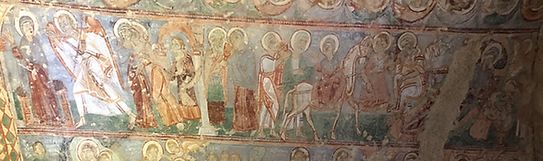
Here too at the Annunciation, it will be by the power of the Holy Spirit that Mary will become the Mother of the Redeemer (cf. Lk 1:35). It is the Holy Spirit, the Divine Spouse of Mary, who prepares and sustains Mary at each stage of her coredemptive role. After Mary receives the word from the heavenly messenger that she in her virginity would be overshadowed by the Holy Spirit to become the Mother of the Son of God (cf. Lk 1:34-35), this Daughter of Zion37 gives her free response to the invitation sent by Yahweh, the Father:
“Behold I am the handmaid of the Lord; let it be done to me according to your word” (Lk 1:38).
It is the providential union of the creative overshadowing of the Holy Spirit (cf. Lk 1:35) and the consenting cooperation of Mary (cf. Lk 1:38) by which “the Word became flesh” (Jn 1:14) in the redemptive Incarnation.
With the freely given “yes” of Mary to the new plan of salvation offered by the Father, Mary willfully and physically enters into the heart of the new covenant established for the redemption of the human family.
The Council confirms: “After a long period of waiting the times are fulfilled in her, the exalted Daughter of Zion, and the new plan of salvation is established, when the Son of God has taken human nature from her, that he might in the mysteries of his flesh free man from sin.”38 At the Annunciation, Mary begins her role as the Coredemptrix with the Redeemer. Her “fiat mihi” to the angel is a free “let it be done to me” to an intimate sharing in God’s new plan of salvation revealed by the angel (cf. Lk 1:31-33).
It is a free “let it be done to me” to the giving of a human body to the Redeemer, who would fulfill the saving messianic role referred to in Mary’s own magnificat (Lk 1:46-55), which “rejoices in God my Saviour” (Lk 1:47). It is a free “let it be done to me” in cooperating with the Redeemer so intimately that Mary Coredemptrix (or utterly unique cooperative++ in the history of salvation) gave to the Saviour the very instrument of Redemption – his human body – for “we have been sanctified through the offering of the body of Jesus Christ once for all” (Heb 10:10).
Early Church Fathers
Mary, the “New Eve” Possibly the most ancient doctrinal image of Mary in the Early Church is that of the “New Eve.” The early Fathers saw Mary (cf. Gen 3:15; Lk 1:28) as having a free and uniquely integral role with Jesus Christ, the “New Adam” (cf. Rom 5:12; 1 Cor 15:21), in the redemption of the human family, through the restoration of the supernatural life of grace.39
As the virgin Eve, through her disobedience to the Father, interiorly cooperated with Adam in the sin that lost the saving life of grace for the human family (cf. Gen 3:6), the Virgin Mary, in her obedience to the Father (cf. Lk 1:38), interiorly cooperated with Jesus Christ, the New Adam, in the salvation of the human family through his redemption.
St. Irenaeus exemplifies the early Patristic understanding of Eve’s secondary though instrumental sharing in the “death” of the supernatural life for the world and Mary’s parallel (though antithetical), intimate sharing in the salvation of the human race:
“…the Virgin Mary was found obedient, saying ‘Behold Thy handmaid, O Lord, be it done unto me according to Thy word.’ Eve, however, was disobedient; for, while yet a virgin, she did not obey. Just as she … became disobedient and became the cause of death to herself and the whole human race, so Mary… being obedient became for herself and the whole human race the cause of salvation.”40 Mary’s unequaled participation in the redemption of the human race as the New Eve was the universal Christian teaching in the Early Church.41
The Second Vatican Council notes the unquestionable acknowledgment by the Fathers of the Church of Mary’s unique and free cooperation with the Redeemer in the work of man’s salvation:
“Rightly, therefore, the Fathers see Mary not merely as passively engaged by God, but as freely cooperating in the work of man’s salvation through faith and obedience… Not a few of the early Fathers gladly assert with him [St. Irenaeus] in their preaching: ‘the knot of Eve’s disobedience was untied by Mary’s obedience: what the virgin Eve bound by her disbelief, Mary loosened by her faith.’
Comparing Mary with Eve, they call her “Mother of the Living,” and frequently claim: “death through Eve, life through Mary.”42
We can summarize the profound wisdom of the Fathers by saying that just as Eve had an active sharing with Adam in the loss of salvation for the human family (although a role secondary and subordinate to that of Adam), so Mary had an active sharing with Jesus Christ in the redemption of the human family (although a role completely secondary and subordinate to that of Jesus Christ).43
For the Fathers, the Incarnation of Jesus Christ into the world was the beginning of one unified divine act of redemption that saw its merciful climax in the passion and death of the Redeemer on the Cross.44
The Incarnation is the Redemption begun and anticipated,45 and Mary’s moral and physical cooperation in the Redemptive Incarnation alone merits her Patristic titles of being, in her rightful subordinate manner, the “cause of our salvation,”46 “the price of the redemption of captives,”47 and she who “brought forth redemption for the human race.”48
Following then this Patristic parallel between Eve and Mary, Eve could rightly be seen as the Co-peccatrix (“with the Sinner”). For it was Eve who freely gave the “instrument” of the Fall, the “forbidden fruit,” (cf. Gen 3:6) to Adam, the Peccator (“the Sinner”) whose sin as father of the human race led to loss of grace for the human race.49 It is through the instrumentality of the Co-peccatrix that the Peccator effected the death of the human race.50 Mary then can rightly be seen as the Coredemptrix (with the Redeemer).
For it is Mary who freely gave the instrument of the Redemption, the human body, to Jesus Christ. The Father no longer desired the sacrifices of the Old Law but prepared for his Saviour Son a body as the New Law instrument of Redemption: “When Christ came into the world, he said, “Sacrifices and offerings thou hast not desired, but a body has thou prepared for me” (Heb 10:5). “We have been sanctified through the offering of the body of Jesus Christ (Heb 10:10).” This body, the God-designated instrument of Redemption, was freely given to the Redeemer at the Incarnation by Mary, the Coredemptrix. Truly can it be said that Eve was the Co-peccatrix with the Peccator; Mary, the Coredemptrix with the Redeemer. Summary The Father elected Mary from among all women to be the Coredemptrix with the Redeemer.
_________
++ The word cooperative functions as both an adjective and a noun, centering on the idea of working together for a common benefit.
St Irenaeus Agams Heresse III c 22, n4 Says of mary that she is the “cause of salvation forherself and the whole human race”
At the Council of Ephesus (431 A.D) St. Cyril of Alexandria in one of the most famous Marian sermons of antiquity proclaims Mary as the one “through whom” the works of salvation are
accomplished:
“Hail Mary Theotokos, venerable treasure of the whole world it is through you whom the Holy trinity is glorified and adored through whom the tempter, the devil is cast dow from heaven, through whom the fallen creature is raised up to heaven, through whom all creation, once imprisoned by idolatry, has reached knowledge of the truth, through whom holy baptism has come to believers through whom nations are brought to repentance…” Hom. In Deiparam PG 65 p. 687
Another Father of Ephesus, Antipa of Bostra, exclaims: “hail you who acceptably intercede as Mediatrix for mankind”. In Joannem Bapt…PG 85, 1772C
One of the most ancient of prayers to mary as modiatrix in times of trial is the Sub Tuum (c. 250-300):
“We fly to your patronage, O holy mother of God, despise not our petitions in our necessities, but deliver us from all danger, O ever glorious and blessed virgin”.
St. Germain of Constantinople exclaims: “No one is saved except through you, O Theotoko
no one secured a gift of mercy, save through you in you all peoples of the earth have obtained the blessing”
———–

