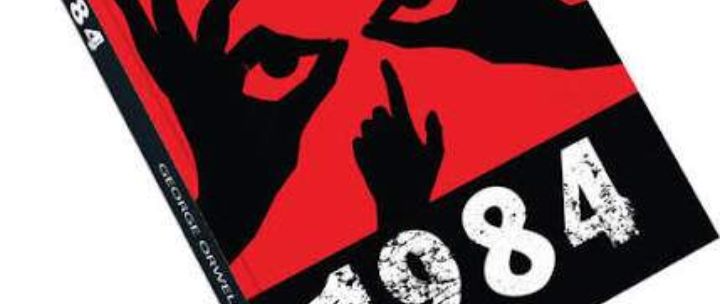
Which book’s world would be the absolute worst to live in?”
At first, it sounds like an invitation to explore our favourite fictional worlds. We often dream of entering the pages of a wonderful book, meeting its characters, and experiencing adventures beyond our imagination.
But what if the world inside those pages turned into our everyday reality?
After thinking about this question, I would choose 1984 by George Orwell as the worst world to live in.
It is not because the novel lacks imagination, but because it presents a society where freedom, truth, privacy, and even independent thought become dangerous luxuries.
1. A World Where Freedom Is an Illusion
Published in 1949, George Orwell’s 1984 presents a frightening dystopian society ruled by an authoritarian government led by Big Brother.
Citizens are constantly watched, their actions are controlled, and their personal lives are never truly private.
Imagine waking up every morning knowing that someone might be monitoring your conversations, reading your expressions, and judging your thoughts. You cannot freely criticise the government, express your opinions, or trust even your neighbours.
What kind of life would that be?
As the famous warning associated with Orwell’s novel reminds us, “Big Brother is watching you.”
These words are more than a fictional slogan. They remind us how precious privacy and personal freedom are. A life without freedom may keep the body alive, but it gradually imprisons the mind.
2. When Truth Becomes a Weapon
Perhaps the most disturbing feature of 1984 is the government’s power to manipulate truth. Historical records are altered, facts are changed, and people are forced to accept whatever the authorities declare to be true.
The protagonist, Winston Smith, works at the Ministry of Truth, where his job involves rewriting historical documents to suit the government’s changing claims.
Imagine living in a world where yesterday’s truth becomes today’s lie, and questioning the official version of events makes you an enemy.
How would we know whom to trust? How could we make sensible decisions if facts were constantly manipulated?
Orwell’s novel offers a chilling reminder: when truth is controlled, freedom of thought is never far behind.
In our own lives, we may disagree about many things, but access to reliable information and the freedom to question authority are essential for a healthy society.
3. A Life Without Love and Trust
Human beings need more than food, shelter, and security. We need affection, friendship, meaningful relationships, and the freedom to express our emotions.
Unfortunately, the world of 1984 seeks to destroy these connections. Loyalty to Big Brother is expected to outweigh love for family, friends, and even oneself. Trust becomes dangerous because anyone might betray another person.
Imagine being afraid to speak honestly to your closest friend or share your worries with your family. Imagine living without the comfort of a sincere conversation or the warmth of a loving relationship.
Such a society would be emotionally exhausting.
As I see it, a world without trust may have people everywhere, but it has very little humanity.
4. Why Not Other Fictional Worlds?
Of course, literature offers many other terrifying places. In Suzanne Collins’s The Hunger Games, children are forced to fight for survival as wealthy rulers enjoy watching their suffering.
In William Golding’s Lord of the Flies, a group of stranded boys gradually descends into violence and disorder.
Both worlds are frightening in their own ways.
However, I find 1984 especially disturbing because its oppression extends into every corner of existence. It does not merely threaten your life; it attempts to take possession of your memories, beliefs, relationships, and identity.
There is little room to escape because the prison is not simply a place. It is an entire system designed to control the human mind.
5. What This Book Teaches Us
The greatest value of a dystopian novel is not simply the fear it creates but the questions it leaves behind.
Are we protecting our freedom? Do we question information before accepting it? Do we respect different opinions? Are we willing to defend the rights of others, even when their views differ from ours?
These questions matter because societies do not lose their freedoms overnight. Sometimes, restrictions grow gradually, while people become accustomed to them.
Literature helps us recognise the dangers before they become our reality.
❤️ Let Us Choose a Better World
If I could enter any fictional world, I would choose one filled with kindness, imagination, and adventure.
But if I had to live in the world of 1984, I would consider it a nightmare from which there might be no awakening.
For me, the worst fictional world is not necessarily one filled with monsters or natural disasters. It is one where human beings are denied the right to think freely, speak honestly, love sincerely, and live with dignity.
A society becomes truly frightening when people are no longer allowed to be themselves.
RetiredKalam.com, India

