
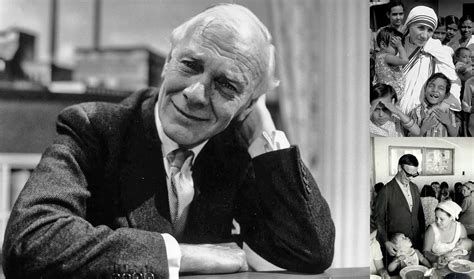
Malcolm Muggeridge.
“… Confronted with [our] crazy contradiction between, on the one hand, so many hungry sheep, and, on the other, so many over-indulged ones under constant pressure and persuasion to indulge themselves further, what is to be done? There are those who very properly attempt to rectify the balance by charitable endeavour or political agitation. Others, particularly among the young, consider that the only valid answer is yet another revolution whereby, as is promised in the ‘Magnificat’, the hungry will be filled with good things and the rich sent empty away. A more self-righteous approach to the problem lies in attributing the trouble to there being too many people in the world.
When I was young the same sort of attitude was taken by the middle and upper classes towards the poor. They had selfishly become too numerous, they were told. So today, when the so-called developing nations ask for bread, we give them birth pills. Has there ever, I wonder, been a stranger evangel than this -missionaries of sterility, colporteurs of contraceptives; bearers, as though it were our civilisation’s proudest product, of ingeniously devised means to make procreation unprocreative?
‘Feed my sheep,’ yes, but not, surely, with birth pills! Jesus himself well understood what poverty is from firsthand experience. He lived for the most part among the poor, and, as the Gospels tell us, unlike foxes which have holes and the birds of the air which have nests, often had nowhere to lay his head. Through the centuries that followed some of the most attractive and effective of his followers, from St Francis to Mother Teresa, have sought and loved poverty for his sake.
Jesus also knew what riches were and what they do to people. In the Roman cities of Tiberias and Capernaum, whose ruins one may see today by the Lake of Galilee, he could observe a way of life uncommonly like ours, an affluent, permissive society dedicated to growing ever more affluent and permissive, with the games providing, like our media, the vicarious and morally debilitating excitement of violence and eroticism.
When Jesus said ‘Feed my sheep’ he was not, then, launching a charitable appeal, or proclaiming a revolution, or even preparing the way for a family-planning service. He himself, he said, was the bread of life, and no one partaking of it would ever again hunger or thirst. In 20th-century terms this seems like expressing indifference to actual physical hunger and deprivation, but quite the opposite was the case. Through the life and teaching of Jesus we may know how the suffering of every living creature, even of a sparrow falling to the ground, is part of the suffering of God, and that his purpose for us comprises seeking in all circumstances to relieve suffering and to help and support the weak and the oppressed.
How to put into words this innermost mystery of the Christian Faith? That it is only in being indifferent to our bodily needs that we can truly care about them in others. That it is only in seeing beyond this world that we can truly see into its troubles and its beauties, and only in being a stranger here on earth and among our fellow men that the earth can be so dear a home and mankind so dear a family. That to live we must die.
It was accompanying Mother Teresa in Calcutta to the scene of the various activities of her Missionaries of Charity, to the house of the dying where street persons are brought in so that at least in their last moments they may see a loving face and hear a word of love, to the homes for unwanted children sometimes pulled out of dustbins, and to the leper settlements, that I came nearest to understanding for a moment what Jesus meant by feeding his sheep. For I had reached beyond horror and beyond compassion, into an awareness never before experienced that somehow these dying and derelict human beings, these abandoned children and lepers with stumps instead of arms, were not repulsive or pitiable, but brothers and sisters upon whom, through the agency of Mother Teresa’s perfect dedication, the bright radiance of God’s universal love shone, as it does on all creation..”.
— from Time and Eternity by Malcolm Muggeridge

_______
Thomas Malcolm Muggeridge (24 March 1903 – 14 November 1990)[1][2] was a British journalist and satirist. His father, H. T. Muggeridge, was a socialist politician and one of the early Labour Party Members of Parliament (for Romford, in Essex). Malcolm’s brother Eric was one of the founders of Plan International. In his t— from Time and Eternity by Malcolm Muggeridgewenties, Muggeridge was attracted to communism and went to live in the Soviet Union in the 1930s, and the experience turned him into an anti-communist.
Increasingly disillusioned by his close observation of communism in practice, Muggeridge decided to investigate reports of the famine in Ukraine by travelling there and to the Caucasus without first obtaining the permission of the Soviet authorities. The revealing reports that he sent back to The Manchester Guardian in the diplomatic bag, thus evading censorship, were not fully printed, and those that were published (on 25, 27 and 28 March 1933) were not published under Muggeridge’s name.[7][8] Meanwhile, fellow journalist Gareth Jones, who had met Muggeridge in Moscow, published his own stories. The two accounts helped to confirm the extent of a famine. Writing in The New York Times Walter Duranty denied the existence of any famine.[9] Jones wrote letters to the Manchester Guardian in support of Muggeridge’s articles about the famine.
Having come into conflict with British newspapers’ editorial policy of not provoking the authorities in the Soviet Union,[10] Muggeridge returned to novel writing. He wrote Winter in Moscow (1934), which describes conditions in the “socialist utopia” and satirised Western journalists’ uncritical view of the Soviet regime. He was later to call Duranty “the greatest liar I have met in journalism”. Later, he began a writing partnership with Hugh Kingsmill. Muggeridge’s politics changed from an independent socialist point of view to a conservative religious stance. — Wikipedia

