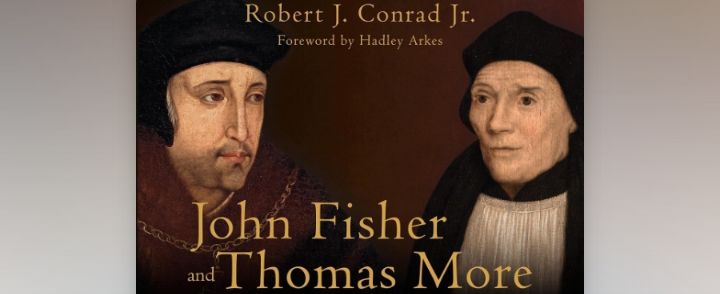
John Fisher and Thomas More
“… It is worth pausing to recall the sequence of legal measures brought forth by Henry and his willing aides. The first Act of Succession in March 1534 prohibited any malicious slandering by writing, print, deed, or act of the king’s title. This act was followed by an oath of allegiance not only to the succession but also to the legitimacy of the king’s marriage to Anne Bolyen—and the illegitimacy, then, of his prior marriage to Catherine.
Listen to John Fisher and Thomas More by Robert J. Conrad Jr. on Audible.
The Act of Supremacy made the king the “only Head of the Church of England on Earth so far as the Law of God allows.” And the Treason Act that followed made it treason, punishable by death, to challenge the Act of Supremacy. Fisher and More had held back in decorous silence from taking the oath to support Henry’s divorce, and they refused to acknowledge the king as the Supreme Head of the Church. For refusing to take the oath following the Act of Succession, they were “attainted” in different bills. That is, they would be proclaimed guilty, by name, in an Act of Parliament, without one of those vexing trials that could test in a demanding way the guilt or innocence of these men—and the statute under which they were imprisoned for life.
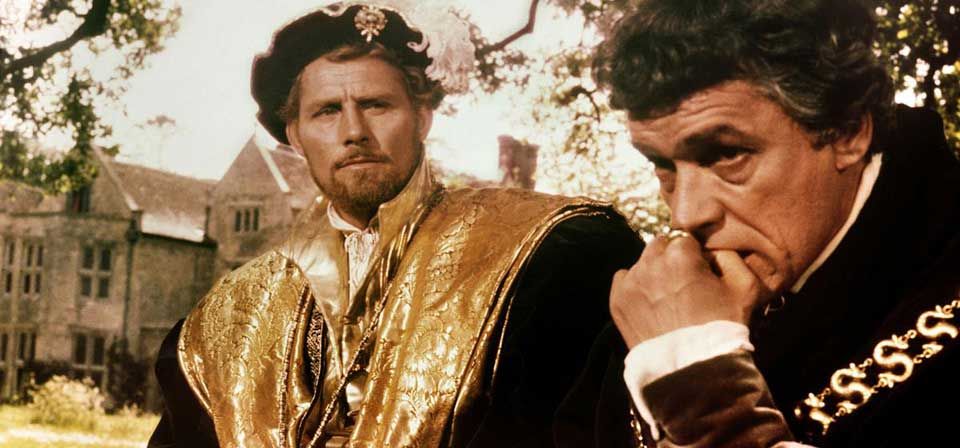
More and Fisher would fall back, even in their own minds, on the “claims of conscience.” But the notion of conscience has been the parent of serious confusion in this story. The most famous account of More has come through Robert Bolt’s play-turned-movie A Man for All Seasons. Bolt had More say that what matters to him is not that “I believe” these arguments to be true, but that “I believe” them. In the vernacular of our day, Bolt sought to show that the lodestar for More was to be comfortable with himself. That stands in striking contrast to John Paul II’s teaching that our conscience is directed to an objective set of moral norms outside ourselves. And as Conrad shows, that is the only account of More that makes sense. For Bolt, the key to More was the “possession of self”—that More was a “hero of selfhood.” To take that path, as John Paul II said, was to move to a “subjectivist” understanding, and in that way, “the inescapable truths disappear.”
Conrad catches the core of the matter: “[More and Fisher] were not adamantine followers of self-will but servants of the one true God who spoke through his Word and his Church. Their shared conviction was that … God was truth, and that his Church was a truth-telling institution.” As my late teacher Leo Strauss used to say, it is critical to try to understand a writer as he understands himself. It is evident that Robert Conrad sees the lessons of Fisher and More as offering, as he says, a “script” for our lives. And he sees his whole life bound up in the lessons he is trying to glean—not merely in his role as a prosecutor and judge, but as husband and father.
But there is yet something more: his friends know that he was also a legendary figure in college basketball in his years at Clemson. Thus, he brings to the story also the lens of a man who has been closely attentive to the grace and character so often tested in sports. But then he does a turn, using the analogy of a modern sport, golf, to illuminate a key point in Fisher’s teaching. Our friends doing what is called the New Natural Law will write about the fascination for the drama and grace of a game as one of the most natural “goods” to which human beings are readily drawn—as with the good of falling in love.
People don’t ask, “Why did you fall in love?” And for similar reasons, the question of why people are drawn to an exciting game, played at a high level, is something that needs no auxiliary motive to explain. It explains itself. Some critics have wondered, though, whether these felt goods are put on the same plane, or whether the devotion to God must be a good rising above the rest. But others will say that there is no conflict among the motives: the grace and character manifested in sports may offer an understanding that guides the rest of one’s life. The pressing question of, “What is the purpose of the game?” leads naturally to the question, “What is the purpose of my life?” Conrad recalls a football star in Chicago where he and I grew up who, after a mesmerizing career, wrote a memoir called I Am Third. Clearly, he understood where his celebration in the public arena stood in the hierarchy of things. He suffered no confusion about the ordering of goods.
First came God, second the family, then he came third. In his own natural way, as Conrad sees it, this athlete grasped the same ordering of ends that commanded the devotions of Thomas More and carried him to his death, without a trace of moral doubt. But anyone who knows Robert Conrad knows that his own life has been connected in the same way. He has cultivated a lovely family, vibrant and reverent, sprung from the matchless Ann; they have coached their children in sports and guided them as they’ve grown, and they can see now the men and women they have shaped, with a loving hand, as devoted Catholics. And everything has been ordered to the rightful ranking of ends.
Conrad sees Fisher and More as providing “ultimately a script for my children, and grandchildren, of the kind of man their father and grandfather longs to be.” With this book, Robert Conrad gives us an account of Fisher and More that runs to the core, and with that, he invites us into the world that he and Ann have lived.
Hadley Arkes March 19, 2021, The Feast of Saint Joseph
+