
Joseph Pearce writes,
Aleksandr Solzhenitsyn and I go back a long way. I first met him in the newspapers and on the TV news when I was a child, in the early seventies. Solzhenitsyn was so famous in those days that his face was instantly recognized; no caption was needed under his photograph. He had won the Nobel Prize for Literature in 1970, and his expulsion from the Soviet Union in 1974 was front-page news across the world. Solzhenitsyn was a heroic presence only dimly perceived in my pre-political memories, as remote and imposing as a mountain range glimpsed through fog.
That mountain came fully alive to me a few years later, in 1978, when, as a seventeen-year-old, I began reading the first volume of The Gulag Archipelago. It left an indelible anti-totalitarian mark upon my psyche.
The book exposes the horror of the Soviet communist regime as it played itself out in the imprisonment of millions of political dissidents in the vast network of prison and labour camps across the darkened empire. Along with Orwell’s cautionary works of fiction Nineteen Eighty-Four and Animal Farm, Solzhenitsyn’s factual illumination of communism’s dark underbelly changed me forever.
Never again would I trust big government solutions to the problems that big governments themselves create. Ever afterwards would I see political liberty as being rooted in grassroots localism. If the Soviet tyranny taught anything, it was the truth of Lord Acton’s aphoristic maxim that power tends to corrupt and absolute power tends to corrupt absolutely. At seventeen, The Gulag Archipelago had permanently altered the architecture of my political imagination. That is the mark of a great writer.
But what makes Solzhenitsyn more than a great writer is the crucible through which his vision was forged.
❦
Early Life and Conversion
Born in Russia in 1918, only months after the Bolshevik Revolution had unleashed its terror upon his motherland, Solzhenitsyn was brainwashed by a state education system which taught him that socialism was just and that religion was the enemy of the people. Like most of his contemporaries, he enslaved himself to the zeitgeist, became an atheist, and joined the Communist Party.
Then, while serving in the Red Army on the Eastern Front during the Second World War, he witnessed cold-blooded murder and the violation of women and children as the Red Army took its “revenge” upon the Germans. Disillusioned, he committed the indiscretion of criticizing Josef Stalin in private letters to a friend. Since there was no such thing as private correspondence in the Soviet Union, his letters were intercepted and he was sentenced to eight years of hard labour for the crime of expressing his private opinions.
It was in the camps that the miracle occurred.
Solzhenitsyn considered the experience of being arrested and imprisoned as an unmitigated blessing, because it stripped away the lies of the Soviet system and forced him to perceive the evil which he had been deluded by propaganda to believe was good. In his eyes, the knowledge of truth outweighed any suffering that was necessary for its attainment.
And then, shortly after his release, during a period of compulsory exile in Kazakhstan, Solzhenitsyn was diagnosed with a malignant cancer in its advanced stages and was not expected to live. Faced with what appeared to be impending death, he made a final and wholehearted embrace of Christianity, converting to Russian Orthodoxy. The recovery that followed was in his own estimation nothing short of miraculous.
Here was a man who had walked through the valley of the shadow of death twice and who emerged not embittered but illuminated. Solzhenitsyn had proven in his own flesh what the saints have always taught: that suffering, when received with faith, is not the destroyer of meaning but its crucible.
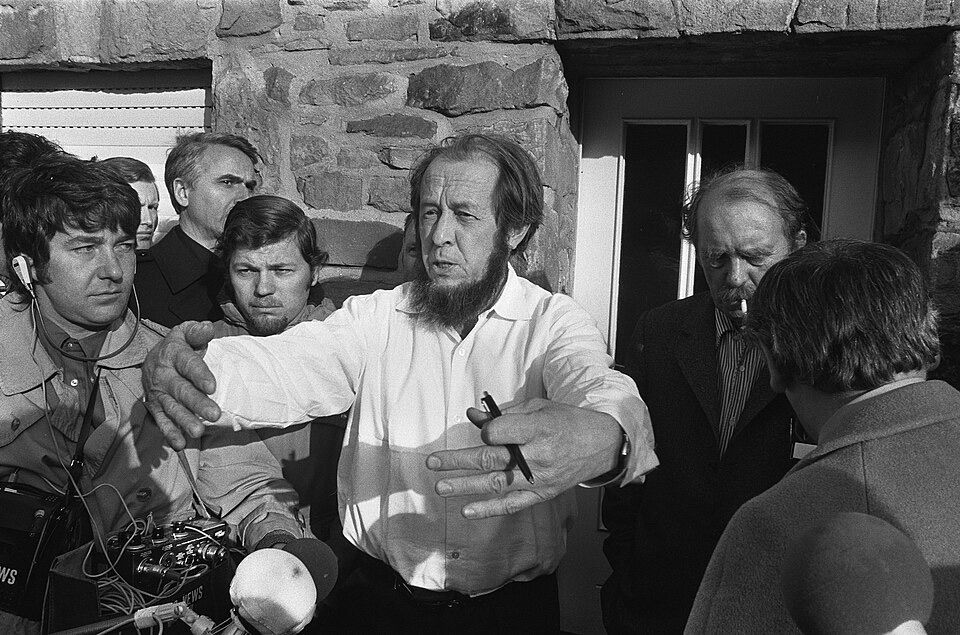
Warning at Harvard University
In 1978, Solzhenitsyn caused a sensation when he delivered his now-famous commencement address at Harvard University. Having endured decades of totalitarian oppression, he was expected to praise the free West and to affirm its moral superiority. He did nothing of the sort.
Instead, with the prophetic candour of a modern Jeremiah, Solzhenitsyn condemned the nations of the so-called free West for being morally bankrupt. He urged that it was time “to defend not so much human rights as human obligations.” The emphasis on rights instead of responsibilities was leading to “the abyss of human decadence,” he warned, and to the committing of “moral violence against young people.” At the root of the modern malaise was the philosophy of “rationalistic humanism or humanistic autonomy,” which declared the autonomy of man from any higher authority above him.
The audience had expected gratitude; they received a diagnosis. And the diagnosis stung precisely because it was true.
❦
When I Met Solzhenitsyn
My own latent interest in Solzhenitsyn was rekindled in 1990, when I came across his book Rebuilding Russia, published on the cusp of the Soviet Union’s collapse. Upon reading it, I realized that his brilliance was in the precision of his prescribed political alternative. It was clear to me that Solzhenitsyn’s political philosophy dovetailed with that of Belloc and Chesterton in their advocacy of distributism, and with E. F. Schumacher’s Small is Beautiful, as well as harmonizing with the social teaching of the Catholic Church as expressed in encyclicals from Leo XIII’s Rerum Novarum to John Paul II’s Centesimus Annus.
The great Russian, independently and through a wholly different crucible of experience, had arrived at the same conclusions as the great Englishmen and the great popes: that human flourishing depends upon the wide distribution of property and power, that local self-government is the foundation of authentic liberty, and that all centralizing ideologies, whether of the left or the right, are enemies of the human person. The torch of distributist wisdom, it seemed, had been passed across the Iron Curtain by hands that had never met.
Around this time, I was completing the research for my biography of G. K. Chesterton, which would be published in 1996. Following its publication, in a moment of what I can only describe as quixotic madness, I wrote to Solzhenitsyn requesting that he grant me an interview. I have no idea how I managed to discover his postal address in Russia, his having returned there from exile in 1994. Nor did I expect a reply.
He had been treated so abysmally by western journalists that he had ceased giving interviews entirely, and who could blame him? Nonetheless, I wrote. I told him that I was the author of a recently published biography of Chesterton and that I wished to write his biography because I felt that none of the existing accounts had paid due deference to the centrality of his Christian faith.
Imagine my astonishment when I received a letter from the great man himself, inviting me to his home near Moscow and providing the addresses of two of his sons, Yermolai and Ignat, with whom I was asked to make all the necessary arrangements.

Solzhenitsyn with his wife Natalya and son Yermolai
On the morning after my arrival in Moscow, I was picked up at the appointed hour by Yermolai, who drove me to Solzhenitsyn’s home, secluded deep within a wood of towering pine trees. As I stepped out of the car, I felt that I was stepping into the greatest adventure of my life.
The mystery of why he had permitted me, an unknown writer, to visit him when he had spurned the advances of many better-known authors was solved almost immediately by Solzhenitsyn’s wife, Natalya. As we waited for her husband to join us, she took me into another room and pointed to the top shelf of books. To my surprise and delight, the shelf contained a dozen or so volumes of the Ignatius Press Collected Works of G. K. Chesterton.
It was Chesterton who had gained me access to Solzhenitsyn! Recalling the inscription above the impenetrably locked doors of the mines of Moria in The Lord of the Rings, “Speak, friend, and enter,” it dawned on me that Chesterton was the mutual “friend” whose name had served as the magic word to unlock the otherwise impenetrable doors to Solzhenitsyn’s presence.
Joseph Pearce and Aleksandr Solzhenitsyn during their interviews near Moscow, 1998
And then the long-awaited moment arrived. Solzhenitsyn entered the room. His well-known features, carved in my consciousness since childhood, were there in front of me in the all too solid flesh. It felt as though I had intruded upon a weightier world, a land of giants, in which I did not really belong.
During our conversation, I read him a list of major Christian literary figures: Chesterton, Belloc, Hopkins, Newman, Eliot, Waugh, Tolkien, Lewis. I asked whether he was familiar with their work. “Yes,” he replied, “I know their work.” Then, with a mischievous glint in his eye, he smiled and said that they were as unpopular with the western intelligentsia as he was.
Solzhenitsyn insisted that those who considered him to be anti-western were in error. Russia was part of the West, he told me, in the sense that the West was inseparable from the concept of Christendom. If the Iron Curtain had come down, and the cream of western culture had poured in over the top, he would have rejoiced; instead, it had been raised so that the dregs of western decadence and corruption had seeped in underneath, polluting Russia with the disease of hedonistic liberalism.
It is this moment, more than any other, that has seared itself into my memory. I, a mere hobbit of the Shire, had truly communed with giants.
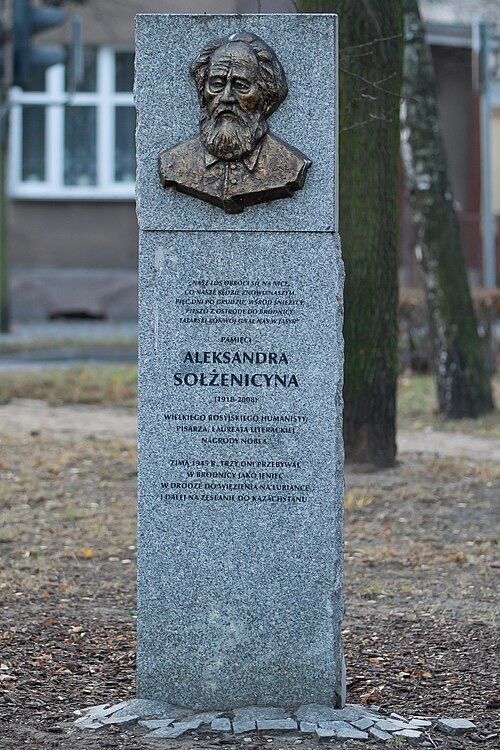
Monument to Solzhenitsyn in Brodnica, Poland
Over these five days we have walked together in the company of five extraordinary men.
Chesterton saw the truth through paradox and wonder, and taught us that astonishment is the only rational response to existence. Tolkien wove that truth into myth and subcreation, building a world that shimmers with hidden holiness. Lewis argued for it with crystalline reason and unshakeable joy. Belloc defended it with the force of a tank, insisting that civilisation and the Faith are one. Solzhenitsyn proved it in his own flesh, in the camps and the cancer ward, demonstrating that an empire of lies can be toppled by a single courageous man and the truth he tells.
What unites these five great writers is the conviction that truth, beauty, and goodness are not subjective preferences but objective realities. Realities knowable through the marriage of fides et ratio, faith and reason. Each in his own way stood against the materialism and relativism of the age. Each paid a price for doing so. And each, in the end, was vindicated by the permanence of the truths they defended.
Tomorrow, I will share one final reflection on what these five writers knew, and what we have yet to learn from them.
Until then, I leave you with this. What would it mean for your own life if suffering were not the enemy of meaning but its indispensable teacher? And what would it mean for our civilization if we took seriously the prophetic warnings of a man who saw the disease of the West more clearly than those who lived in comfort at its centre?
I commend to you my book Solzhenitsyn: A Soul in Exile, published by Ignatius Press, in which I have endeavoured to tell the full story of this giant among men.
Yours faithfully,
Joseph Pearce Tomorrow · A Final Reflection
The Legacy of Five Writers
I commend to you my book Solzhenitsyn: A Soul in Exile (Ignatius Press), in which I have endeavoured to tell the full story of this giant among men.
__________


[…] Joseph Pearce on Friendship with Solzhenitsyn […]
LikeLike