“When war broke out in September 1939, Pound began a letter-writing campaign to the politicians he had petitioned months earlier.[296] On 18 June 1940, after the fall of France, he wrote to Senator Burton K. Wheeler: “I have read a regulation that only those foreigners are to be admitted to the U.S. who are deemed to be useful etc/. The dirtiest jews from Paris, Blum??” He explained that they were all a pox.[297] To his publisher, James Laughlin, he wrote that “Roosevelt represents Jewry” and signed off with “Heil Hitler”.[287] He began calling Roosevelt “Jewsfeldt” or “Stinky Rooosenstein”.[294] In Meridiano di Roma he compared Hitler and Mussolini to Confucius.[295] In Oswald Mosley‘s newspaper, Action, he wrote that the English were “a slave race governed by the House of Rothschild since Waterloo”.[294] By May 1940, according to the historian Matthew Feldman, the British government regarded Pound as “a principal supplier of information to the BUF [British Union of Fascists] from abroad”.[298] His literary agent in New York, John J. Slocum, urged him to return to writing poetry and literary criticism; instead, Pound sent Slocum political manifestos, which he declined to attempt to publish in the United States.[299] … Wikipedia.
In Italy Pound began radio propaganda broadcasts in favor of the Axis Powers.
In May 1944 the German military, trying to secure the coast against the Allies, forced the Pounds to evacuate their seafront apartment in Rapallo. From then until the end of the war, the couple lived with Rudge in her home above Rapallo at Sant’ Ambrogio.[319] There were food shortages, and no coffee, newspapers, telephones, or letters.[320] According to Rudge, Ezra and Dorothy would spend their nights listening to the BBC.[321] In addition to the radio scripts, Pound was writing for the newspaper Il Popolo di Alessandria. He wanted to write for the more reputable Corriere della Sera in Milan, but the editor regarded his Italian as “incomprehensible”…
In the end he was arrested on charges of treason.
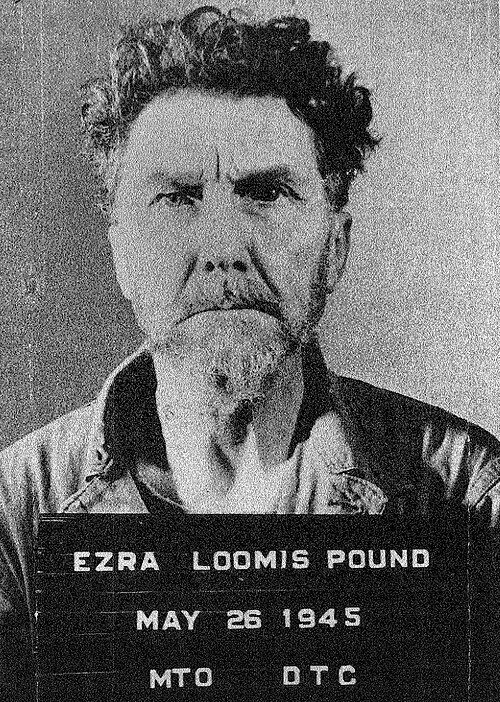
Pound arrived back in Washington, D.C., on 18 November 1945, two days before the start of the Nuremberg trials.[339] Lt. Col. P. V. Holder, one of the escorting officers, wrote in an affidavit that Pound was “an intellectual ‘crackpot'” who intended to conduct his own defense.[340] Dorothy would not allow it; Pound wrote in a letter: “Tell Omar I favour a defender who has written a life of J. Adams and translated Confucius. Otherwise how CAN he know what it is about?”.[341]
He was arraigned on 27 November on charges of treason,[ac] and on 4 December he was placed in a locked room in the psychiatric ward of Gallinger Hospital.[343] Three court-appointed psychiatrists, including Winfred Overholser, superintendent of St. Elizabeths Hospital, decided that he was mentally unfit to stand trial. They found him “abnormally grandiose … expansive and exuberant in manner, exhibiting pressure of speech, discursiveness and distractibility.”[344] A fourth psychiatrist appointed by Pound’s lawyer initially thought he was a psychopath, which would have made him unfit to stand trial.[345]
On 21 December 1945, as case no. 58,102, he was transferred to Howard Hall, St. Elizabeths’ maximum security ward, where he was held in a single cell with peepholes.[346] Visitors were admitted to the waiting room for 15 minutes at a time, while patients wandered around screaming.[347] A hearing on 13 February 1946 concluded that he was of “unsound mind”; he shouted in court: “I never did believe in Fascism, God damn it; I am opposed to Fascism.”[348] Pound’s lawyer, Julien Cornell, requested his release at a hearing in January 1947.[349] As a compromise, Overholser moved him to the more comfortable Cedar Ward on the third floor of the east wing of St. Elizabeths’ Center Building.[350] In early 1948 he was moved again, this time to a larger room in Chestnut Ward.[351]
“The searchee is not being deprived of his right to travel.”
Francis Sweeney.
New York Times.
October 1973.
BOSTON—One day in the spring of 1958 Robert Frost, in his eighty‐fourth year, left his grey Victorian house on Brewster Street in Cambridge and went down to Washington. At Back Bay station in Boston his secretary, Kay Morrison, saw him aboard The Senator, which would bring him into the capital at supper time.
In his room at the Hotel Jefferson he worked through the night trying out his thoughts in the clear, rough script that was like a spill of stones across the page. Nothing came right until at dawn he knew what he wanted to say, and then he wrote “like lightning.”
In the morning he walked into the office of Attorney General William P. Rogers and presented his petition for the release of Ezra Pound. He had been there before on the same errand, always with a committee. But the time had not been ripe, and perhaps the Attorney General had been wearied by the number of pleas in Pound’s behalf. Like many others, Frost felt it a duty to continue the effort. “He did a lot for me,” Frost said more than once. “I must never forget.”
When Rogers had heard Frost out, he looked at the fresh‐faced old man in a suit of grey with a touch of lichen in it. Then he spoke quietly, and the twelve‐year struggle was ended, The Government of the United States would no longer oppose the motion for Pound’s freedom. Frost should engage counsel to prepare the legal forms, and the Government would agree to the release.
The Washington law firm Frost approached did the work gratis, and the thousand‐dollar check Ernest Heming way had sent from Cuba to help with legal expenses was not needed. With Thurman Arnold appearing for Pound in Federal District Court in Washington on April 18, Judge Bolitha 1. Laws freed the prisoner in the care of his wife and guardian, Dorothy Shakespear Pound.
Later that year Frost told me of his part in the final successful move. Some time after the hearing he had received a bombastic letter from Ezra Pound, with no mention of thanks. It was a melancholy confirmation of the testi mony Frost had given. “Pound,” Robert Frost told me sadly, “is nuts.”
There had been a cloud of eminent witnesses about Robert Frost when he met the Attorney General. Among those who had kept the cause alive were, notably, Archibald MacLeish in America and T. S. Eliot in England. There is a thick file of letters written by Eliot enlisting support for Pound.
When Eliot died on Jan. 4, 1965, Pound cabled from Italy asking whether, if he came to the memorial service, he would be received. When Mrs. Eliot reassured him, he came to London and attended the service in Westminster Abbey. He sat impassively while the choir intoned the anthems in the language of the Authorized Version that Eliot loved, and while the voice of Sir Alec Guinness, all woodwinds and deep strings, made as pure a music with a reading from the “Quartets.” Then the muffled bells tolled along Thames’ side for this good man, Tom Eliot of London, whose name would soon be graven on the Abbey pavement among the poets and the kings.
The day following the memorial service Pound came to Eliot’s home in Kensington to express his sympathy to Valerie Eliot. In the hallway Eliot’s big brown hat hung on its peg, and a handsome old umbrella stand sprouted his walking sticks.
Pound sat for a long time before the fire in an armchair—”Tom’s chair“— in the lovely green living room. Mrs. Eliot waited in silence. Then Pound spoke, almost for the first time since his return to London: “He did much more for me than I ever did for him.”
See more on: Ezra Pound

