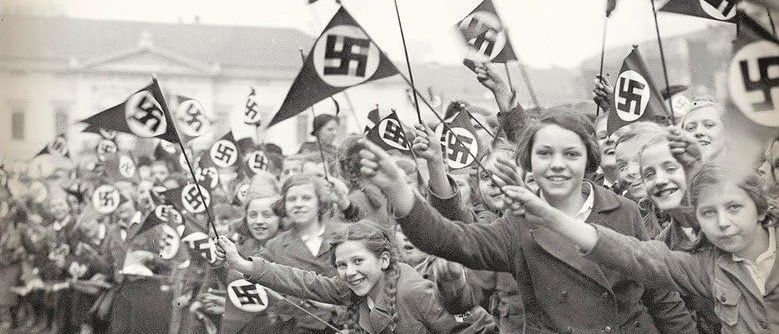
Excerpt from Richard Evans‘ The Third Reich in Power [Footnotes found in book].
CATHOLICS AND PAGANS.
Hitler both admired and feared the Catholic Church, which at the time of his appointment as Reich Chancellor claimed the allegiance of about 20 million Germans, or one-third of the population, mostly in the South and West. Like Bismarck before him, he considered Catholics less than totally committed to the national cause because their Church owed its institutional allegiance not to the German state but to Rome. Other leading Nazis who had come from a Catholic background, such as Joseph Goebbels, also stood in some awe of the Church’s powerful and elaborate organization and its ability to convince its members of the rightness of its creed.
Hitler admired the commitment that celibacy gave its priests, and the closeness of its links with the common people.45 Himmler’s deputy, Reinhard Heydrich, reacted against a strict Catholic upbringing with a hatred of the Church that can only be called fanatical. In 1936, Heydrich classified the Jews and the Catholic Church, acting above all through political institutions such the Centre Party, as the two principal enemies of Nazism.
As an international body, he argued, the Catholic Church was necessarily subversive of the racial and spiritual integrity of the German people.46 Moreover, the Catholics, unlike the Protestants, had been largely represented by a single political party, the Centre, whose voters, again unlike those of most other parties, had mostly remained loyal and resisted the appeal of Nazism during the elections of the early 1930s. Much of the blame for this could be laid in the Nazis’ view at the feet of the clergy, who had preached vehemently against the Nazi Party, in many cases ruled that Catholics could not join it, and strongly urged their congregations to continue voting for the Centre or its Bavarian equivalent, the Bavarian People’s Party.47
For many if not most leading Nazis, therefore, it was vitally important to reduce the Catholic Church in Germany as quickly as possible to total subservience to the regime. The Catholic community had already agreed in 1933 to abandon the Centre Party, which duly wound itself up along with a few other obviously political organizations such as the Catholic Trade Unions, but it expected the vast majority of other lay organizations within the Catholic confession to be allowed to maintain their independence. This expectation seemed reasonable enough to many Catholics in view of the formal Concordat concluded between the Nazi regime and the Papacy in July 1933, which had promised to protect Catholic lay institutions in return for the Church’s commitment to abstain from any involvement in politics. 48
The Concordat’s provisions on this point were extremely vague, however, and during the summer of 1933 the regime began seizing the property of Catholic lay organizations and forcing them to close down if they did not do so voluntarily. On 20 July newspapers were forbidden to call themselves ‘Catholic’ (all newspapers were to be ‘German’), and on 19 September 1933, the Bavarian political police, under Heinrich Himmler, banned ‘all activities on the part of Catholic organizations’ apart from youth groups, church choirs meeting for rehearsal, and charitable organizations considering applications for support.
Alarmed, Cardinal Bertram, in Breslau, told Pope Pius XI on 4 October of the problems he foresaw with the Nazi ambition to exert total control over society, the banning of Catholic periodicals, the state’s interference in Church charities, and the banning or ‘co-ordination’ of Catholic voluntary associations. Another leading figure in the Church, Cardinal Michael Faulhaber, objected publicly to attacks on non-Aryan Catholics, although he made no criticism of the regime’s moves against non-Catholic Jews. In the Vatican, Cardinal Pacelli, former Papal Nuncio to Germany and now Secretary of State under Pope Pius XI, complained to the German Foreign Ministry and threatened to issue a public letter of protest. But in practice nothing was done.
The Catholic hierarchy in Germany considered it more effective to issue general declarations of support for the regime in the hope that they would stem the tide of anti-Catholic actions. Thus Archbishop Gröber in Freiburg declared publicly on 10 October 1933 ‘that I am placing myself completely behind the new government and the new Reich’, and then used his open loyalty to the regime to try to persuade the Nazi authorities in Baden to stop attacks on the Church. Yet the hierarchy could not protest too forcefully against measures it disliked because that was to enter the realm of politics, from which it had explicitly excluded itself by agreeing to the Concordat.49

Religious Affiliation in 1936 In practice, the leading Nazis were aware of the dangers inherent in attacking deep-rooted institutions and traditions in the Catholic community. So they proceeded slowly. Even Himmler insisted in an order issued on 2 November 1933 that no anti-Catholic measures were to be taken without his instructions. The Gestapo began surveillance of Catholic activities, including church services, and paid particular attention to laymen formerly prominent in the Centre Party and the Bavarian People’s Party, drawing up lengthy lists of Catholics thought still to be opposed to the regime.50
Leading Nazis were particularly concerned at the continued refusal of Catholic youth organizations to dissolve themselves, which meant that the Hitler Youth was unable to make much progress in strongly Catholic areas. Control over the younger generation was vital for the building of the future. On 15 March 1934 the Hitler Youth leader Baldur von Schirach condemned the divisive influence of Catholic youth groups and urged parents to enrol their children in his own movement. He also started to encourage Hitler Youth units to pick fights with members of rival Catholic youth groups, thus beginning to apply the kind of coercion on the streets that had proved so effective on a wider scale in the first half of 1933.51
The hierarchy was given a sharp reminder when the SS shot dead Erich Klausener, General Secretary of Catholic Action, an important lay body, in his office in Berlin during the ‘Night of the Long Knives’ in 1934, along with Adalbert Probst, National Director of the Catholic Youth Sports Association. In Munich those shot included Fritz Gerlich, editor of the Catholic weekly The Strait Way (Der gerade Weg) and a well-known critic of the regime. It was also strongly rumoured that the former Centre Party leader and ex-Reich Chancellor Heinrich Brüning had been on the death-list, but he happened fortuitously to be on a visit to London and so escaped.
The import of these events, which took place in the middle of personal negotiations between Hitler and the Catholic hierarchy on the future of Catholic lay organizations, could hardly have been clearer. Yet the same hierarchy made no protest about the murders. Instead, it joined with the Evangelical Church in a shared sense of relief at the defeat of supposedly immoral brownshirt radicals such as Röhm and appeared outwardly satisfied with the explanation that the murdered men had committed suicide or been shot while trying to escape.52
II
These events were swiftly followed by the death of Hindenburg, who was strongly identified as a representative of a conservative, Protestant, Christian faith, and the ending of the Nazi project of creating a national Church united around the German Christian idea. All this opened the way to a sharp escalation of anti-Catholic policies. It was at this time that a fierce debate began over the anti-Christian writings of the Nazi ideologue Alfred Rosenberg, who publicly rejected such central doctrines as the immortality of the soul and Christ’s redemption of humankind from original sin. In his book The Myth of the Twentieth Century, Rosenberg excoriated Catholicism as the creation of Jewish clericalism, and he elaborated these ideas further in a series of books published in the mid-1930s.53
Even the German Christians were appalled. They asked Hitler to repudiate these ideas, though without success. Rosenberg’s publications were immediately placed on the Catholic Church’s Index of Prohibited Books, and elicited a furious response from the German Catholic clergy. A variety of pamphlets, books, meetings and sermons condemned Rosenberg’s teachings, and anathematized his supporters within the Nazi Party.
Rosenberg’s works were officially treated by the regime as nothing more than expressions of his own private views, however. It felt no need to disown them. But the regime recognized at the same time that the controversy was building up the resistance of the Catholic community to further penetration by Nazi ideology and institutions. As a Gestapo report noted in May 1935:
‘Numerous clerics are now taking a very critical position from the pulpit towards Rosenberg’s Myth and his new work To the Obscurantists of Our Day. They curse the spirit of the new age, the Godless and the heathen, by which they mean National Socialism.’54
The controversy over Rosenberg’s ideas soon began to take on what the Nazi leadership regarded as more dangerous forms as the German bishops issued public rebukes to the Nazi ideologue and called on the faithful to reject his ideas.55
In his Easter message, written on 19 March 1935, Clemens von Galen, the Bishop of Münster, launched a fierce attack on Rosenberg’s book. ‘There are heathens again in Germany,’ he noted in alarm, and he criticized Rosenberg’s idea of the racial soul. ‘The so-called eternal racial soul’, declared Galen, ‘is in reality a nullity.’
Early in July 1935, Rosenberg took the opportunity to criticize Galen at a rally in Münster, and in response, the Catholic faithful in Münster appeared in unprecedented numbers at the annual July procession through the streets held to commemorate the local Church’s survival of Bismarck’s persecution half a century before and – on this occasion – the 400th anniversary of the defeat of the Anabaptists who had instituted a reign of terror in the town during the Reformation.
Nineteen thousand Catholics, double the usual number, came out to cheer their bishop, who issued a ringing declaration that he would never give in to the enemies of the Church. In response, the local Party put up notices denying any intention of renewing the Bismarckian attempt to suppress the Church’s independence, while local officials reported to Berlin that Galen was stirring up discontent and accused him of meddling in politics.56
Galen wrote personally to Hitler complaining about attacks on the clergy by leading Nazis such as Baldur von Schirach.57 Compromise was clearly not in the air. Tightening the screws on the Church, Himmler and the Gestapo now began to introduce tougher measures against Catholic lay organizations and institutions, limiting public meetings, censoring the remaining Catholic newspapers and magazines and banning particular issues, and putting proven Nazis into editorial positions in the Catholic press.
Both Hermann Goring and Wilhelm Frick, the Reich Interior Minister, spoke out against ‘politicizing Catholicism’, declaring that the continued existence of Catholic lay organizations was incompatible with the spirit of the age.58 Towards the end of 1935, Goebbels and the Propaganda Ministry took a hand in the controversy, releasing a flood of accusations against Catholic organizations for financial corruption, just as they had done in 1933 with the trade unions.59 These new tactics failed altogether to have the desired effect in weaning the Catholic community away from its faith.

The Gestapo reported that the priesthood, through the confessional and through a whole programme of house visits, was so successful in countering the allegations that the laity, especially in rural areas, ‘regards what stands written in the newspapers as a falsehood, or at least a great exaggeration’.60 The drive to recruit young people to the Hitler Youth and its female equivalent, the League of German Girls, ran up against tough opposition from Catholic priests, who were reported in some areas to be refusing absolution to girls who joined the League instead of a Catholic girls’ organization.61
Incidents began to multiply. Catholic congregations reacted with undisguised fury at the attempts of local Party bosses to remove religious statuary from public buildings such as mortuaries, and demonstratively flew Church flags instead of swastika banners to welcome visiting Catholic dignitaries. The brownshirts staged public demonstrations such as one in Rosenheim, where they demanded the sacking of a teacher who had been disciplining his pupils for failing to attend Church (‘to Dachau with him!’ was the cry).62 The Church, complained the regional government in Upper Bavaria in July 1937, was becoming a ‘state within a state’, and local Nazis were angry ‘that the Church is propagating an ongoing opposition in the most public way from its pulpits’.63 The regime’s policy even had repercussions near the centre of government: when Hitler held a ceremony to pin the golden party badge on the remaining non-Nazis in the cabinet on 30 January 1937, the Postal and Transport Minister, Peter Baron von Eltz-Rübenach, a staunch Catholic, refused to accept it and told Hitler to his face to stop repressing the Church. Furious at the embarrassment, Hitler stormed out of the room without saying a word, while the quick-witted Goebbels secured the refractory Minister’s resignation on the spot.64 In one area the conflict erupted into open protest. Villagers in a rural, deeply Catholic part of southern Oldenburg had already been upset by a reduction of religious education in the schools and the regional Education Minister’s defence of Rosenberg’s anti-Catholic diatribes.
On 4 November, the Minister made matters far worse by banning the religious consecration of new school buildings and ordering the removal of religious symbols such as crucifixes (and, for that matter, portraits of Luther) from all state, municipal and parish buildings, including schools. The local Catholic clergy protested from the pulpit. On 10 November, 3,000 war veterans assembled to celebrate Remembrance Day heard a priest swear never to tolerate the removal of crucifixes from the schools. He would, he told the crowd, fight the decree and if necessary die for the cause, just as the veterans had in the First World War. Parish bells were rung everywhere in the morning and evening as a further sign of protest.
Mass petitions were handed in ceremoniously to the regional Education Ministry. Crosses on people’s houses and in the schools were decorated, and large crosses were affixed to church towers and lit up at night with electric light bulbs. Parishioners began to resign from the Nazi Party and one branch of the brownshirts dissolved itself in protest. At a meeting attended by 7,000 ordinary citizens, the Party’s Regional Leader was forced to announce the decree’s withdrawal. It was followed by the renewed ringing of church bells all over the district, services of thanksgiving and the publication in the whole diocese, far beyond the immediate locality, of a pastoral letter by Bishop von Galen recounting the affair, celebrating the victory, and vowing to have no truck with enemies of Christ. The affair did lasting damage to the standing of the Nazi Party in southern Oldenburg, where despite massive manipulation and intimidation it gained a strikingly low vote in the Reichstag election of 1938 – 92 per cent as against 99 per cent in the same district in the election of March 1936.65 Already since even before the Concordat had been ratified, Cardinal Pacelli, the Vatican Secretary of State in Rome, had been sending a steady stream of lengthy and circumstantially detailed complaints to the German government about such violations, listing hundreds of cases in which the brownshirts had closed down Catholic lay organizations, confiscated money and equipment, engaged in anti-Christian propaganda, banned Catholic publications, and much more. In response, the German government repeatedly told the Vatican that its fight against Marxism and Communism demanded the unity of the German people through the ending of confessional divisions.
Catholic priests were hindering this struggle, publicly branding the swastika as the ‘Devil’s cross’, refusing to use the Hitler greeting, expelling brownshirts from church services and continuing to violate the Concordat by including political attacks on the regime in their sermons. The regime therefore continued the war on the cultural infrastructure of the Catholic community on many fronts. Catholic youth organizations, which in May 1934 numbered 1.5 million members, and ranged from the Catholic equivalent of the Boy Scouts to Catholic sports clubs of many kinds, were an obvious target, especially since there were frequent clashes with the Hitler Youth, though these were mostly confined to the shouting of insults. Catholic youth organizations in the eyes of the regime were ‘anti-nationalist and anti-National Socialist’ and had to be suppressed. Members of these organizations came under growing pressure to resign and join the Hitler Youth instead.66
The Reich Theatre Chamber began from 1935 onwards to ban Church-sponsored musical and also theatrical events, arguing that they were competing financially and ideologically with Nazi-sponsored concerts and plays. By 1937 it was banning Nativity plays, arguing they were a form of Catholic political propaganda and so contrary to the provisions of the Concordat.67 In these as in many other areas, Pacelli continued to remonstrate with the German government in a stream of lengthy, detailed and strongly worded memoranda. After the beginning of Goebbels’s campaign against alleged financial corruption in the Church, the tone of the exchanges between Berlin and Rome became much sharper. Relations seemed to be plunging into open hostility.68 Church services and sermons in Germany were now, the Vatican complained, being subjected to constant surveillance by the authorities:
‘The repellent phenomenon of informers hovers around every step, every word, every official act.’69 In many parts of the country, Catholic priests were engaging in a largely spontaneous war of words with local Party leaders and officials over continuing Party attempts to co-ordinate denominational schools and Catholic youth organizations. These struggles were indeed, regional state officials reported, the only cause of open political dissent within Germany by the mid-1930s.70 Matters came to a head when, alarmed at the escalating conflict, a delegation of senior German bishops and cardinals, including Bertram, Faulhaber and Galen, went to Rome in January 1937 to denounce the Nazis for violating the Concordat.

Mit brennender Sorge
Meeting with a favourable response from the Pope, Faulhaber drafted a Papal Encyclical which was considerably extended by Pacelli, drawing on his lengthy correspondence with the German government and summing up the complaints that the Vatican had now been making for several years. The document was approved by the Pope, smuggled into Germany, secretly printed at twelve different locations, distributed to parish priests by boys on bicycles or on foot, and read out from virtually every Catholic pulpit in the land on 21 March 1937.
Written in German and entitled Mit brennender Sorge, ‘with burning concern’, it condemned the ‘hatred’ and ‘calumny’ poured on the Church by the Nazis.71 Although much of the document was cast in theological language not easily comprehensible to laypeople, some of it at least was clear enough. When it came to the regime’s policies towards the Church, Pope Pius XI, using language supplied to him by Cardinal Pacelli, certainly did not mince words. ‘Anyone’, he thundered, who unties the race, or the people, or the form taken by the state, the bearers of state power or other basic values of human social construction – which claim a significant and honourable place within the earthly order of things – from this, its temporal scale of values, makes it the highest norm of all, including religious values, and deifies it with an idolatrous cult, overturns and falsifies the order of things created and commanded by God.72
For the faithful, the eternal values of religion had to be paramount. In order to undermine them, however, the Encyclical went on, the German government, was conducting an ‘annihilatory struggle’ against the Church: With measures of compulsion both visible and concealed, with intimidation, with threats of economic, professional, civic and other disadvantages, the doctrinal faithfulness of Catholics and in particular of certain classes of Catholic civil servants are being placed under a pressure that is as illegal as it is inhumane.73
Enraged at this condemnation, and alarmed at the evidence it provided of the Catholic Church’s ability to organize a nationwide protest without arousing the slightest suspicion in advance even from the Gestapo, Hitler ordered all copies of the Encyclical to be seized, anyone found in possession of it to be arrested, any further publication of it to be banned and all the firms who had printed it closed down.74 Armed since 1936 with his new powers as Head of the German Police, Himmler now stepped up the campaign against the Church.
Together with his deputy Reinhard Heydrich, he placed secret agents in Church organizations, and escalated police harassment of clerics. There was a further clamp-down on the diocesan press, restrictions were placed on pilgrimages and processions, even Catholic marriage guidance and parenthood classes were banned because they did not convey the National Socialist view of these things.
By 1938 the majority of Catholic youth groups had been closed down on the grounds that they were assisting in the dissemination of ‘writings hostile to the state’. Catholic Action, whose leaders in Germany allegedly maintained communications with Prelate Kaas, the former leader of the Centre Party, was also banned in January 1938.75 State subsidies for the Church were cut in Bavaria and Saxony, and monasteries were dissolved and their assets confiscated. House-searches and arrests of ‘political’ priests underwent a sharp increase, with a steady stream of well-publicized cases of ‘abuse of the pulpit’ brought before the court. The arrest and trial of one Jesuit priest, Rupert Mayer, led to angry public demonstrations in court by his supporters and special prayers for him being defiantly said in Munich’s St Michael’s church.
Some priests continued to refuse to knuckle under, and there were reports of priests refusing to give the Nazi salute and telling children to say ‘Praised be Jesus Christ’ instead of ‘Hail, Hitler’.76 In the course of this struggle, more than a third of Catholic priests in Germany were subject to some form of disciplining by the police and state authorities, up to and including imprisonment, over the whole course of the Third Reich.77

The Encyclical had clearly failed to have any immediate effect apart from further worsening relations between the Church and the regime. The campaign was not confined to the police and the judicial administration. Reich Propaganda Minister Goebbels also played his part.
[The old standby allegations of persecutors. Broad brush tactics targeting celibacy.]
After the Encyclical, he intensified the publicity campaign against alleged sexual scandals involving Catholic priests that had already begun in the middle of 1935. Fifteen monks were brought before the courts in November 1935 for offences against the law on homosexuality in a home for the mentally ill in western Germany, revealing, as the press put it, a state of affairs that was ‘worse than Sodom and Gomorrah’.78 They received severe prison sentences and the attention of endless column-inches in the press. Other priests were soon being tried for alleged sexual offences against minors in Catholic children’s homes and similar institutions. By May 1936 the press was reporting the trial in Koblenz of over 200 Franciscans for similar crimes.79 Such stories meshed with the Nazi disapproval of homosexuality. They often took up the whole of the front page of national newspapers. Less publicity was given to incidents of Catholic priests and monks arrested for sexual offences against girls. Focusing on allegations of pederasty, the press claimed that the monasteries were ‘breeding-grounds of a repulsive epidemic’ which had to be stamped out. By April 1937 over a thousand priests, monks and friars were said – with what degree of truth is uncertain – to be awaiting trial on such charges.80 The tabloid press had no hesitation in leading these stories with headlines such as ‘Houses of God degraded into brothels and dens of vice’, and demanding of the Catholic Church ‘off with the mask!’, more than hinting that homosexuality and paedophilia were endemic in the Church as a whole, and not merely in isolated instances.81 These trials were created above all by the Propaganda Ministry, which supplied detailed reports to the Reich Justice Ministry and pressed for the supposed culprits to be brought before the courts in such a way that would allow it to draw the maximum publicity. Particularly offensive, declared the press, was the fact that the Church stood behind the accused and treated them as martyrs.82

