
Thomas Hobbs writes. “In the introductory voice-over to Woody Allen’s film You Will Meet a Tall Dark Stranger (2010), the narrator quotes Macbeth’s lines: “Life is a tale told by an idiot, full of sound and fury, signifying nothing.” In an interview with Commonweal just after the release of the film Whatever Works (2009) and not long before Tall Dark Stranger, Allen confesses to feeling “impotent against the overwhelming bleakness of the universe.” He states,
“Everybody knows how awful the world is and what a terrible situation it is and each person distorts it in a certain way that enables him to get through.”
[This is an excerpt from Shows About Nothing. By Thomas Hobbs.]
Asked about the plot of Crimes and Misdemeanors, Allen’s only truly serious film, in which the main character, a murderer, is surprised to discover that his conscience really does not bother him and that he has been able to move forward with his life, Allen states that there are people “who commit terrible crimes and they have wonderful lives, wonderful, happy lives, with families and children, and they have done unspeakably terrible things. There is no justice, there is no rational structure to it. That is just the way it is, and each person figures out some way to cope…. Some people cope better than others.I was with Billy Graham once, and he said that even if it turned out in the end that there is no God and the universe is empty, he would still have had a better life than me. I understand that. If you can delude yourself by believing that there is some kind of Santa Claus out there who is going to bail you out in the end, then it will help you get through. Even if you are proven wrong in the end, you would have had a better life…”
This may or may not be helpful as a commentary on his films; as a piece of amateur philosophy, it is sheer rubbish. There is no evidence that Billy Graham [was] actively deceiving himself or that he could maintain his hope and joy if he tried to embrace the Christian faith or any other by playing cognitive tricks on himself. Indeed, that is a bizarre, one is tempted to say incredible, model of how beliefs are formed.
What might be more accurate is to say that the only way Woody Allen could imagine himself becoming a Christian would be for him actively to deceive himself. But what sort of belief would that be? There can be distraction or diversion, and for Allen, art seems to serve this episodic function, but once and for as long as nihilism takes hold, there is no remedy.
When the artist becomes a theorist, both off and on screen, of the meaninglessness of existence, the balm of art loses its power to assuage our fears and alleviate our malaise. When the film insists on telling you directly and repeatedly that life is pointless, that illusion is necessary, and illusions are to be valued insofar as they suit you, then the illusion is unmasked and no longer works as an illusion. The problem with the therapeutic bluntness is that whatever works does not work.
Always tempted by nihilism, Allen’s early work was almost exclusively comic. If in the earlier films relationships are almost always doomed, marital love unreachable, and the purpose of individual lives unknown, there is nonetheless an accent upon the felt gesture of sympathy across the divide of the broken, impossible relationship. Ordinary human sympathy tempers the nihilism and affirms the viewer’s desire for human connection and friendship.
Only recently, and in films in which he does not appear as a character, has Allen seemed willing to allow his nihilistic theories to dominate his art. It is not surprising that the quality of his art has suffered considerably. Even in Crimes and Misdemeanors, the character espousing nihilism without regrets is but one character in a larger drama, and he speaks at a peculiar moment in his own life, the moment when he has the sudden realization that his world has not collapsed because of his heinous deeds. We might wonder whether his account of his own freedom from the qualms of conscience is not self-justifying or whether he will be able to sustain his equanimity, especially given that the lies about the murder of his adulterous lover cannot simply be kept in the past, locked away from his ongoing relationship with his wife. Indeed, the suspicion that meaning is a construct gives rise to the thought of nihilism. As a popular song puts it, “When everything feels like the movies, you bleed just to know you’re alive” (“Iris,” Goo Goo Dolls).
From The Matrix to Inception, many highly successful contemporary films begin from the assumption that what we have taken to be real is in fact a construct. The quest is to make clear the distinction between fantasy and reality and return to the latter. If the line becomes entirely blurred, then we are lost in a hall of mirrors where images end up reflecting one another. Reality dissolves into a self-referential trap. Nihilism generates banality, an egalitarian sense of emptiness. But Allen feels compelled to bestow gravity upon nothingness by alluding to great literature. That is true of the opening quotation from Macbeth in You Will Meet a Tall Dark Stranger and of an allusion to Dostoevsky’s Crime and Punishment in Match Point, a film that replays the central themes of Crimes and Misdemeanors in a much less interesting way.
Dostoevsky’s great novel of rebellion, guilt, and redemption might have had some place in Crimes and Misdemeanors, where the question of God is still a real one, but it is wholly without significance in Match Point, where there is no great passion, no great guilt, and no question of whether God and the devil are at war in the human heart. Even less appropriate is the passage from Macbeth in Tall Dark Stranger. The words themselves do not work here, as Allen’s film is a rather tame tale of the role of chance in modern life, hardly a tale of sound and fury. Moreover, Allen turns the view of one character in Macbeth into the whole story, indeed into the story of all stories. But Shakespeare does not share Macbeth’s nihilism; instead, he gives an account of how the murderous intentions “return to plague the inventor.” The action of the play represents not the exaltation of nihilism but its defeat and the restoration of moral and political order.
Nihilism is the vantage point of the morally depraved, not the normative judgment of the artist. If art no longer communes with the good, the true, and the beautiful and if it feels duty bound (whence such an obligation in a nihilistic world?) to inform us that its magic is merely illusory, then it loses its capacity to enchant or even pleasantly distract. It loses its claim on us. Citing great works of the past, whose very assumptions the new art has dismissed as so much infantile wishful thinking, cannot improve matters.
Nihilism on screen is not nearly as terrifying as nihilism in real life. The recent suicide of an educated, handsome, witty thirty-five-year-old, Mitchell Heisman, on the steps of Memorial Church in Harvard Yard shocked his family. In his Boston Globe article (September 27, 2010), David Abell comments that Heisman’s 1,905-page suicide note “included 1,433 footnotes, a 20-page bibliography, and more than 1,700 references to God and 200 references to the German philosopher Friedrich Nietzsche.” In the note Heisman wrote,
“Every word, every thought, and every emotion come back to one core problem: life is meaningless…. The experiment in nihilism is to seek out and expose every illusion and every myth, wherever it may lead, no matter what, even if it kills us.”2 Serial killers, from Manson and Berkowitz to Ramirez and Dahmer, have often held the national imagination captive, and the killers’ wacky theories have become as notorious as the heinous acts they committed. After he was apprehended, Ramirez taunted citizens, the media, and the justice system with the Nietzschean line, “I’m beyond you. I’m beyond good and evil.”
More recently, from Paducah, Kentucky, and Jonesboro, Arkansas, to Pearl, Mississippi, and Springfield, Oregon, towns known for nothing other than their decent, law-abiding citizens have given birth to children capable of positively demonic deeds. Aside from the rural settings and multiple victims, another common feature of these killings has been the influence of films such as Natural Born Killers and Basketball Diaries, of fantasy video games, and of the nihilistic lyrics of Marilyn Manson.

Whatever one makes of the causal relationship between the endemic violence of our popular culture and the behavior of those immersed in it, this much is clear. The universal availability of popular culture—through videos, cable television, radio, and the Internet—means that no place can be protected from its corrosive influence. Wherever you are, it can find you. As Michael Medved, one of our most informed and eloquent critics of contemporary mores, notes, we have no other culture than popular culture, and popular culture is Hollywood, especially television. In Hollywood vs. America: Popular Culture and the War on Traditional Values, Medved details Hollywood’s strong amoralist bent and argues that the entertainment industry is hostile to mainstream American values.
There is little doubt that Hollywood’s nihilism has the effect of coarsening our public life, desensitizing us to violence, and making us generally more cynical. In its celebration of the grotesque artistry of destruction, of evil for its own sake, and of untutored, adolescent self-expression, Hollywood promotes a debased, Nietzschean culture and the side of Nietzsche that values unrestrained creativity. It does not follow from Hollywood’s nihilism, however, that the primary target of the entertainment industry is the traditional values espoused by Republicans or the Christian Coalition. Such hostility is incidental, for nihilism cuts much more deeply.
As we shall see, it attacks the very foundations of modern politics, whose assumptions both the Left and the Right share. It puts into question democratic ideals such as individual rights and human dignity, the politics of equality and consensus, the pursuit of happiness, and the possibility of progress, even modern science and medicine. These ideals supply the framework for what it means to lead a good human life and the principles for our code of good and evil. If they are exposed as bankrupt, then to move beyond good and evil, to attempt to transcend our conventional moral code, can be seen as liberating, as a perverse affirmation of life and freedom in opposition to a degrading moral system. The pursuit of evil has a certain grandeur to it, or at least it seems cool and hip.
Those of us inclined to be critical of Hollywood would do well to ponder the following questions: Why does our democratic culture breed such demonic characters? And why should American citizens be so captivated by these figures of rebellion both in real life and in fictional accounts? Indeed, American fascination with crime and criminality remains high even as there has been a remarkable decline of serious crime in most large cities. Furthermore, nihilistic premises pervade our popular culture, infiltrating not just horror films and violent movies of the week but also the most successful mainstream sitcom of the last thirty years, Seinfeld, a show about the comical consequences of life in a world void of any ultimate significance or fundamental meaning. By its own account, it is a show about nothing. Is there perhaps some as yet unnoticed link between the American experiment and nihilism?
Can our contemporary popular culture be seen as drawing out the natural consequences of certain strains of liberal individualism? That is precisely the suggestion we will explore in the present study. The thesis gains some credibility from the fact that thinkers as diverse and as profound as Nietzsche, Tocqueville, T. S. Eliot, and Arendt have detected a subtle link between certain forms of democratic liberalism and nihilism. As Harvard political philosopher Harvey C. Mansfield observes, Friedrich Nietzsche, the nineteenth-century German philosopher best known for announcing the death of God, is the philosopher of our times.
He surfaces with some regularity in popular culture. In the 1991 film Cape Fear, an execrable film in the otherwise glorious career of Martin Scorsese, the evil protagonist, played by Robert DeNiro, takes breaks from terrorizing, mutilating, biting, blinding, and raping the locals to visit the library and read Thus Spake Zarathustra by Nietzsche.
Woody Allen’s films offer frequent comic reflections on Nietzschean themes. In the midst of one of his many forays into pop philosophy, Allen has a desperate character, played by himself, rehearse various philosophical analyses of the meaning of life. He mentions Nietzsche’s theory of the eternal return but flippantly dismisses it: “It wouldn’t be worth it. I’d have to sit through the Ice Capades again.” Allen pokes as much fun at nihilistic theories as he does at claims to have discovered the meaning of life.

Both scholars and laypeople see Nietzsche as the philosopher of nihilism—the era, according to Nietzsche, of the ultimate degradation and degeneration of man. Francis Fukuyama caused a stir when he suggested, in The End of History and the Last Man, that the nearly worldwide acceptance of democracy means we are now living in a postrevolutionary age, that humanity has no great battles left to fight, and hence that we have reached the end of history. Absent some clearly defined enemy or profound challenge, there is a danger that the tensions and springs of human greatness will dissipate, that human beings will become what Nietzsche called the “last men,” who have a calm indifference to all elevated aspirations.
Writing as a social critic influenced more by Tocqueville than by Nietzsche, Andrew Delbanco traces three great moments in the American manner of construing the purpose of our lives together: the first, the Puritan moment, was organized around the Christian God; the second, which comes to fruition in Lincoln, focused on the sacred nation itself; and the third, our current era, a period of liberation from all external standards, bestows the highest value on the self. Our era is an era of irony, of detachment from deep and lasting convictions.
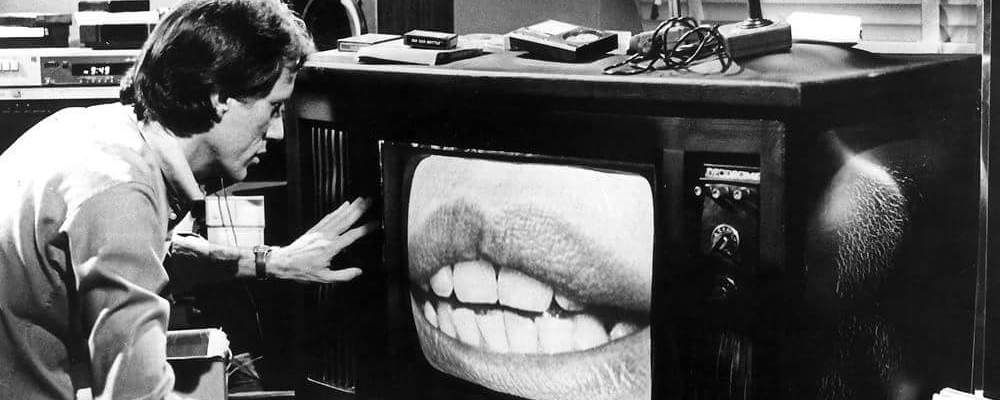
Perception, Reality and the Videodrome

 Catholic Critique