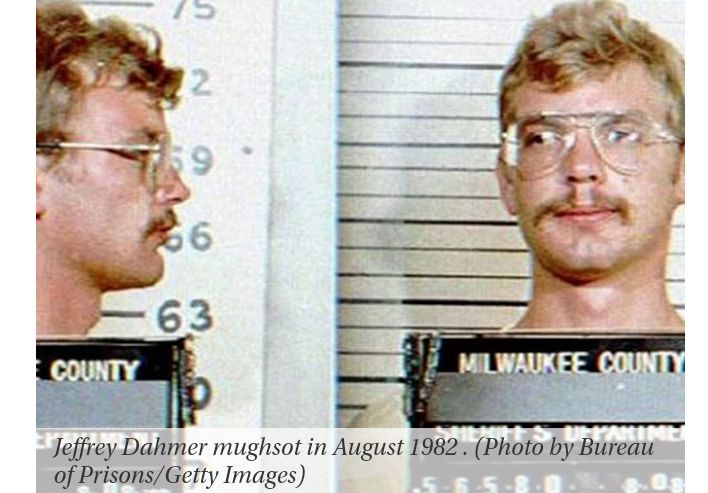
Jeffrey Dahmer murdered 17 men between the late ‘70s and early ‘90s, killing them in the most horrendous ways.
His killing spree involved rape, dismemberment, necrophilia, and cannibalism.
Few crimes in modern history are seen as disgusting and evil as Dahmers’. Police discovered mutilated bodies, refrigerated skulls, a shrine and a barrel with headless torsos, along with gruesome photos of the bodies as they were being dismembered. — news.com.au
“I was so wrapped up in what I was doing. I felt I was gonna continue doing that for the rest of my life.”
“Lionel and Shari Dahmer requested a ten-minute private meeting with their son before he was led away…. Dahmer was straightway taken to the Correctional Institute at Portage in upstate Wisconsin, where the following day the director received nearly two hundred enquiries from authors and mental health experts wishing to interview him.”
Jeffrey Dahmer’s Statement to Court, 1992
“Your Honor, … I know my time in prison will be terrible, but I deserve whatever I get because of what I have done. Thank you, Your Honor. I am prepared for your sentence, which I know will be the maximum. I ask for no consideration.”
Jeffrey Dahmer deeds were, it goes without saying, an example of extreme evil. But were they more evil than the unspeakable deeds of many apparently renowned contemporary and ancient world leaders who have committed atrocious crimes against countless innocent peoples down through the centuries and up to our own times? SH
The Darwin Connection
“In November of 1994 Jeffrey Dahmer was interviewed by Stone Phillips on NBC’s Dateline. It aired the day after his death in prison.
“If a person doesn’t think that there is a God to be accountable to, then what’s the point of trying to modify your behavior to keep it within acceptable ranges? That’s how I thought anyway. I always believed the theory of evolution as truth, that we all just came from the slime. When we died, you know, that was it, there is nothing, and I’ve since come to believe that the Lord Jesus Christ is truly God, and I believe that I, as well as everyone else, will be accountable to Him.”
~~~
The following is from the account Dark Journey Deep Grace: Jeffrey Dahmer’s Story…. by Roy Ratcliff, published in 2022 —and Wikipedia.
“Crimes unspeakable. A name synonymous with twisted brutality and hate. Jeffrey Dahmer. The most notorious serial killer of our time. A decade ago his story shocked our nation and the world. But we didnt get the whole story. In prison, Dahmers dark journey crossed paths with deep grace. Here is the whole story, told by a man who at first tried to avoid meeting Jeffrey Dahmer, but later became his friend and showed him the light of Gods love.
According to Wikipedia, Roy Ratcliff is “a minister in the Church of Christ and a graduate of Oklahoma Christian University whom he had met on April 20, 1994.
Ratcliff visited Dahmer on a weekly basis, providing him with spiritual counseling and leading him in Bible study sessions. Six months later, Dahmer was murdered by a fellow prisoner Christopher Scarver.
Ratcliff conducted his funeral service on December 2, 1994, and eulogized him:
Jeff confessed to me his great remorse for his crimes. He wished he could do something for the families of his victims to make it right, but there was nothing he could do. He turned to God because there was no one else to turn to, but he showed great courage in his daring to ask the question, ‘Is heaven for me too?’ I think many people are resentful of him for asking that question. But he dared to ask, and he dared to believe the answer.
Pastor Ratcliff writes,
I was anxious and nervous about meeting someone I had never met – someone with such a heinous criminal history. I was too nervous, even, to read the Bible. After about 7 or 8 minutes, there he was, standing in the doorway—Jeffrey Dahmer. He was alone, with no escort, no guard, no chaplain. He looked just like he did on television, barely 6 feet tall, with blond hair and pale blue eyes. His dark green prison uniform made me think of the work clothes my grandfather bought regularly at Sears.
“Hello, my name is Jeffrey Dahmer,” he said. He took a step toward me and put out his hand. I reached for it. “Hello, I’m Roy Ratcliff.” He closed the door, stepped around the table and sat down opposite me. We were all alone. Periodically, a guard would walk by and look through a window, but other than that, it was just the two of us.
Dahmer was not as big as I expected. I’m approximately 6’1”, and he was shorter than I am. He was not as large as I had expected, although later he would say he had gained weight because of sedentary prison life. I looked into his eyes, and he looked back unafraid. “I want to thank you for coming” he began. “I was afraid you might not come.”
As he spoke, I glanced down at his hands. They were small. Are these the hands of a murderer? They didn’t look large enough to have done the damage everyone had read and heard about. I didn’t waste any time. “I understand that you want to be baptized.” “Yes, I believe it is something I need to do, but I am not certain they will allow it in this prison.”
I was startled – Dahmer was more concerned with the physical problems of accomplishing the baptism than he was about whether or not he should be baptized! “Before we get into how we will do it,” I said, “I need to ask you an important question. Why do you want to be baptized?”
Over the years, I’ve regretted baptizing people who were pushed into it by anxious parents or pressing circumstances. Baptism is important to spiritual development, and must be undertaken with the proper understanding of what it means and what is expected of the person afterward. “Well, I used to think baptism was an optional thing, but I’ve done some reading and studying on the subject, and I’ve realized that I need to have my sins washed away, like Paul did in Damascus [see Acts 22:16, “Arise and be baptized and wash away your sins, calling upon the name of the Lord”].
In the past I picked up the idea from watching religious shows on television that baptism is not very important,” Jeffrey said. Now, he said, his view had changed. He had come to believe in the importance of baptism by studying books and pamphlets and the New Testament books of Mark, Acts and Romans.
He believed he needed to be “buried with Christ,” as Romans describes it. He wanted to be baptized like many were on the day of Pentecost—as reported in Acts. Finally, he said, “I really want to be baptized.” I was surprised. Jeffrey had studied the subject beyond basic Bible correspondence courses. He was familiar with Bible passages about the subject; he understood the purpose and place of baptism. He very much wanted to address the sin in his life. He believed in Jesus Christ, and said he wanted to “put Him on in baptism”—a common phrase in my Christian fellowship.
So, he did understand the nature of baptism—and once the issue of proper understanding is settled, the issue of urgency kicks in. Such urgency is illustrated by the account of the Philippian jailer in Acts, who was baptized in the middle of the night. Once the Apostle Paul saw that the jailer had a good understanding of the need for baptism, he did not waste any time. My decision came quickly.
“Yes, I’ll baptize you. It’s clear that you understand what baptism is all about.” When I told him this, he let out a loud sigh, an obvious feeling of relief. “Why did you make that noise just now?” I asked. His answer has remained with me since. “I was very nervous about meeting you today,” he said. “I was afraid you would come and tell me that I couldn’t be baptized because my sins are too evil.” “I would never say that,” I said. “Such a thought never entered my head. The whole point of baptism is dying to one’s old life of sin. All sins are evil before God. I don’t know of any sins too evil for Christ’s blood to wash away.”
The baptismal service was conducted in the prison whirlpool.”
+++

Malthusian Wars. Fletcher Prouty.
Most moral people are shocked at the thought that leaders of a nation could engage in unnecessary wars, kill many hundreds of thousands of people, very likely millions (1) in the process, and still sleep at night and smile on the golf course for the cameras.
Leroy Fletcher Prouty (January 24, 1917 – June 5, 2001) served as Chief of Special Operations, CIA, for the Joint Chiefs of Staff under President John F. Kennedy, (*) and he sheds chilling light on how and why this is possible. He says that despite their posing as good Christian church-going men and women, politicians and high officials are, when possible, actually carefully vetted before being allowed to “pass and go” on to seriously higher office. They are vetted to ensure that they subscribe in principle to “a quartet of the greatest propaganda schemes ever put forth by man”. Catholics like JFK were once a different and unwelcome breed; and we’ve seen that sometimes populists slipped through the nets.
Wars almost always have many strategic purposes; some are truly defensive just wars when a nation has been violently aggressed upon; and some are unjust, as when a nation seeks to attack others without serious and morally justified cause, even when asserting pretexts to justify these aggressions or engagements.
Fletcher Prouty said some war advocates constantly seek to rationalize morally repugnant excess as cover for the aforementioned philosophical / ideological “quartet” of assumptions.
What follows are “the quartet of philosophical points” chosen elites subscribe to, as stated by Prouty:
“1. The concept of “real property,” a function of colonialism that began with the circumnavigation of the Earth by Magellan’s ships in 1520 and “a doctrine of discovery and rights of conquest” put forth by John Locke (which enabled those sent to conquer, enslave, confiscate land, etc).
2. The population theory of Thomas Malthus which says there are too many people on earth for sustainable living. Thus wars and similar ways of eliminating peoples are, to their ideological thinking, doing Mother Earth a favor. (Prouty the author, btw, does not appear to have been a religious man. He was simply stating facts as he saw them.)
3. Darwin’s theory of evolution, as enhanced by “the survival of the fittest”; the owners of real property and capital are seen as the “fittest,” from the time of Darwin.
4. Heisenberg’s theory of indeterminacy. (God—whatever that is— threw the dice, and the elites naturally took over from there.)” * … More