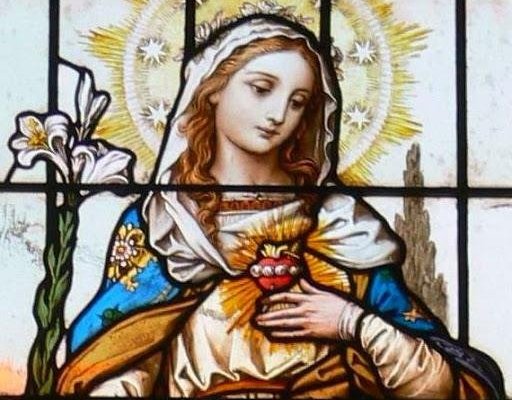
In his 1987 encyclical letter, Redemptoris Mater, Pope Saint John Paul II writes, “Thanks to his special bond, linking the Mother of Christ with the Church, there is further clarified the mystery of that “woman” who from the first chapters of Genesis until the Book of Revelation, accompanies the revelation of God’s salvific plan for humanity. For Mary, present in the Church as the mother of the Redeemer, takes part as a mother in that ‘monumental struggle against the powers of darkness’ which continues throughout human history. And by ecclesiastical identification as the “woman clothed with the sun” (Revelation 12:1-5).”
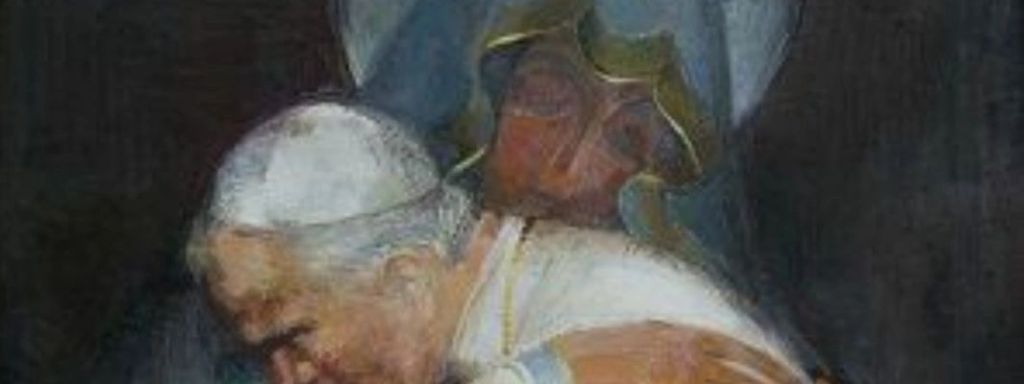
Art credit top Maria Angela Grow
On Our Mother Mary
Mark I. Miravalle, S.T.D.
“When the fullness of time had come, God sent his son, born of a woman…to redeem those who were under the law, so that we might receive adoption as sons” (Gal 4:4-5). It was the will of the heavenly Father that his Son, Jesus Christ, be sent into the world for the purpose of redeeming the human family (cf. Jn 3:16, Phil 2:6-11).
It was also the will of the Father that a woman be intimately involved in this wondrous plan of human redemption; for as John Paul II tells us, “the Mother of the Redeemer has a precise place in the plan of salvation.”1
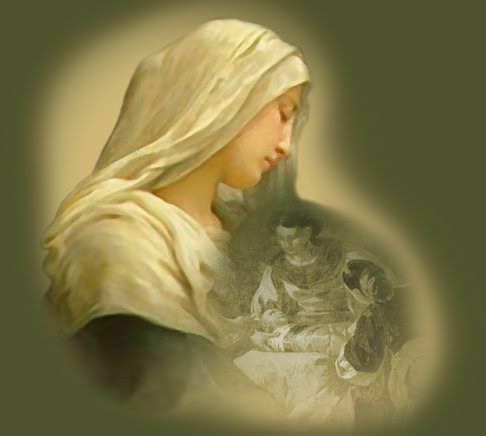
In the rich Tradition of the Church founded by Christ, four divinely revealed doctrines about Mary, Mother of Jesus, have come forth from the inspired pages of Sacred Scripture, and through the inspiration of the Holy Spirit, the Spirit of Truth, these Marian doctrines have been gradually brought to light by the living Church.2
“The Virgin Mary, who at the message of the angel received the Word of God in her heart and in her body and gave Life to the world, is acknowledged and honored as being truly the Mother of God and of the redeemer.”3
These words of the Second Vatican Council echo the Council of Ephesus where in 431 A.D. this early ecumenical council defined the first Marian doctrine which, the Motherhood of God, “Theotokos,” proclaims that Mary is truly the Mother of God the Son made man: “the Holy Virgin is the Mother of God since according to the flesh she brought forth the Word of God made flesh.”4
A few centuries later [confirming what the Church always and virtually everywhere believed] the living and praying Church, pondering the Scriptural revelation of Mary’s virginity, defined the second Marian doctrine, the Perpetual Virginity of Mary. At the Lateran Council in 649, Pope Martin I proclaimed the three-fold nature of the virginity of Mary: “she conceived without seed, of the Holy Spirit…and without injury brought him forth…and after his birth preserved her virginity inviolate.”5
The third Marian doctrine came to its most complete illumination by the Church more than a thousand years later. “The Most Holy Virgin Mary [confirming what the Church always and virtually everywhere believed] was, in the first moment of her conception, by a unique gift of grace and privilege of Almighty God, in view of the merits of Jesus Christ, the Redeemer of mankind, preserved free from all stain of original sin.”6
The infallible statement by Pope Pius IX in 1854 [confirming what the Church always and virtually everywhere believed] which defined the Immaculate Conception of Mary confirmed centuries of Christian belief that she who was greeted by the angel as “full of grace” (Lk 1:28) entered into human existence without the stain of original sin. In more recent times, the Assumption of Mary was the fourth Marian doctrine defined to be contained in God’s revelation to humanity [confirming what the Church always and virtually everywhere believe]
“Mary, the immaculate perpetually Virgin Mother of God, after the completion of her earthly life, was assumed body and soul into the glory of Heaven.”7
The woman who intimately shared in the victory of Christ over the serpent (cf. Gen 3:15) could not suffer the effects of sin and death that came from the Evil one and his seed, with whom she was given complete enmity by Almighty God. But at the same time we know that the Marian mystery in God’s plan of salvation does not end with the earthly life of the Virgin of Nazareth and her departure. The Second Vatican Council reminds us: “Taken up in Heaven she did not lay aside this saving office, but by her manifold intercession continues to bring us the gifts of eternal salvation.”8
The Council goes on to say: “Therefore the Blessed Virgin is invoked in the Church under the titles of Advocate, Helper, Benefactress, and Mediatrix.”9 These titles of Mary, such as Mediatrix and Advocate, refer to roles given to Mary by the heavenly Father and sustained by the Holy Spirit because of her intimate sharing in the redemptive work of Jesus Christ.
To understand, therefore, the roles of Mary as Mediatrix and Advocate which she now exercises with the aid of the Holy Spirit from her rightful place in Heaven, we must examine the meritorious foundation for these God-given roles during her earthly life as the “handmaid of the Lord” (Lk 1:38).
“Thus the daughter of Adam, Mary, consenting to the word of God, became the Mother of Jesus. Committing herself wholeheartedly and impeded by no sin to God’s saving will, she devoted herself totally, as a handmaid of the Lord, to the person and work of her Son, under and with him, serving the work of redemption….”10
Mary’s intimate cooperation with the Redeemer began at the Annunciation, where she freely participated in the work of man’s salvation through faith and obedience (cf. Lk 1:28). But the cooperation of the Mother of the Redeemer in the work of redemption did not cease with her fiat to the angel.
“The Blessed Virgin advanced in her pilgrimage of faith and faithfully persevered in her union with her Son unto the cross, where she stood, in keeping with the divine plan, enduring with her only begotten Son the intensity of his suffering, associated herself with his sacrifice in her mother’s heart, and lovingly consenting to the immolation of this victim which was born of her.”11
These profound words of the Second Vatican Council describe the spiritual sufferings and intimate cooperation Mary experienced with the Redeemer at the foot of the cross (cf. Jn 19:26) in perfect maternal obedience to God’s plan of salvation. It is in light of Mary’s unique and intimate cooperation with the Redeemer, both at the Incarnation (cf. Lk 1:28) and at the work of Redemption at Calvary (cf. Jn 19:26), that the Church has invoked Mary under the title, “Coredemptrix.”12
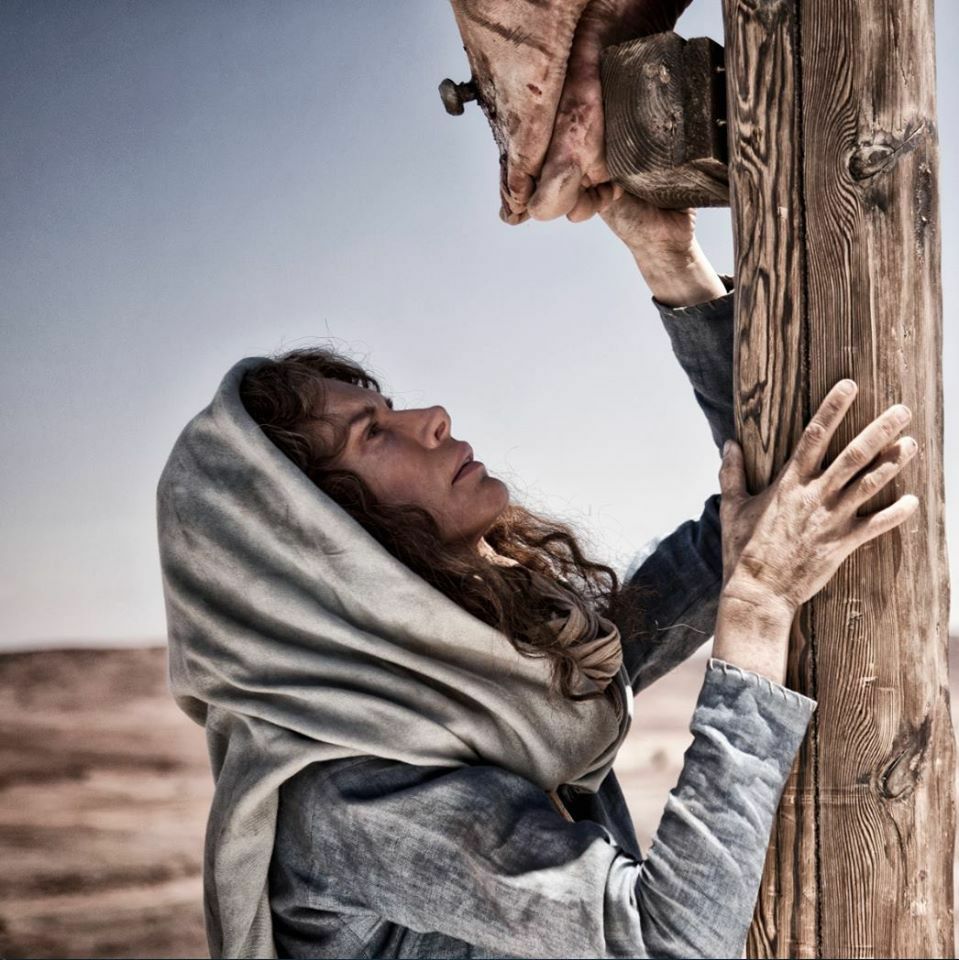
The prefix “co” does not mean equal, but comes from the Latin word, “cum,” which means “with”. The title of Coredemptrix applied to the Mother of Jesus never places Mary on a level of equality with Jesus Christ the divine Lord of all, in the saving process of humanity’s redemption. Rather, it denotes Mary’s singular and unique sharing with her Son in the saving work of redemption for the human family.
The Mother of Jesus participates in the redemptive work of her Saviour Son, who alone could reconcile humanity with the Father in his glorious divinity and humanity. Jesus Christ, true God and true man, redeems the human family, as the God-man. Mary, who is completely subordinate and dependent to her redeeming Son even for her own human redemption,13 participates in the redemptive act of her Son as his exalted human mother.
Because of her intimate and unparalleled sharing in the mysterious work with the divine Redeemer, Mary, human Mother of the Redeemer, has merited the Church title, “Coredemptrix” which literally means, “with the Redeemer.” Mary’s other roles in the Church as Mediatrix14 and Advocate15 are in fact a flowing over of her role as Coredemptrix. Pope John Paul II tells us,
“Mary’s role as Coredemptrix did not cease with the glorification of her Son.”16
There remains one final doctrinal pillar of the Marian mystery revealed by God that seems to call for the proclamation of clarity and truth that only the Church can provide in its crucial task of “giving an authentic interpretation of the Word of God.”17
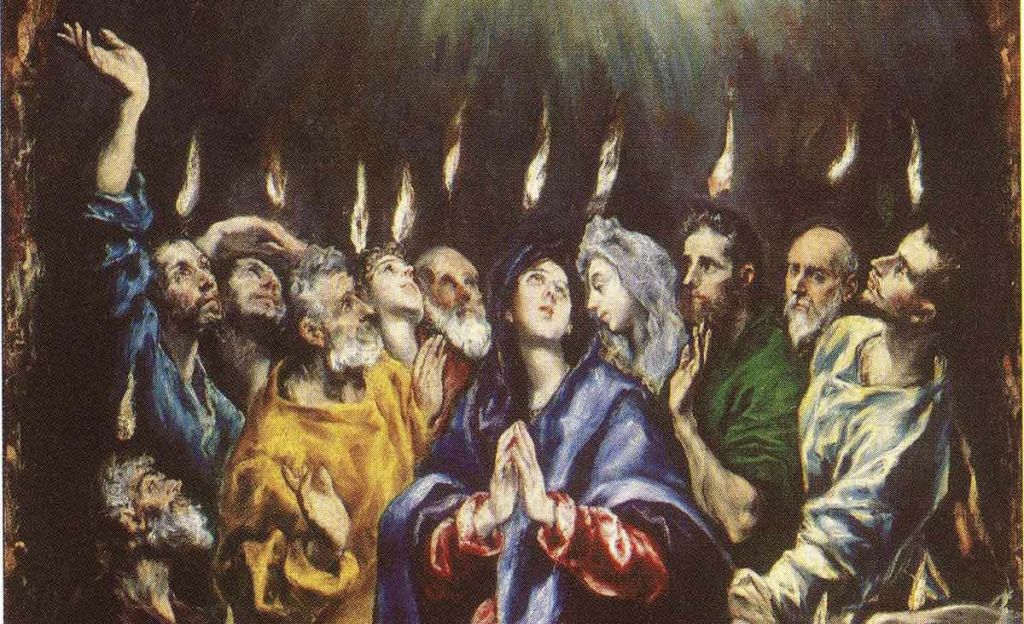
It is the Christian revelation of Mary as Coredemptrix with the Redeemer, as well as the resulting roles of Mediatrix and Advocate for the People of God. For the People of God, as the Council tells us, “still journey on earth surrounded by dangers and difficulties, until they are led into their blessed home.”18
Notes:
1 Pope John Paul II, Redemptoris Mater, 25 March 1987, n. 1. 2 Cf. Vatican Council II, Dei Verbum (Dogmatic Constitution on Divine Revelation), n. 9-10, as contained in Austin Flannery, O.P., ed., Vatican Council II: The Conciliar and Post Conciliar Documents, New York, Costello Publishing Co., 1975 (all later Vatican II Conciliar references will be cited from this source by the document’s Conciliar name). 3 Vatican Council II, Lumen Gentium (Dogmatic Constitution on the Church), n.53. 4 Council of Ephesus, 431 A.D., as cited from Henricus Denzinger, Enchiridion Symbolorum, Definitionum et Declarationum De Rebus Fidel et Morum, Barcelona, ed., Herder, 1946, n. 113 (all later references from this source will be entered as “D” followed by the reference number). 5 Pope Martin I, Lateran Council, 649 A.D., D 256. 6 Pope Pius IX, Ineffabilis Deus, 1854, D 1641. 7 Pope Pius XII, Munificentissimus Deus, 1950. 8 Vatican Council II, Lumen Gentium, n. 62. 9 Vatican Council II, Lumen Gentium, n. 62. 10 Vatican Council II, Lumen Gentium, n. 56. 11 Vatican Council II, Lumen Gentium, n. 58. 12 For example, see Pope Pius XI, Radio message to Lourdes, 28 April 1935, L’Osservatore Romano: “O Mother of piety and mercy, who as Coredemptrix stood by your most sweet Son suffering with Him when He consummated the redemption of the human race on the altar of the cross…(emphasis added).” For other appearances of the Marian title “Coredemptrix” in official Church documents, see Sacred Congregation of Rites, 13 May 1908, Acta Apostolicae Sedis (in later references “AAS”) 41, 1908, p. 408; Holy Office, Decree of 26 June 1913, AAS, 5, 1913, p. 364; Holy Office, Decree of 22 January 1914, AAS, 6, 1914, p. 108; Pope Pius XI, L’Osservatore Romano, 1 December 1933, L’Osservatore Romano, 25 March 1934. Cf. P. Gabriele M. Roschini O.S.M., Maria Santissima Nella Storia Delia Salvezza, Isola de Liri, Italy, Editrice m. Pisani, 1969, p. 126. 13 Mary herself is redeemed by the saving merits of Jesus Christ at Calvary through an application of the graces of redemption at the moment of her conception by God who is out of time, cf. Pope Pius IX, Ineffabilis Deus, 1854. 14 Cf. Vatican Council II, Lumen Gentium, n. 62. 15 Cf. Vatican Council II, Lumen Gentium, n. 62. 16 Pope John Paul II, Papal Address at the Sanctuary of Our Lady of Alborada in Guayaquil, 31 January 1985, L’Osservatore Romano, 11 March 1985. 17 Vatican Council II, Dei Verbum (Dogmatic Constitution on Divine Revelation), n. 10. 18 Vatican Council II, Lumen Gentium, n. 62. 19 Cf. Vatican Council II, Dei Verbum, n. 10. 20 Vatican Council II, Dei Verbum, n. 8. 21 Cf. Pope John Paul II, Encyclical Letter, Redemptoris Mater, n. 30.
Rome 5 May 1993
“I read with pleasure and admiration this theological study about Mary, Coredemptrix, Mediatrix, Advocate. It is all in conformity with Divine Revelation, in the Holy Scriptures of the Old and New Testaments, in the Tradition of the Church from the times of the Apostles, and in the solemn and ordinary Magisterium of the Church, up to and including Pope John Paul II in his encyclical, Redemptoris Mater. I had the great honor to be the professor of Mariology to the Polish student Karol Wojtyla (Pope John Paul II), when he attended the Pontifical Athenaeneum International “Angelicum” in Rome, for his license and doctorate in Theology (1947-1948).
The doctrine of St. Albert the Great (now thought to be Pseudo- Albert) and of St. Thomas Aquinas about the maternal participation of the Virgin Mother in the Redemption as Coredemptrix, Mediatrix, and Advocate had a great influence in the Church. I share the hope of Dr. Mark Miravalle:
“With the profound contribution of our present Holy Father, Pope John Paul II, to the understanding of the mediating mystery of Mary with Christ and the Church … there is only one final action that remains in bringing the Marian roles of Coredemptrix, Mediatrix and Advocate … into the fullest acknowledgement and ecclesial life of the People of God: that our Holy Father, in his office as Vicar of Christ on earth and guided by the Spirit of Truth, define and proclaim the Marian roles of Coredemptrix, Mediatrix of all graces, and Advocate for the People of God as Christian dogma revealed by God, in rightful veneration of the Mother of Jesus, and for the good of the one, holy, catholic and apostolic Church of Christ.”
Yours sincerely in Christ and in the Virgin Mary, Luigi Cardinal Ciappi, O.P. Papal Theologian Emeritus for Popes Pius XII, John XXIII, Paul VI, John Paul I and John Paul II
—- From The book Mary Coredemptrix, Mediatrix, Advocate by Dr. Mark Miravalle
Art credit top: Maria Angela Grow
Mark Miravalle PhD holds the St. John Paul II Chair of Mariology at Franciscan University of Steubenville.
+ The Predestination of Mary by Reginald Garrigou-Lagrange
The heart that beat beneath the breast of a very young girl gave Jesus our Lord and Savior the Sacred Heart and Blood poured out for us on the hill of Calvary for the redemption of the whole world.
In Catholic theology, the term used to describe the biological relationship of Jesus and Mary is Theotokos, which is Greek for “God-bearer” or “Mother of God”². This term emphasizes Mary’s role as the mother of Jesus Christ, who is both God and man. The Council of Ephesus in 431 AD affirmed this title for Mary, declaring her the Mother of God as a way to assert the true divinity of Christ².
Additionally, Mary is sometimes referred to as the New Eve because, just as Eve was the mother of all living in the natural order, Mary, by her obedience and by being the mother of Jesus, becomes the mother of all who are reborn into the life of grace³. Her unique role in salvation history is also highlighted by titles such as co-redemptrix, acknowledging her cooperation in the redemption process with Jesus, the Redeemer⁴. However, it’s important to note that while Mary is given a special honor and veneration in Catholic theology, she is not worshipped, as worship is due to God alone¹.
5/5/2024
(1) Mariology | Definition, History, Theology, Feasts, Devotions, & Facts. https://www.britannica.com/topic/Mariology.
(2) Mary, Mother of Jesus | Encyclopedia.com. https://www.encyclopedia.com/social-sciences/encyclopedias-almanacs-transcripts-and-maps/mary-mother-jesus.
(3) How Can Catholics Understand Mary as Co-Redemprix, Mediatrix of All …. https://www.catholic.org/featured/headline.php?ID=5154.
(4) The Biblical Roots of the Marian Doctrines – Catholic Answers. https://www.catholic.com/magazine/print-edition/the-biblical-roots-of-the-marian-doctrines.

