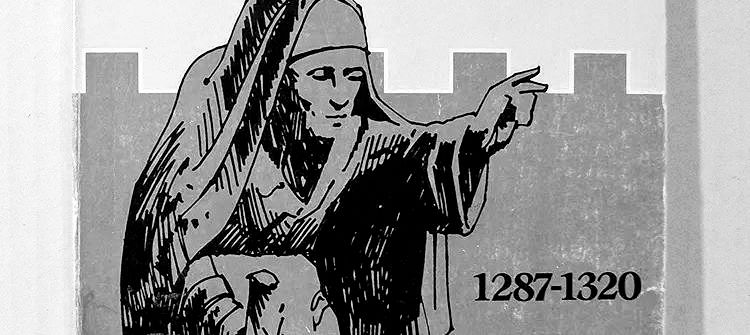
Perhaps most Catholics know her story. Saint Margaret of Castello was born into a well-to-do family near Florence, Italy in 1287. To the great distress of her parents, upon her birth they discovered that she suffered from a variety of severe physical ailments. She was a dwarf, had a curved spine that left her hunched over, was lame to the point that she could barely walk and was blind.
Her family was embarrassed by her, and kept her hidden away for many years. As young as age 6, she was walled up in a room beside a chapel. A family chaplain taught her about God. Seeking a miracle, her parents took her to a Franciscan shrine. They didn’t receive one and abandoned her. Some in the community took pity on her, and gave her the help she needed to survive. She became a member of the Dominican Third Order of Castello, developed a deep prayer life and devoted the remainder of her 33-year life to performing acts of penance and charity.
Despite her suffering, Saint Margaret remained serene, calm, cheerful and courageous. She never became bitter, complained, criticized others or became discouraged. She went to mass daily, and prayed fervently to Jesus, Mary, Joseph and St. Dominic. St. Margaret accepted her suffering with the eyes of faith. She did not know why God allowed her to suffer from so many afflictions, yet she did know that He was all-good, did not allow evil without a good reason and always turned evil into good for His children. She wondered why people pitied her; was it not a privilege to suffer with Christ? Suffering for her was her way to heaven.
One benefit of suffering was that it made her more sympathetic to the trials of others. She visited prisoners, helped the sick and comforted the dying.
Saint Margaret has continued doing good in heaven. Since her death at age 33, she has continued to help those who pray to her. Many cures have since been attributed to her intercession. She is an inspiration to those who are discouraged and tempted to self-pity. Her intercession is most powerful to those who suffer from eye and muscular diseases. She has also become a patron for pro-life groups, and those who are unwanted and abandoned.
St. Margaret was declared Blessed in 1609. Her incorrupt body lies under the main altar of St. Dominic Church in Castello. Many visit her shrine there. She was canonized a saint, 701 years after her death, by Pope Francis April 24, 2021.
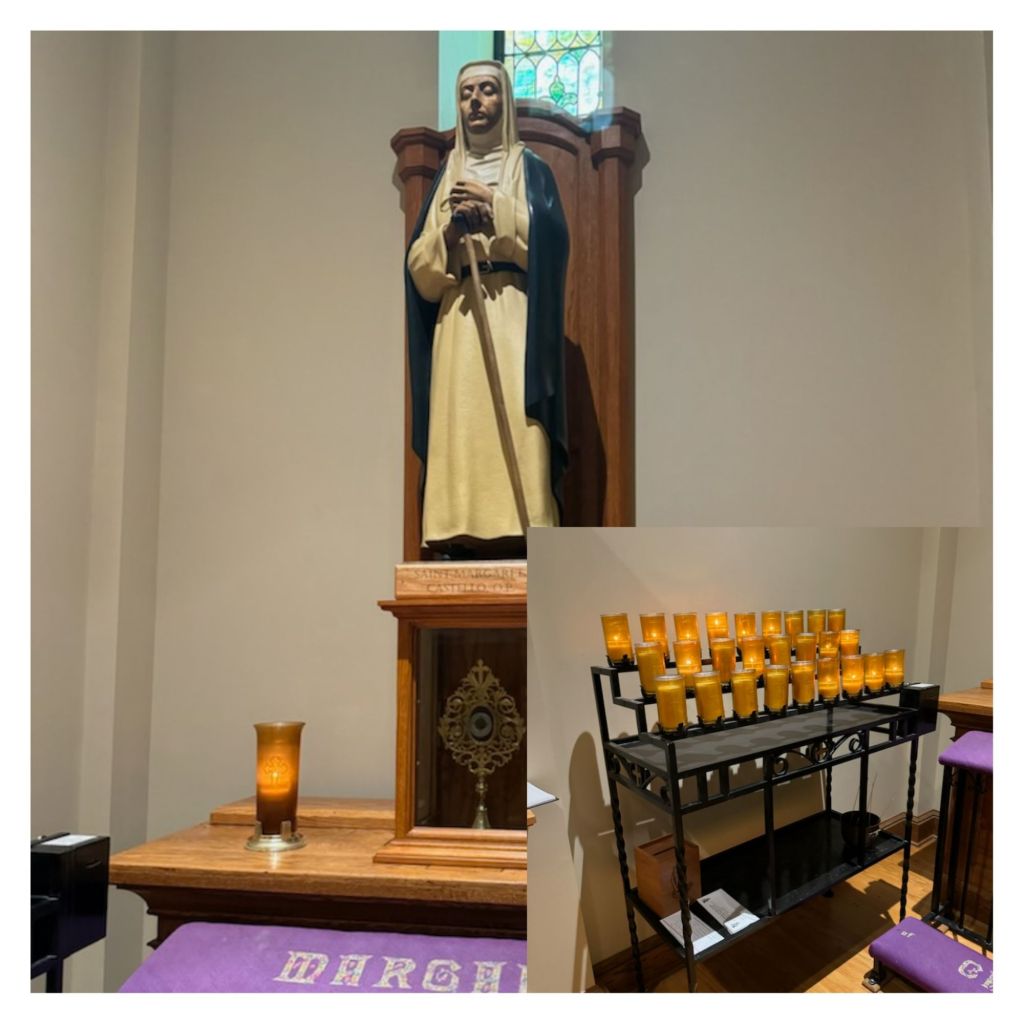
The Saint Margaret of Castello Shrine is located in St. Patrick’s Church, 280 N. Grant Avenue, Columbus, Ohio. The Shrine is a separate chapel in the rear of the church. It consists of a life size statue, a first class relic of her heart, space for prayer, meditation, and blessed candle offerings.
Patron Saints
A Brief History and How They Are Chosen
By Scott P. RichertUpdated on September 09, 2018
Few practices of the Catholic Church are so misunderstood today as devotion to patron saints. From the earliest days of the Church, groups of the faithful (families, parishes, regions, countries) have chosen a particularly holy person who has passed on to intercede for them with God. Seeking the intercession of a patron saint does not mean that one cannot approach God directly in prayer; rather, it’s like asking a friend to pray for you to God, while you also pray—except, in this case, the friend is already in Heaven, and can pray to God for us without ceasing. It’s the communion of saints, in actual practice.
Updated on September 09, 2018
Few practices of the Catholic Church are so misunderstood today as devotion to patron saints. From the earliest days of the Church, groups of the faithful (families, parishes, regions, countries) have chosen a particularly holy person who has passed on to intercede for them with God. Seeking the intercession of a patron saint does not mean that one cannot approach God directly in prayer; rather, it’s like asking a friend to pray for you to God, while you also pray—except, in this case, the friend is already in Heaven, and can pray to God for us without ceasing. It’s the communion of saints, in actual practice.
Intercessors, Not Mediators
Some [Protestants] argue that patron saints detract from the emphasis on Christ as our Savior. Why approach a mere man or woman with our petitions when we can approach Christ directly? But that confuses Christ’s role as mediator between God and man with the role of intercessor. Scripture urges us to pray for one another; and, as Christians, we believe that those who have died still live, and therefore are capable of offering prayers as we do.
In fact, the holy lives lived by the saints are themselves testimony to the saving power of Christ, without Whom the saints could not have risen above their fallen nature.
The History of Patron Saints
The practice of adopting patron saints goes back to the building of the first public churches in the Roman Empire, most of which were built over the graves of martyrs. The churches were then given the name of the martyr, and the martyr was expected to act as an intercessor for the Christians who worshiped there.
Soon, Christians began to dedicate churches to other holy men and women—saints—who were not martyrs. Today, we still place some relic of a saint inside the altar of each church, and we dedicate that church to a patron. That’s what it means to say that your church is St. Mary’s or St. Peter’s or St. Paul’s.
How Patron Saints Are Chosen
Thus, the patron saints of churches, and more broadly of regions and countries, have generally been chosen because of some connection of that saint to that place—he had preached the Gospel there; he had died there; some or all of his relics had been transferred there. As Christianity spread to areas with few martyrs or canonized saints, it became common to dedicate a church to a saint whose relics were placed in it or who was especially venerated by the founders of the church. Thus, in the United States, immigrants often chose as patrons the saints that had been venerated in their native lands.
Patron Saints for Occupations
As the Catholic Encyclopedia notes, by the Middle Ages, the practice of adopting patron saints had spread beyond churches to “the ordinary interests of life, his health, and family, trade, maladies, and perils, his death, his city, and country. The whole social life of the Catholic world before the Reformation was animated with the idea of protection from the citizens of heaven.” Thus, Saint Joseph became the patron saint of carpenters; Saint Cecilia, of musicians; etc. Saints were usually chosen as patrons of occupations that they had actually held or that they had patronized during their lives.
Patron Saints for Diseases
The same is true of patron saints for diseases, who often suffered from the malady assigned to them or cared for those who did. Sometimes, though, martyrs were chosen as the patron saints of diseases which were reminiscent of their martyrdom. Thus, Saint Agatha, who was martyred c. 250, was chosen as the patron of those with diseases of the breast since her breasts were cut off when she refused marriage to a non-Christian.
Often, such saints are chosen too as a symbol of hope. The legend of Saint Agatha attests that Christ appeared to her as she lay dying and restored her breasts that she might die whole.
Personal and Familial Patron Saints
All Christians should adopt their own patron saints—first and foremost being those whose name they carry or whose name they took at their Confirmation. We should have a special devotion to the patron saint of our parish, as well as the patron saint of our country and the countries of our ancestors.
It’s also a good practice to adopt a patron saint for your family and to honor him or her in your house with an icon or statue.
Scott P. Richert is the senior content network manager of Our Sunday Visitor