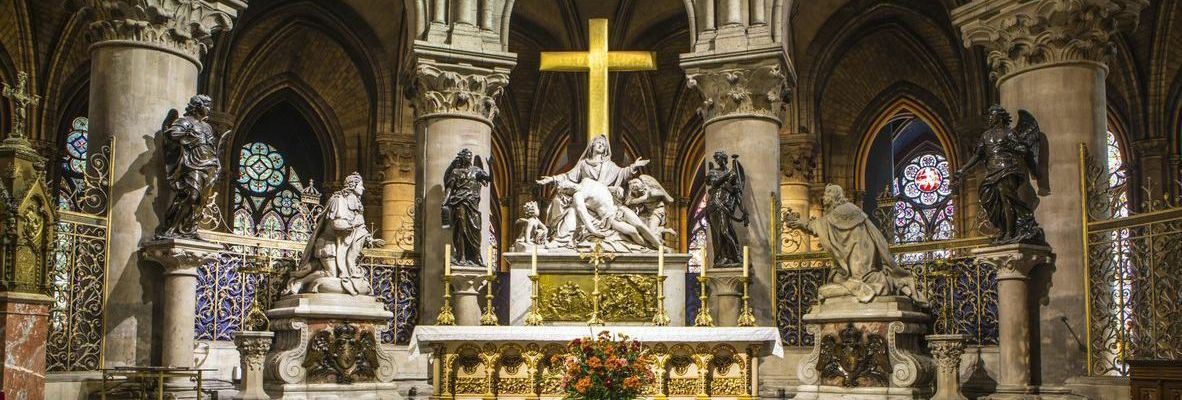
This war is not like any other war. A revolution … involve[s] ideologies, dogmas and creeds.
1914
The so-called “Age of Reason” was really an Age of Unbelief for its strongest protagonists were corrosive men like Hume, Kant, Voltaire, who measured the growth of reason by its alienation from God Who Alone could guarantee its deliverances and its conclusions. The sovereignty of reasonable people replaced the sovereignty of God. All principles were rejected except a few self-evident ones which, it was hoped, would preserve the brotherhood of man without the Fatherhood of God. But reason could not hold society together for everyone soon became his own interpreter of reason, as everyone once before was his own interpreter of the Book…
1943
How many philosophies of life are involved in this [our new phase] revolution? It is quite generally and falsely assumed that there are only two: Democracy and the Totalitarianism, or the Christian and the anti-Christian. Would to God it were that simple!
There are actually three great philosophies of life or ideologies involved: First, the Totalitarian which is anti-Christian, anti- Semitic, and anti-human.
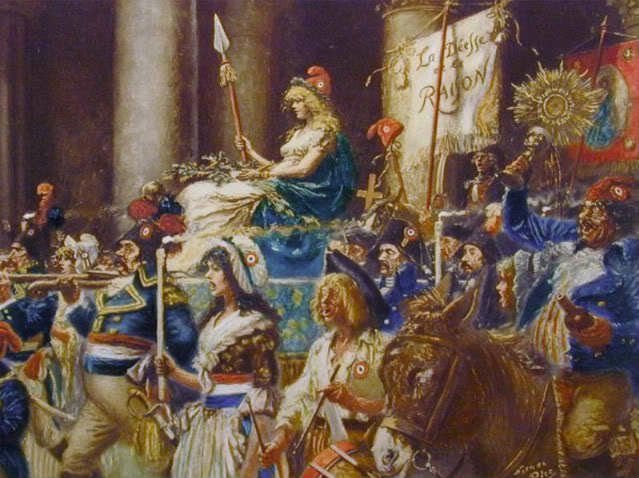
Secondly, the Secularist world view which is humanistic and democratic, but which attempts to preserve these values on a non-religious and non-moral foundation by identifying morality with self-interest instead of morality with the will of God.
Thirdly, the Christian world view which grounds the human and the democratic values of the Western World on a moral and religious basis.
This Christian view includes not only Christians but also Jews, who historically are the roots of the Christian tradition, and who religiously are one with the Christian in the adoration of God and the acceptance of the moral law as the reflection of the Eternal Reason of God.
In the light of these three conflicting philosophies of life our task is three-fold.
This anti-Christian, anti-Jewish and anti-human Totalitarian system must be defeated and crushed not just because it is a political or economic system contrary to ours, but because it is anti-human, and it is anti-human because it is anti-God. Hence our war against it is not in the name of democracy, but in the name of humanity.
We must fearlessly admit that we are not fighting the war to keep everything just as it is, for the materialism, selfishness and godlessness which would eat away the vitals of American traditions, justice and equality we can and should scrap. Then, having recovered our allegiance to God’s moral law, we may be worthy of our mission to lead the world to the peace born of the justice and charity of God, for “Unless the Lord build the house, they labour in vain that build it. Unless the Lord keep the city, he watch-eth in vain that keepeth it.”
This war is incidental to the great decision the world must make: whether man is a tool of the state as Totalitarianism believes; or whether man is an animal as the secularist tradition of the Western World and too many Americans believe; or whether man is a creature made to the image and likeness of God as the Christian believes. There is the essence of conflict. We have a double enemy in this war, not a single one. We must defeat the active barbarism from without, and we must defeat the passive barbarism from within. We must use our swords with an outward thrust against Totalitarianism and its hard barbarism; but we must also use the sword with an inward thrust to cut away our own soft barbarism. In personal language, each of us must say: I must fight the enemy of man, and I must fight myself when I am my own worst enemy. We have a war to win; and we have a revolution to win. A war to win by overthrowing the power of the enemy in battles and a peace to win by making ourselves worthy to dictate it.
Victory on the field will conquer the hard barbarism. Repentance and catharsis of spirit alone will conquer the soft barbarism. Guns, ships, planes, dynamite, factories, ships and bombs will put down the first evil. Prayer, sorrow, contrition, purging of our hearts and souls, meditation, reparation, sacrifice and a return to God will alone accomplish the second.
If we merely defeat the hard barbarism and lose to the soft, we will be at the beginning of cyclic wars, which will return and return until we are beaten and purged and broken in the creative despair of getting back to God. This is the true revolution. All the other revolutions of the twentieth century have been from without; this time we want a revolution from within.
The revolutions which shook Europe during the last twenty-five years only shifted power from one class to another, and booty from one pocket to another, and authority from one party to another. This time we want a revolution that will change hearts! A revolution like the one pictured in “The Magnificat” which was a thousand times more revolutionary than the Manifesto of Karl Marx in 1848. The trouble with all political and economic revolutions is they are not revolutionary enough! They still leave hate in the heart of man!
Anti-Christian Fascism, Imperialism, Marxism Socialism
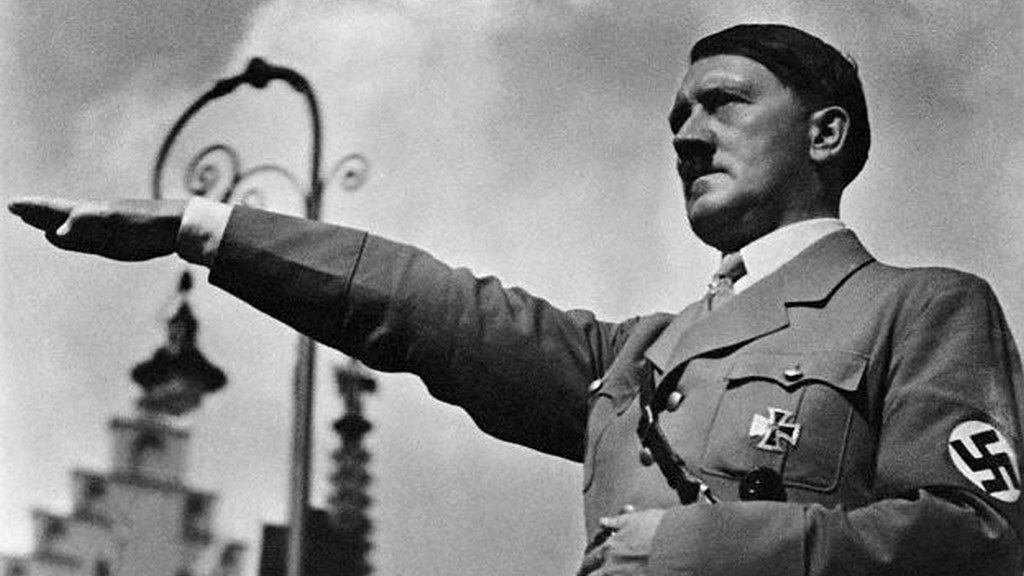
This anti-Christian, anti-human, anti-democratic totalitarian ideology exists in four forms widely scattered throughout the world: In a historical form, as the revival of the imperial traditions of the ancient Roman Empire, which is Fascism.
In an anthropological form, as the glorification of the Nordic race, which is Nazism. In a theological form, as the identification of Divinity with a dynastic house, which is Japanese Imperialism.
In an economic form, as the proclamation of class struggle on the anti-religious basis of dictatorship of the proletariat, which is Marxian Socialism.
In the Christmas (1942) Encyclical, the Pope condemned these four forms as a “conception which claims for particular nations, or races or classes ‘the norm from which there is no appeal.’” Not one of these four forms is a state in the political sense of the term; rather each is a philosophy of life working through a unique party which acts as a substitute for the State. All agree in investing primitive ideas of class, race, nation and blood with a Divine significance.
Furthermore, as the very word “totalitarian” implies, these systems demand power over the total man—the whole man, body and soul, and aim at control over the most intimate regions of the spirit. In this sense they are religions; only secondarily, are they systems of politics. Because they are religions they persecute Jews and Christians, for in their eyes these are rival religions. In fact, they claim more than Christianity, for Christianity left to Cæsar the things that were Cæsar’s, but these new false religions insist that even the things of God belong to Cæsar. How did these pseudo-mysticisms originate? In their European form they arose in part as a reaction against the excesses and defects of the secularist and materialist culture of the rest of the Western World, just as a man might foolishly burn his barn to get rid of a few rats.
Anyone who looks at history in the perspective of the last few hundred years, will see in it a progressive repudiation of Christian principles in social, political and economic life, which repudiation produced first our present non-religious civilization; then an anti-religious civilization (Communism) and finally by reaction the anti-religious one of Nazism against which we are struggling.
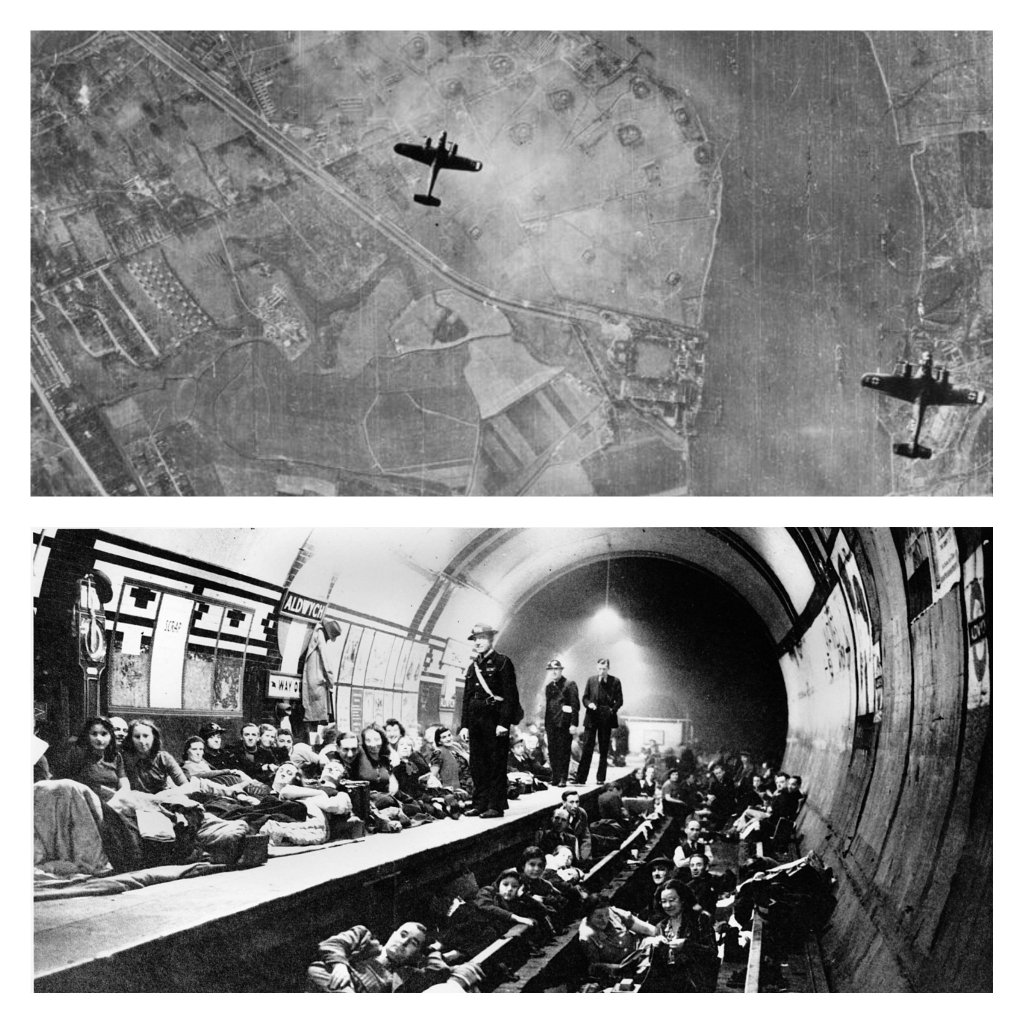
Once upon a time there was a Christian culture. It was not a perfect culture, because Christianity was never meant to be perfected in this world. It flowered during the Middle Ages. Chesterton once said that these are called the “Dark Ages” by those who are in the dark about them. The basis of its civilization was that law, education, politics, economics, social service, arts, crafts, labor and capital were all built up in a hierarchical fashion like a pyramid, with God at the peak. Everyone, whether he was a scholar or peasant, lord or serf, sinner or saint, recognized the Lord as the One to Whom he would one day return to render an account of his stewardship. Thus all life was impregnated with morality; economics and politics were branches of ethics; men were one because there was one Lord, one Faith, one Baptism. This great civilization went into decline partly through the rebirth of pagan ideas and partly through the moral decline of the individuals.
Moral Substitutions
There then began what might be called the Era of Substitutions in which men sought other bases for moral unity than the Church…
The first substitute, the Bible, had the great advantage of still keeping society together on the basis of the super-natural and the moral inspiration of Christ the Son of God. But it was unable to maintain that unity long, first of all, because, when every man became an infallible interpreter of the Book, there were as many religions as heads; and because once the Book was detached from the Board of Editors which guaranteed its inspiration, and from a Supreme Court which interpreted it, it became rather the basis of discord than of harmony.
Men then set about for a new bond of cohesion and they sought it in reason—not reason illumined by faith, but reason divorced from faith.
The so-called “Age of Reason” was really an Age of Unbelief for its strongest protagonists were corrosive men like Hume, Kant, Voltaire, who measured the growth of reason by its alienation from God Who Alone could guarantee its deliverances and its conclusions. The sovereignty of reasonable people replaced the sovereignty of God. All principles were rejected except a few self-evident ones which, it was hoped, would preserve the brotherhood of man without the Fatherhood of God. But reason could not hold society together for everyone soon became his own interpreter of reason, as everyone once before was his own interpreter of the Book. As Dean Swift so well described it: “Wisdom is a hen whose cackling we must value and consider because it is attended with an egg. But then lastly it is a nut, which, unless you choose with judgment, may cost you a tooth, and pay you with nothing but a worm.”
Finally there came the last and final substitute: the enthronement of individual self-interest, which is known as Liberalism. Men once said, we will not have the Church of Christ rule over us, and then later on added, we will not have the Word of God rule over us, then, we shall rule ourselves by our own reason; now they finally decided to rule themselves on the basis of their absolute independence of God. The three most important principles of this Liberal culture were: Economically: leave every man free to work out his economic destiny as he sees fit, and the general good of all will result. Upon this non-moral principle modern Capitalism is grounded. Politically: in order that the individual may be free from restraint in his economic exploitation, the State must have only a negative function like a policeman whose business it is to prevent others from meddling in our affairs, and particularly to preserve property rights. Socially: Freedom means the right to do whatever you please. A man is therefore most free when he is devoid of all restraints, discipline and authority. Personality is self- expressive when it is unhampered by law.
Three Revolutions
The Era of Substitution has behind it three great revolutions: the religious revolution which uprooted man from responsibility to a spiritual community; the French Revolution which isolated man from responsibility to a political community or the State; and the Industrial Revolution and Liberalism which isolated man from all responsibility to the social community or the common good. Such is the essence of our secularist culture: the supremacy of the individual man.
Torn away from his roots in God, his roots in law and his roots in a brotherhood of men, it naturally led to the anarchy of the jungle and the oppression of the weak and the unfortunate, and a society which was nothing but a criss-cross of individual egotism, where each man was a wolf to his neighbor. And when these egotisms became nationalized and militarized they came to a head in the first World War. Thus did a secularist age, which began with the dream of a universal brotherhood without God, end in a series of frustrated strifes in which men of different races and nations were tempted to deny the last vestige of humanity. — from Philosophies at War, TAN Books
Fulton J. Sheen
(1895–1979)
Fulton John Sheen was born in El Paso, Illinois, in 1895. In high school, he won a three-year university scholarship, but he turned it down to pursue a vocation to the priesthood. He attended St. Viator College Seminary in Illinois and St. Paul Seminary in Minnesota. In 1919, he was ordained a priest for the Diocese of Peoria, Illinois. He earned a licentiate in sacred theology and a bachelor of canon law at the Catholic University of America and a doctorate at the Catholic University of Louvain, Belgium.
Sheen received numerous teaching offers but declined them in obedience to his bishop and became an assistant pastor in a rural parish. Having thus tested his obedience, the bishop later permitted him to teach at the Catholic University of America and at St. Edmund’s College in Ware, England, where he met G.K. Chesterton, whose weekly BBC radio broadcast inspired Sheen’s later NBC broadcast, The Catholic Hour (1930–1952).
In 1952, Sheen began appearing on ABC in his own series, Life Is Worth Living. Despite being given a time slot that forced him to compete with Milton Berle and Frank Sinatra, the dynamic Sheen enjoyed enormous success and in 1954 reach tens of millions of viewers, non-Catholics as well as Catholics.
When asked by Pope Pius XII how many converts he had made, Sheen responded, “Your Holiness, I have never counted them. I am always afraid if I did count them, I might think I made them, instead of the Lord.”
Sheen gave annual Good Friday homilies at New York’s St. Patrick’s Cathedral, led numerous retreats for priests and religious, and preached at summer conferences in England.
“If you want people to stay as they are,” he said, “tell them what they want to hear. If you want to improve them, tell them what they should know.” This he did, not only in his preaching but also in the more than ninety books he wrote. His book, Peace of Soul was sixth on the New York Times best-seller list.
Sheen served as auxiliary bishop of New York (1951–1966) and as bishop of Rochester (1966–1969).
His two great loves were for the Blessed Mother and the Eucharist. He made a daily holy hour before the Blessed Sacrament, from which he drew strength and inspiration to preach the gospel and in the presence of which he prepared his homilies. “I beg [Christ] every day to keep me strong physically and alert mentally in order to preach His gospel and proclaim His Cross and Resurrection,” he said. “I am so happy doing this that I sometimes feel that when I come to the good Lord in Heaven, I will take a few days’ rest and then ask Him to allow me to come back again to this earth to do some more work.”
The good Lord called Fulton Sheen home in 1979. His television broadcasts, now on tape, and his books continue his earthly work of winning souls for Christ. Sheen’s cause for canonization was opened in 2002, and in 2012 Pope Benedict XVI declared him “Venerable.”
________
4th Revolution?
Report: The Obamas just produced a viral Netflix show demonizing white people…
— What the Critics of the Crusades Forget or Downplay

