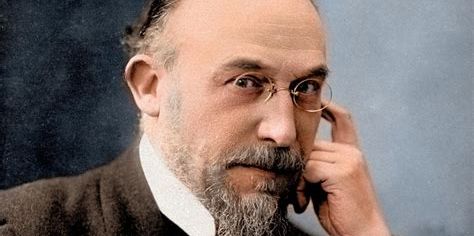
By Dominic Nicholas | 8 Notes | October 2023
You have likely heard and loved his work even if you knew little or nothing of him or it. Listen again here.
Erik Satie (186–1925) wrote his celebrated Trois Gymnopédies in the 1880s whilst living and working in Montmartre, Paris. Unassuming though they may seem, these works were quietly radical, establishing him as one of the most important composers of his generation. Satie led a peculiar life marked by eccentricities, including his solitary lifestyle, refusal to let anyone into his home for decades, and his unique musical compositions that defied traditional norms. He also founded his own religion and had only one confirmed romantic relationship, which ended abruptly, leaving him in a state of loneliness that influenced his work.
[ After each movement or piece there is the usual pause. 42:06 minutes. ]
Eccentricities and Lifestyle
Musical Career
- Satie began his career playing in cabaret cafes in Montmartre, Paris.
- He was expelled from the Paris Conservatoire for being “gifted but lazy.”
- His compositions, such as the Gymnopédies and Gnossiennes, were groundbreaking, lacking conventional time signatures and bar lines.
Personal Life
- Satie lived a solitary life, often referred to as “Mr. Poor” by friends.
- He had only one confirmed romantic relationship with artist Suzanne Valadon, which lasted six months.
- He founded his own religion, the Église Métropolitaine d’Art de Jésus Conducteur, and was its sole member.
Notable Works and Innovations
- One of his most famous pieces, Vexations, requires the performer to repeat a single phrase 840 times.
- Satie’s music influenced later movements, including minimalism and avant-garde music.
Final Years
- Satie lived in a locked room for 27 years, never allowing visitors.
- He died on July 1, 1925, from cirrhosis of the liver, leaving behind a legacy of unique and thought-provoking music.
- Classic FM / Wikipedia
Student Failures
“Born in Hornfleur, France in 1866, Satie’s early years were marked by failure. In the Paris Conservatoire preparatory piano class at the age of 14 he was described as ‘gifted but indolent’, the following year as ‘the laziest student in the Conservatoire’ before being expelled. He returned to the Conservatoire in 1885, his teacher describing him as ‘Worthless. Three months just to learn the piece. Cannot sight-read properly.’ Dismissed a second time, he left the Conservatoire without a diploma.
Trois Gymnopédies
After leaving the Paris Conservatoire Satie scraped together a living as a pianist at the the Chat Noir cabaret, also doing some conducting, then at the Auberge du Clou, where he became friends with Claude Debussy. It was around this time that he wrote his Trois Gymnopédies, the whole set being published in 1888.
The meaning of ‘Gymnopédie’
The strange title refers to an ancient Spartan festival at which young men, unencumbered by clothes, danced and competed against each other. Satie’s use of the title may, therefore, have been to a certain degree ironic—though the pieces can be considered to be dances, their dreamy quality does not tend toward the strenuous.
Musical Qualities
The pieces are all written in 3/4 time and marked as ‘Lent’ (‘Slow’), each with a qualifier: No.1 is ‘Lent et douloureux’ (‘Slow and painful’); No 2 ‘Lent et triste’ (‘Slow and sad’); No. 3 ‘Lent et grave’ (‘Slow and serious’). They follow a similar pattern—elaborating a simple theme over subtly transforming harmony. The effect is hypnotic, ethereal, nostalgic, abstract, mysterious and transfixing.
Gymnopedie 1
The most celebrated of the Gymnopedie is the first of the set, ‘Lent et douloureux.’ It is novel from the first bar, with its jazzy sounding major seventh, the bass centring the tonality on G, despite the D key signature. This suggests the influence of old church modes (the Lydian, in this case, though things become more ambiguous later on). After four bars that famous, achingly beautiful melody begins. It floats above the chords and is freely expanded, like plainchant heard through an aural prism. The effect is hypnotic.
Quietly revolutionary
Satie’s style of composition in these pieces (and elsewhere, for example, his Gnossiennes) ran completely against that of the more established late-Romantic Germanic tradition as represented by composers such as Wagner, Brahms, Mahler and Strauss.
In their works musical material was carefully and vigorously worked out, goal-oriented and with a tendency towards loud and bombastic perorations. Satie’s music, by contrast, emphasised stillness and gradual evolution. This was an important factor in leading other French composers such as Debussy, Ravel and the group known as Les Six away from the orbit of the Germanic tradition…His music may also be viewed as a precursor to minimalist music.
Enduring popularity
Today Satie’s ‘Trois Gymnopédies’ are amongst the popular piano works in the repertoire, their relative lack of technical difficulty making them popular with amateurs and professionals alike. The works have also been arranged by many other artists including Claude Debussy, Dick Halligan, Gary Numan and Janet Jackson and used in movies such as ‘Another Woman’ (1988), ‘The Royal Tenenbaums’ (2001) ’Man on Wire’ (2009) and ‘Mr. Nobody’ (2009).

