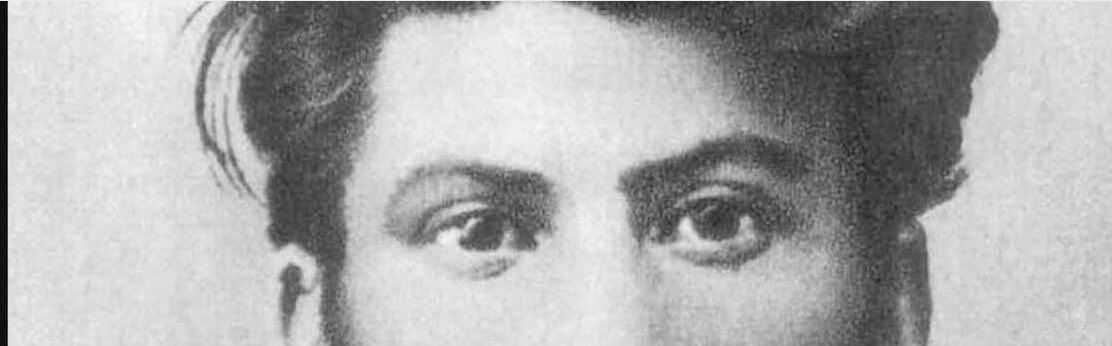
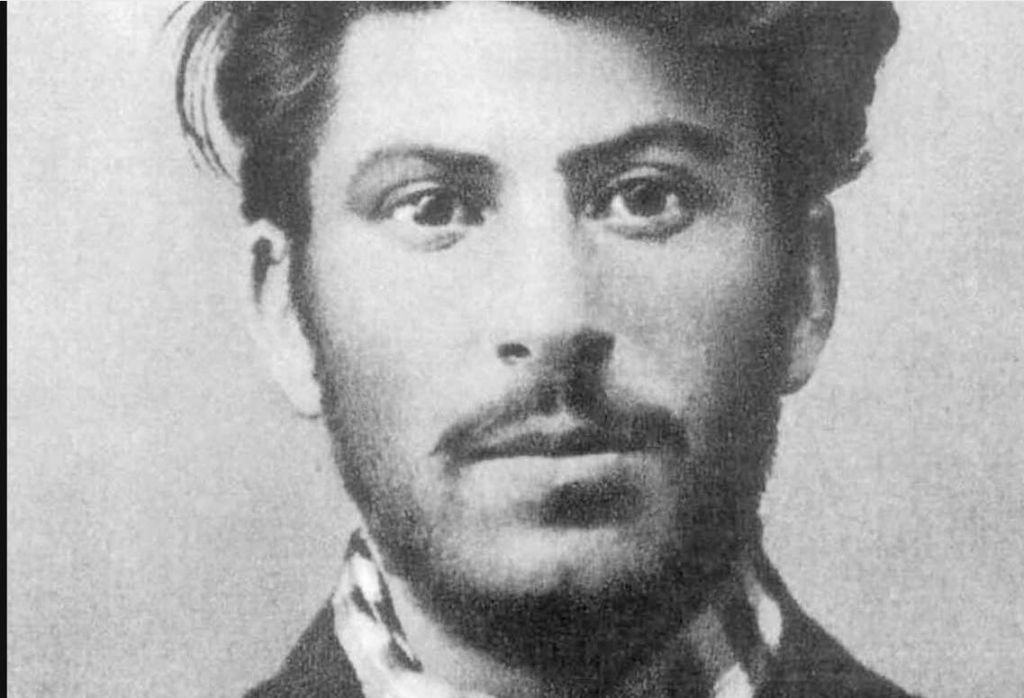
Josef Stalin, seen here, “was once a hip young Liberal intellectual, an atheist Democrat Socialist, who led protests against the rich and powerful. He rose to power, promising equity, then took over private industry, leading to mass poverty and famine. With utter indifference he killed over 20 million of his own people.”
Below: From the Foreward of The Gulag Archipelago by Alexander Solzhenitsyn:
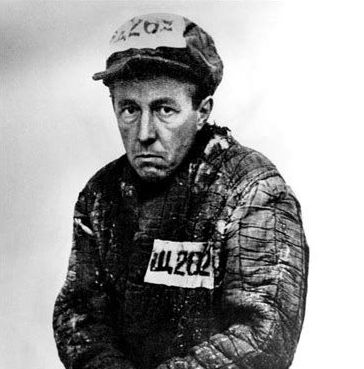
“…Russians responded so strongly because The Gulag Archipelago’s author was, at that time, simultaneously very famous and strictly taboo. Twelve year earlier, in 1962, Solzhenitsyn had attained an unusual distinction, becoming both the first authentic Gulag author to be published in the official press, as well as the last. In that year—the height of the post-Stalinist “Thaw”—the Soviet general secretary Nikita Khrushchev had personally permitted the publication of Solzhenitsyn’s short novel One Day in the Life of Ivan Denisovich. The book, based on Solzhenitsyn’s own camp experiences—like Ivan Denisovich, he too had been a camp bricklayer—described a single, ordinary day in the life of a Gulag prisoner.
Reading it now, it can be hard for contemporary readers to understand why Solzhenitsyn’s only published work had created such a furor in the Soviet literary world. But in 1962, Ivan Denisovich came as a revelation. Instead of speaking vaguely about ‘repressions,’ as some other books did at the time, Ivan Denisovich was blunt and specific. The sufferings of its heroes were pointless. The work they did was boring and exhausting, and they tried to avoid it. They spoke using camp slang and were rude to one another. The Party did not triumph at the end of the story, and communism did not win out in the end. This honesty, unusual in an era of morality tales and social realism, won Solzhenitsyn admirers, particularly among camp survivors, who wrote him long letters of praise.
Each new printing of the novel sold out instantly, and copies were eagerly shared among groups of friends. Solzhenitsyn’s honesty also quickly won him detractors. Within a month of publication, the novel had already been denounced at a meeting of the Soviet Writers’ Union. Critics wrote that it was too bleak, too “amoral.” Within a few more months, Solzhenitsyn himself was under personal attack, falsely accused of having surrendered to the Germans during the war, and of having been convicted on criminal charges. He fought back, but to no avail: thanks to the furor caused by this first published novel, none of his work would ever be officially published in the Soviet Union again. Yet his name and his novels remained in circulation thanks to the world of underground publishing in Russia, which at that time was growing rapidly. In fact, in the years between his first burst of “official” fame and the appearance of The Gulag Archipelago in samizdat form, Solzhenitsyn became if anything more notorious, and more celebrated, despite the official ban. The KGB began to follow him closely, and at one point stole his entire personal archive.
His wife lost her job. Recently released archival documents show that his every move was closely analyzed at the highest levels of the Soviet security apparatus, and sometimes even by the Politburo itself. At the same time, his occasional lectures were wildly popular: six hundred people showed up for one of his first public readings in 1966. His books began to appear in foreign translations, to great acclaim, and were copied and re-copied in secret.
Nobel Prize
Then, in 1970, Solzhenitsyn won the Nobel Prize. Fearing he would be barred from returning to Russia, he decided not to travel to Stockholm to accept the award. But he issued a statement to be read out at the Nobel banquet, among other things noting the “remarkable fact that the day of the Nobel Prize presentation coincides with Human Rights day,” and calling on all Nobel Prize winners to remember that fact:
“Let none at this festive table forget that political prisoners are on hunger-strike this very day in defence of rights that have been curtailed or trampled underfoot.”
The Swedish government was unnerved, and the Nobel Committee failed to read out that part of the statement. The Soviet authorities were furious, and boycotted the ceremony. The Soviet Writers’ Union denounced Solzhenitsyn as the darling of “reactionary circles in the West,” and reviewers described him as “a run-of-the-mill writer with an exaggerated idea of his own importance” whose literary gifts were “inferior to many of his Soviet contemporaries—writers the West chooses to ignore because it finds the impact of truth in their writing unbearable.”
Still, millions of Russians learned of the prize through Western radio, as well as through the underground press (which circulated the statement that the Swedes had feared to read), and celebrated the award to their countryman.
Thus when news that Solzhenitsyn had written a history of the Soviet Gulag began to filter out too, there was an enormous reading public—and a listening public, for excerpts were immediately read out on Radio Liberty—already waiting to receive it. Yet the impression which The Gulag Archipelago made on its first Russian readers was not solely due to the author’s notoriety, or to his Nobel Prize, or to the denunciations of him in the Soviet press.
More importantly, the book’s appearance also marked the first time that anyone inside Russia had ever tried to write a complete history of the Soviet concentration camps, using what information was then available, mostly the “reports, memoirs and letters by 227 witnesses,” whom Solzhenitsyn cites in his introduction. Many knew fragments of the story, from the cousin who had been there or the neighbor’s nephew who worked in the police. No one, however, had attempted to put it all together, to tell, in effect, an alternative history of the Soviet Union. And the result was unique.
Solzhenitsyn called The Gulag Archipelago an “experiment in literary investigation,” and that remains the best description of a work which is otherwise impossible to categorize. The book is not quite a straight history—obviously, Solzhenitsyn did not have access to archives or historical records—and large sections are autobiographical. Solzhenitsyn describes in great detail his own arrest and interrogation, his first prison cell, and, courageously, his flirtation with camp police who asked him to serve as an informer.
Other parts of the book rely heavily on the words and experiences of others, including some of Solzhenitsyn’s camp friends, as well as many people he did not know but who wrote to him after the publication of Ivan Denisovich. Still other sections are based on Solzhenitsyn’s research into what sources were available: legal tomes, official histories, and the Soviet press. But all of the material was then filtered through Solzhenitsyn’s unique sensibility, and retold in a style which was simultaneously angry, prophetic, ironic—and always opinionated.
Lenin
Thus The Gulag Archipelago is a history, but it is also an interpretation of history, and one which many at first found shocking. Up until the publication of Gulag, many in Russia and elsewhere were content to blame Stalin for Soviet terror, concentration camps, and mass arrests.
Solzhenitsyn argued, and with real evidence, that Lenin, not Stalin, was responsible for creating the Gulag, and that the first Soviet concentration camps for political prisoners were built in the 1920s, not the 1930s. He also showed that the famous “great purge” of the 1930s, during which many leaders of the Bolshevik Revolution were put on public trial and then eXecuted, was no aberration. In reality, it was only one of the many “waves which strained the murky, stinking pipes of our prison sewers to bursting,” and not even the largest at that: far more people were killed during the era of mass collectivization, and the Gulag population actually reached its zenith a decade later, at the end of the 1940s and in the early 1950s.
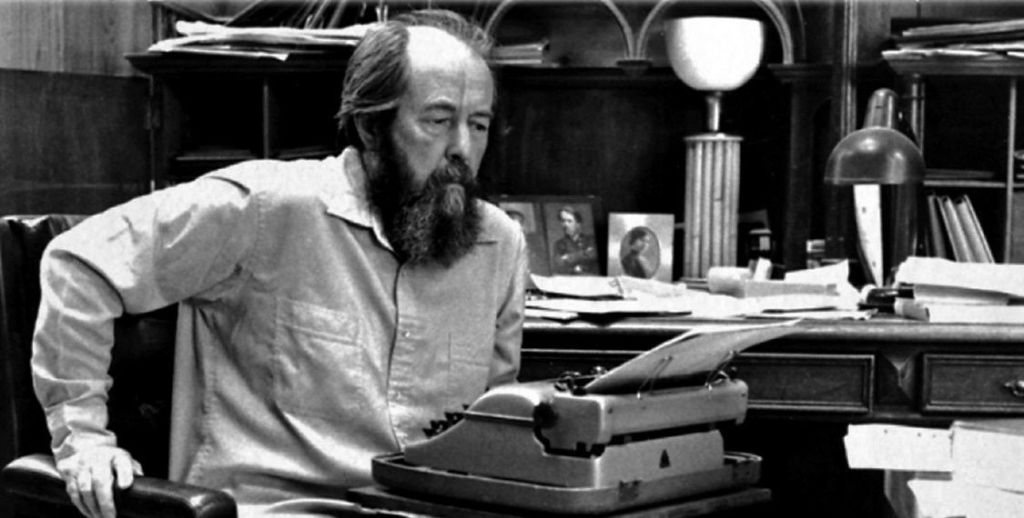
Most importantly, Solzhenitsyn aimed to show that, contrary to what many believed, the Gulag was not an incidental phenomenon, something which the Soviet Union could eventually eliminate or outgrow. Rather, the prison system had been an essential part of the Soviet economic and political system from the very beginning. “We never did have empty prisons,” he wrote, “merely prisons which were full or prisons which were very, very overcrowded.” In fact, The Gulag Archipelago was intended to serve as a condemnation not just of the Soviet camp system, but of the Soviet Union itself. It succeeded—so much so that Soviet authorities decided they could no longer tolerate Solzhenitsyn’s presence at all. As a result of its publication, not just in Russia but in multiple foreign countries, Solzhenitsyn was expelled from the country. He would not return until after the collapse of the Soviet Union in 1991.
Exiled to the West

 Catholic Critique