By Carol Jackson Robinson,
Feb. 1951.
Here seems to be a law of diminishing resistance, whereby people corrupt easier and quicker as progressive barriers come down. For instance if someone were to institute nude bathing, I would be surprised to find much general disapproval.
Certainly nothing to compare with the hullabaloo said to have been aroused when women’s skirts were originally raised above the ankles.
Or remember all those years of discussion, disapproval and hand-wringing about “necking”? Sexual immorality has now reached the stage of wifely infidelity and homosexuality, but the public does not burst spontaneously into righteous alarm. Its moral sensitivity has been so blunted that the nicest people merely cluck over dispassionate socialized statistics of depravity.
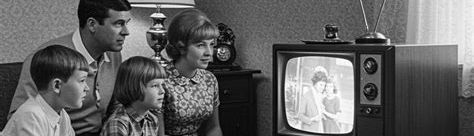
To my mind this law of our deterioration explains why the curious institution of television has moved into millions of American homes without perceptible friction on the part of the householders, why deluxe sets were dangled without misgiving before the chance-takers at church bazaars.
After George Orwell’s “1984” one would expect people to have premonitions of Big Brother every time a picture flashed on their screen.
But no. People had neither shame nor fear in purchasing their sets. Even now as I write I can imagine my readers being astonished at my audacity in presuming to criticize television.
I can hear them say, “This is too much! Now Integrity [magazine] is going overboard! This surely is Jansenism!** How negative can you get?”
Perhaps they will even be wondering what anyone could say against television except perhaps to criticize the décolleté (low necklines) of its female stars.
This is not a diatribe against television. It is a weighing of its value in the light of social circumstance. It is a closer look at the television clichés.
The perspective may be new in places, but the originality of this article consists mostly in calling nonsense by its true name. The wife of a drunkard would not think of setting up a well-stocked bar prior to putting him on rations. Yet a million mothers of small children seem to think the key to rationing their offspring’s televiewing is to buy a set of their own.
This criticism of television may be unpopular but it is extremely easy to make. In its order television is just about as obviously harmful as nude bathing is in its order. True, the morality is not so clear cut, but that does not mean that the consequences cannot be even more disastrous.
Let us trace the genealogy of television in the hope of discovering whether it is a little monster or a little prodigy. On its father’s side it is the child of technology, grandchild of capitalism.
On its mother’s side it was conceived in the womb of despair, ignorance and dehumanization…”
To say nothing of today’s Internet.
_______
** Jansenist morality emphasizes a strict and rigorous approach to ethics, often rejecting the idea that human beings can freely choose to do good and gain greater graces on the basis of sufficient grace alone.

