Inside the Vatican excerpt. By Dr. Ralph Weimann:
“Harvesting organs: “Bioethics is in a disastrous situation”
“…Due to technological progress, Pope Pius XII († 1958) invited scientists to provide medical criteria defining death, whilst upholding the theological definition of death as separation between body and soul. However, ten years after his death, a revolution occurred when the Ad Hoc Committee of the Harvard Medical School determined “brain death” as the new definition of death, even referring explicitly to Pope Pius XII.
Concerning this important development, several aspects have to be mentioned: 1) How can such a new and momentous definition be composed by an Ad Hoc Committee? 2) The surprising historical context: shortly before this new definition was composed, the first heart transplant had taken place in South Africa in 1967, already anticipating, apparently, the “brain death” criterion. It became evident that new norms had to be established to ethically justify such transplants. 3) Brain death was initially referred to as “irreversible coma,” which makes the whole problem apparent: a coma patient is not really dead! So the initial definition was subsequently changed — but the basic problems remained.
Later on, brain death was re-defined as the complete cessation of all brain activity. However, on the one hand it is extremely difficult to prove this from a scientific standpoint. On the other hand, certain parts of the brain remain exempt from the need for “complete cessation” in this criterion — above all, those parts of the brain that are responsible for maintaining alive those very organs that are going to be donated! The basic question must be asked: how one could possibly harvest living organs from a dead person?
To make a very long story short, many scientists are backing away from the brain death definition because it has proven too ambiguous; nevertheless, the general tendency remains in the opposite direction. But the ambiguity of the classical definition of brain death could allow for the inclusion of persons whose vital organs are all still functioning normally, or those that simply do not wish to live anymore.
For that reason, the National Catholic Bioethics Center published a document in 2023, urging not to “change its recommendation for the definition of brain death from the irreversible cessation of brain function to the permanent cessation of most brain activity. Such a change in policy would allow living patients with severe brain damage to be declared legally dead.”
Finally, this arbitrary definition paved the way towards a very problematic development: active euthanasia and suicide could be justified as facilitating the donation/harvesting of organs from living persons in poor health. Then the last ethical principles would be thrown overboard.
Is a brain-damaged person’s “quality of life” a legitimate factor? By what criteria must we judge?
In the absence of a normative, coherent concept of man, a kind of philosophy that refers to what is called “quality of life” has been widely substituted. This concept fits well in our post-modern, hedonistic society, putting the emphasis on one’s own well-being and desires — the “ego” comes first. In the end, Italian philosopher Niccolò Machiavelli’s († 1527) proposition becomes the guiding criterion: the end justifies the means.
Whenever such an understanding becomes accepted, it is almost impossible to defend the inviolable dignity of the human person. The concept “quality of life” is purely subjective and, therefore, not fitting for any ethical evaluation because according to it, anything becomes allowable, including declaring living human beings to be dead.
However, in Western tradition, there are three classical criteria that have proven essential in ethical evaluation — the sources of morality. For an act to be judged moral, what must be considered are, first, the actor’s intention; second, the object of the act; and third, the circumstances. However, an act is only, morally speaking, good when it is good in every respect; but to be bad, it need only be defective in one respect. For example, if a physician or patient specifically intends to end his/her life, the whole action would be, morally speaking, bad. This is summarized in the Latin maxim: bonum ex integra causa, malum ex quocumque defectu (“good from a complete cause, evil from any defect”).
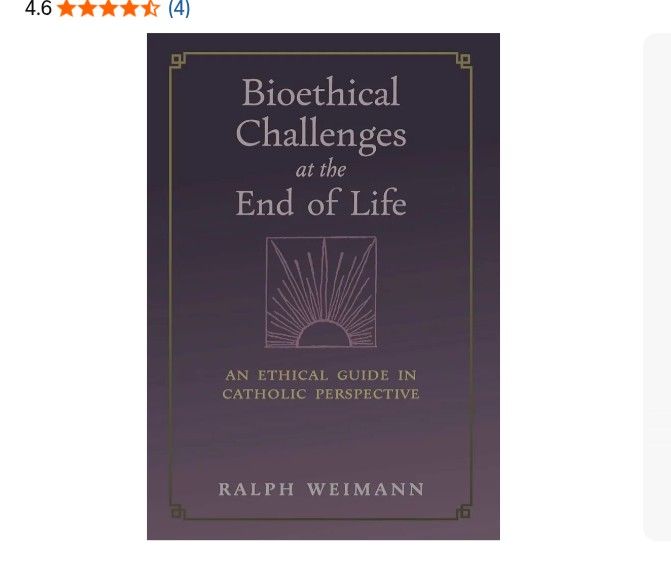
Fr. Ralph Weimann’s new book Bioethical Challenges at the End of Life (New York: Angelico Press 2022) via Amazon.com.
End-of-life issues in our aging populations confuse many. At what point is dying a natural process that need not be impeded, and when is it wrong to withdraw life support?
Firstly, the problematic demographic situation of many countries, especially in the West, is due to an egoistic life-style, based on contraception and abortion, which, as the Second Vatican Council said, is a heinous crime (cf. GS 51).
Secondly, whenever human dignity is not respected at the beginning of life, it will certainly not be respected at the end of life. Acceptance of abortion necessarily leads to acceptance of euthanasia and assisted suicide.
Thirdly, social and economic pressures are increasing continuously, especially for the elderly and disabled. A “culture of death,” as Pope John Paul II called it, is on the rise. This forms the background for two extreme positions: On the one hand, there is a kind of “therapeutic obstinacy” — difficult to define, it refers to the application of medical interventions on someone who is already practically dead, or their application in a way that is disproportionate to the foreseeable effects. Therapeutic obstinacy prolongs unnecessarily the process of dying. On the other hand, at the opposite extreme, life is intentionally terminated, whether voluntarily or involuntarily. Both extremes create anxiety.
It is not possible to answer in much detail here, but a more extensive explanation can be found in my book Bioethical Challenges at the End of Life (New York: Angelico Press 2022). Nevertheless, the following general criteria apply: everything possible must be done, but only the possible and in the best way possible. Thus, therapeutic measures and palliative care have to be proportionate and administered in the right way, so that they correspond to the twofold dimension of the principle of justice: 1) to promote human life, respecting human dignity, and 2) to avoid harming oneself or another.
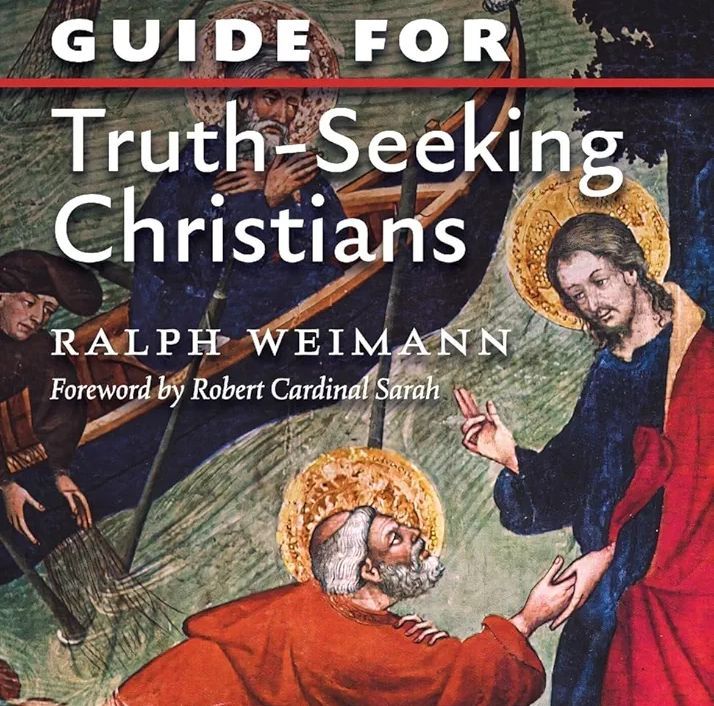
“It is to the credit of Fr. Ralph Weimann, a theologian who lives in today’s world and is particularly attentive to the current challenges of the Church, but at the same time deeply rooted in the great tradition of the Church, to have made a valuable contribution in this regard with this book. The purpose of this book is to offer a guide to show the way to Jesus Christ, the Son of the living God. To this end, in a first step, the common prejudices that supposedly speak against the faith and the Church are outlined in each chapter. In a second step, they are given an answer, based on Sacred Scripture and Tradition.
Therefore, this book is a valuable help especially for disoriented believers and is also useful for every Catholic who wants to be prepared to “explain” his faith.
THE GOAL OF THIS BOOK IS TO PROVIDE A guide for all people of good will and to show them the
way to Jesus Christ, the Son of the living God. To this end, common criticisms that are leveled against the faith and the Church are
examined. Each of these are then countered and addressed based on Sacred Scripture and Tradition.
This book is a valuable tool especially for truth seeking Christians and is also useful for every
Catholic who wants to be prepared to “explain” his or her faith.
Born in 1976, FR. RALPH WEIMANN holds a doctorate in theology and in bioethics. He teaches at the University of St. Thomas Aquinas (Angelicum) in Rome, among other places. Anchored in fidelity to Catholic tradition and informed by international exchange,
Fr. Weimann places faith and theology at the center of the Church to provide answers to the pressing spiritual problems of our time.
He is the author of the recently published book Sacramentals: Their Meaning and Spiritual Use.
The book Addresses:
Can the Truth be Known and Professed?
Faith: Is it More than a Pious Fairy Tale?
Can Everyone be Blessed According
to his Own Idea?
Does it Matter Which Religion
You Choose?.
Do Christians Have to be
Like Everyone Else?.
Are all People Children of God:
Why is Baptism Needed?.
Religion Yes, Church No?
Is the Catholic Church in Possession
of the Truth?
May the Church Prescribe
a Moral Code?
The Pope: Infallible?
Is the Church too Fixated on the
Sacraments?

