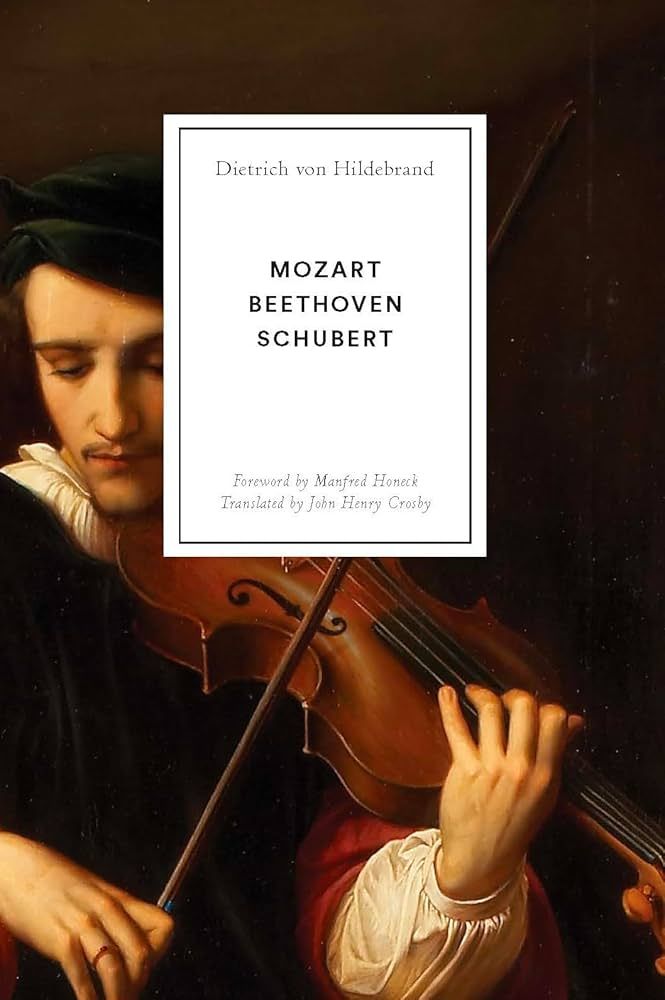
Foreword to Dietrich von Hildebrand’s book by Manfred Honeck (and see a conversation with Manfred Honeck on great composers below). He writes,
“THIS LITTLE BOOK IS A TREASURE, not only because it discusses three of the greatest composers, but also because the author is willing actually to engage with their music. It does not claim to be a modern musicological treatise. Rather, it invites one to listen closely so as to gain a deeper understanding of the music and its composers within the overall beauty of creation.
This approach makes Dietrich von Hildebrand’s consideration of the works of Mozart, Beethoven, and Schubert something extraordinary and special. The honesty with which the author ventures to speak of the great masters is also captivating. His conclusions are not influenced by clichés and the opinions of his time. He is committed only to what is revealed in the music, guided by a conscience that strives for God. Now this does not mean that everyone must come to the same conclusions, but in the search for the true, the good and the beautiful, a genuine, fruitful dialogue can emerge from different points of view. Let me take a brief look at the three composers myself, as I have been privileged to know them in my life as a musician.
With Mozart, beauty always shines; despite harmonic boldness and much drama, he never goes off the rails. He seems to understand human emotions like no one else, and he can capture them musically in a compelling way.
He is both humanly and musically credible. Yet his music remains mysterious. He who composed so effortlessly, allows his melodies, which always seem right, to fit into the whole with simplicity. He remains for me probably the most brilliant of the composers.
Beethoven is a revolutionary; he looks briefly to heaven, but first wants to remake the world. No one has notated so many sforzati: he shocks, sets new accents, and cares not about conventions. With him there are new standards, because he develops or intensifies the motif technique. With him, small motifs become whole movements, as for example in the famous Fate Motif of the Fifth Symphony. He was also someone who struggled to form his themes, as his notebooks attest. Here we encounter a master of variety the likes of which we have never seen since.
Though all three of the composers worked in Vienna, Schubert is the only one who was also born there. He lacks the renown and internationality that Mozart and Beethoven experienced through travel. In his themes we wander through loneliness, abandonment, longing, love, pain and death. He seems to be a bit lost in the world, not wanting to change it much either. His music is created for a small circle of friends; he is poor and has hardly any support from influential people. He speaks the language of the middle class—in his case Viennese—and captures the Viennese mentality in its Gemütlichkeit and melancholy. But those who mistake his approachability for ordinariness are mistaken: his genius unfolds from the seemingly ordinary, even as he prepares a dwelling for heaven.
These brief thoughts are intended to help the reader become attuned to Dietrich von Hildebrand’s rich and profound reflections. This will succeed best if the object to be contemplated is always before our eyes (or better, in our ears): the inimitable music of the three masters, which reveals something new with each new encounter, because what it reveals contains an unfathomable reflection of the glory of the Creator.
Manfred Honeck is music director of the Pittsburgh Symphony Orchestra and known internationally for his acclaimed performances and Grammy-winning recordings. Translator’s Preface
See also, “The loudest sound in the world cannot top the energy of a silence“.
Dietrich von Hildebrand’s consideration of the works of Mozart, Beethoven, and Schubert is something extraordinary and special. —Manfred Honeck
Subscribe to the leading leading review of the arts & intellectual life, The New Criterion. Receive ten issues of the print edition & free digital access on any device.

