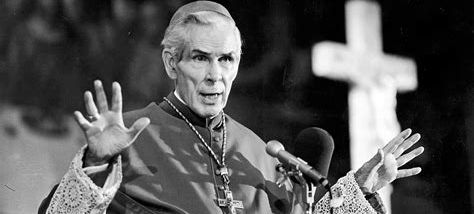
The Pillar wrote earlier this month: “The Holy See is expected to announce in coming weeks a date for the beatification of Archbishop Fulton Sheen, the Emmy-winning American prelate known for catechetical television programs in the 1950s and 1960s.
Sheen, who came within three weeks of a scheduled beatification in 2019, is expected to be formally beatified in September, according to sources close to the process.”
He was doubtless the greatest and most popular teacher of the Faith in the 20th century, and has been opposed by liberal clergymen precisely on account of his fidelity to the traditional Catholic Faith.
Sheen was a very influential American Catholic bishop known for his work in television and radio, particularly through his programs like “The Catholic Hour” and “Life Is Worth Living.” He was born on May 8, 1895, and his cause for canonization as a saint was officially opened in 2002, with significant progress made towards his beatification.
Beatification in Catholic theology is the process by which the Church recognizes a deceased person’s ability by grace to intercede for those who pray in their name. This declaration grants the individual the title of “Blessed” and allows for limited public veneration.
Canonization is the official process in the Catholic Church that declares a deceased person an exemplary saint, allowing for public veneration. This process involves several steps, including verifying miracles attributed to the person’s intercession and examining their life for evidence of holiness
Neo-modernists since his death have looked for pretexts to delay or deny his canonization because they openly wish to transvalue the teachings of the Sacred Scriptures and the Deposit of Catholic Faith, teachings which cannot ever change or “evolve” from one essential meaning to another. Sheen was a professor of philosophy at Catholic University and he warned the western world especially of the attempt to water down the Faith. His written publications and weekly media appearances served to highlight this greatest battle of our age.
“While a graduate student and university professor in the United States and Europe, Sheen made friends with a number of the great thinkers and writers of his day such as G.K. Chesterton, Christopher Dawson, J.R.R. Tolkien, and C.S. Lewis” and many more.

 Catholic Critique