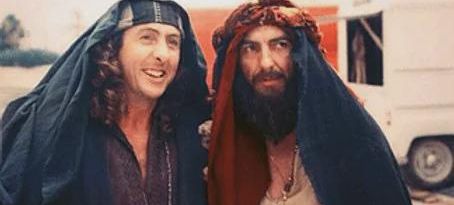
“George Harrison played a crucial role in the production of “Monty Python’s Life of Brian” (1979) by financing the film after EMI Films withdrew their support just before filming began. He mortgaged his home to provide the necessary funds, stating he wanted to see the movie made, which has been described as the “world’s most expensive cinema ticket.” Wikipedia Tumblr, Search Assist.
The crucifixion scene in “Monty Python’s Life of Brian” is a controversial moment where the act is portrayed humorously, with characters making light of the situation, which some critics felt mocked the suffering of Jesus. The scene culminates in a happy song, further emphasizing the film’s satirical take on serious themes like crucifixion and religious iconography.”
It concludes with Graham Chapman’s “Brian of Nazareth” hanging from a cross alongside numerous other condemned individuals. Rather than despairing, they launch into a cheerful rendition of Always Look on the Bright Side of Life, complete with a whimsical dance routine, which some speciously consider the point of the film against the tasteless backdrop of the holiest moment in salvation history.
I think the Python film is very likely a vicious response to Francis Zefferelli’s respectful and globally successful six hour series Jesus of Nazareth, starring British actor Robert Powell, just two years before. SH.
What follows is from Wikipedia.
Initial criticism and blasphemy accusations
Richard Webster comments in A Brief History of Blasphemy (1990) that “internalised censorship played a significant role in the handling” of Monty Python’s Life of Brian. In his view, “As a satire on religion, this film might well be considered a rather slight production. As blasphemy it was, even in its original version, extremely mild. Yet the film was surrounded from its inception by intense anxiety, in some quarters of the Establishment, about the offence it might cause. As a result it gained a certificate for general release only after some cuts had been made. Perhaps more importantly still, the film was shunned by the BBC and ITV, who declined to show it for fear of offending Christians in the UK. Once again a blasphemy was restrained – or its circulation effectively curtailed – not by the force of law but by the internalisation of this law.”[66] On its initial release in the UK, the film was banned by several town councils – some of which had no cinemas within their boundaries, or had not even seen the film. A member of Harrogate council, one of those that banned the film, revealed during a television interview that the council had not seen the film, and had based their opinion on what they had been told by the Nationwide Festival of Light, a grouping with an evangelical Christian base, of which they knew nothing.[13]
In New York (the film’s release in the US preceded British distribution), screenings were picketed by both rabbis and nuns (“Nuns with banners!” observed Michael Palin).[15] It was also banned for eight years in Ireland and for a year in Norway (it was marketed in Sweden as “The film that is so funny that it was banned in Norway”).[47] During the film’s theatrical run in Finland, a text explaining that the film was a parody of Hollywood historical epics was added to the opening credits.[67]
In the UK, Mary Whitehouse, and other traditionalist Christians, pamphleteered and picketed locations where the local cinema was screening the film, a campaign that was felt to have boosted publicity.[68] Leaflets arguing against the film’s representation of the New Testament (for example, suggesting that the Wise Men would not have approached the wrong stable as they do in the opening of the film) were documented in Robert Hewison‘s book Monty Python: The Case Against.
Crucifixion issue
One of the most controversial scenes was the film’s ending: Brian’s crucifixion. Many Christian protesters said that it was mocking Jesus’ suffering by turning it into a “Jolly Boys Outing” (such as when Mr Cheeky turns to Brian and says: “See, not so bad once you’re up!”), capped by Brian’s fellow sufferers suddenly bursting into song. This is reinforced by the fact that several characters throughout the film claim crucifixion is not as bad as it seems. For example, when Brian asks his cellmate in prison what will happen to him, he replies: “Oh, you’ll probably get away with crucifixion”. In another example, Matthias, an old man who works with the People’s Front of Judea, dismisses crucifixion as “a doddle” and says being stabbed would be worse.
The director, Terry Jones, issued the following response to this criticism: “Any religion that makes a form of torture into an icon that they worship seems to me a pretty sick sort of religion quite honestly.”[13] The Pythons also pointed out that crucifixion was a standard form of execution in ancient times and not just one especially reserved for Jesus.[69]

Responses from the cast
Shortly after the film was released, Cleese and Palin engaged in a debate on the BBC2 discussion programme Friday Night, Saturday Morning with Malcolm Muggeridge and Mervyn Stockwood, the Bishop of Southwark, who put forward arguments against the film. Muggeridge and Stockwood, it was later claimed, had arrived 15 minutes late to see a screening of the picture prior to the debate, missing the establishing scenes demonstrating that Brian and Jesus were two different characters, and hence contended that it was a send-up of Christ himself.[15] Both Pythons later felt that there had been a strange role reversal in the manner of the debate, with two young upstart comedians attempting to make serious, well-researched points, while the Establishment figures engaged in cheap jibes and point scoring. They also expressed disappointment in Muggeridge, whom all in Python had previously respected as a satirist (he had recently converted to Christianity after meeting Mother Teresa and experiencing what he described as a miracle). Cleese stated that his reputation had “plummeted” in his eyes, while Palin commented, “He was just being Muggeridge, preferring to have a very strong contrary opinion as opposed to none at all.”[15] Muggeridge’s verdict on the film was that it was “Such a tenth-rate film that it couldn’t possibly destroy anyone’s genuine faith.” In a 2013 interview on BBC Radio 4, Cleese stated that having recently watched the discussion again he “was astonished, first of all, at how stupid [the two members of the Church] were, and how boring the debate became”. He added: “I think the sad thing was that there was absolutely no attempt at a proper discussion – no attempt to find any common ground.”[70]
We always stated Brian wasn’t blasphemous, but heretical. It wasn’t about what Christ was saying, but about the people who followed Him – the ones who for the next 2,000 years would torture and kill each other because they couldn’t agree on what He was saying about peace and love.”
—Terry Jones speaking in 2011.[16]
Right. Sure. SH.

