
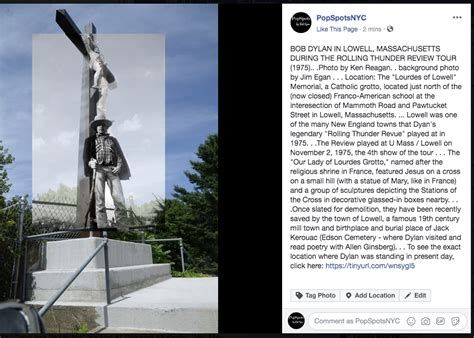
“Towards the end of the show someone out in the crowd … knew I wasn’t feeling too well,” recalled Dylan in a 1979 interview. “I think they could see that. And they threw a silver cross on the stage. Now usually I don’t pick things up in front of the stage. Once in a while I do. Sometimes I don’t. But I looked down at that cross. I said, ‘I gotta pick that up.’ So I picked up the cross and I put it in my pocket … And I brought it backstage and I brought it with me to the next town, which was out in Arizona … I was feeling even worse than I’d felt when I was in San Diego. I said, ‘Well, I need something tonight.’ I didn’t know what it was. I was used to all kinds of things. I said, ‘I need something tonight that I didn’t have before.’ And I looked in my pocket and I had this cross.”[6] — Bob Dylan
Did he persevere? Years after recording Slow Train Dylan affirmed in interviews that he believes in the Resurrection of Jesus. But he also got back in touch with his Jewish background.
In Murder Most Foul (2020) Dylan said of the JFK assassination event, “The age of the Antichrist has only just begun,” (2 Thess 2) reflecting his continued eschatological beliefs.
I surmise from all of this that Dylan is still working through many different kinds of confusions and complexities while completely rejecting atheism. This is not unusual for humans beings. But there is a difference between existential uncertainty and cynical doubt. (The dark night of the soul can seem very much like atheism). Especially for Dylan who is no cynic. According to Jeffrey Edward Green,
“The conflict between selfhood and God—Dylan’s wrestling with religion, his inability to achieve a consistent skepticism or a consistent faith, his inability to decide ultimately whether his religiosity stems only from his own mind or from his attunement to realities transcending it—is a call to see both religion and non-religion as equally compelling existential choices and thus to contest atheists when they fail to respect the integrity and dignity of religious life…
“The problem for Dylan is not just that ordinary civic action is woefully inadequate to achieve peace and social justice, but that politics itself—politicians and conventional political spaces like courts, parliaments, and so forth—is reflective of the fallen conditions of the world… Dylan’s depiction of politicians is uniformly negative, pointing to corruption, selfish power-seeking, and unfair plutocratic relations.

Consider the following example from “I Want You”:
The drunken politician leaps Upon the street where mothers weep
From “Band of the Hand”:
There are pimps on the make, politicians on the take
These lyrics from “Summer Days”:
Politician got on his jogging shoes. He must be running for office, got no time to lose He been suckin’ the blood out of the genius of generosity
From “It’s All Good”:
Big politician telling lies And from “Pay in Blood”: Another politician pumping out the piss
— Jeffrey Edward Green, Prophet Without God, Oxford University Press
Bob Dylan, then, does not expect redemption to come from within this fallen world. And that has irked the political Left since the 1960s. So while Dylan may be back-and-forth about religion in general and his own personal faith in particular, he has not denied either Jesus Christ or the Jewish foundation from which He emerged. / SH.

