
Note: Citing what I regard as a significant insight from an important author clearly does not imply an unconditional endorsement of the author’s entire philosophy, theology or worldview. SH
~~
— Excerpt from Mariology by Michael Schmaus in The Concise Sacramentum Mundi edited by theologian Karl Rahner. Michael Schmaus (17 July 1897 – 8 December 1993) was a German Roman Catholic theologian specializing in dogmatics.
“Since Mary and her work are entirely dependent on Christ, the Mariological treatise cannot but be an appendix to Christology. But since Mary is the spiritual mother of the faithful, the most excellent member of the Church and indeed the beginning and the archetype of the.Church (cf. Rev 12), the Mariological treatise can also be prefixed to ecclesiology or appended to it.
When medieval theologians made Mariological assertions within the framework of systematic theology, such assertions were inserted into Christology. See, for instance, Thomas Aquinas, Summa Theologica, III, q. 27-30, or the Commentaries on the Sentences, where Mariological questions are dealt with in the third book.
The plan of Thomas Aquinas is to discuss the hypostatic union and its salvific consequences and then to deal with the life and actions of Jesus. The Mariological assertions are meant to throw light on part of Jesus’ life, his.entry into the world. The doctrine of his conception and birth as well as that of his work demanded some knowledge of the woman in whose bosom the conception took place.
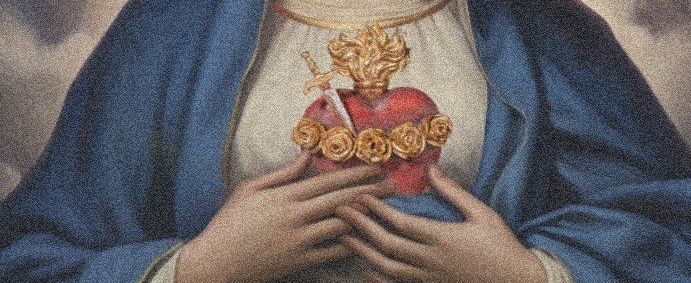
Everything, no doubt, which is said of Mary occurs in a Christological.context. But one cannot reasonably speak of the Son of God made man, of his belonging to the human race, of his situation in human history, without thinking of how he was inserted into history, of his continuity and his dis- continuity in its regard. This is particularly clear from Matthew and Luke.
Truths of faith with regard to Mary form part of the truths of faith with regard to Christ, as may be seen from the articles of the creeds of the Church which speak of Jesus Christ as “born of the Virgin Mary”.
Here the assertions of the faith of the Church with regard to Mary are clearly linked with Christology. That Mariological assertions should occur in theology from the earliest times is quite understandable…
In the course of history the following notions have come to the fore as characteristic of the
basic principle of Mariology:
Mary as the second Eve, Mary as the most fully
redeemed, Mary as archetype of the Church (Rev. 12).
Mary as mother of the Church, Mary as bridal mother of God or Mary simply as mother of the Son of God made man.
What is most in keeping with the Catholic tradition is the notion of the maternity of Mary and of Mary as archetype of the Church. But it would seem that the notion of the divine motherhood is what answers best the demands which must be made on God the basic principle.
In Mary’s assent, which was predefined by God, humanity itself accepts the grace of redemption”.
[i.e., humanity accepts the grace of redemption, wrought by the Cross and Blood of Christ, for the first time. For Mary who gave birth to the Son of God was the Lord’s first believer, His first disciple, who followed with him beyond his first miracle at Cana all the way to the Cross where the Blood she infused in Him in her holy womb was shed for us and our salvation. She continued to follow Him through the darkness of Good Friday and Holy Saturday unto the traumatic Joy of the Resurrection, and then, after forty days, to His Ascension into Heaven.
And from this sacred moment she persevered with all The Twelve to the Event of Pentecost which was the sacred beginning of the Church’s mission into all the world until the consummation of all things at the end of time. — SH]

Fr. Karl Rahner was born on March 5, 1904, in the city of Freiburg im Breisgau, Germany, the fourth of seven children in the family of Karl and Luise (Trescher) Rahner. Upon graduation from secondary school at the age of eighteen, Rahner followed in the footsteps of his elder brother Hugo and entered the Society of Jesus; he was to remain a Jesuit his entire life. During his novitiate studies from 1924 to 1927, Rahner was introduced to Catholic scholastic philosophy and to the modern German philosophers. He seems especially to have been influenced by the work of Joseph Maréchal (1878–1944), the Belgian philosopher and Jesuit, whose adoption of Kant’s transcendental method in his five-volume work, Le point de départ de la métaphysique, had led to somewhat of a breakthrough in the appreciation of Kant’s philosophy among neo-Scholastics. Maréchal was known as the “father of transcendental Thomism” for his use of St. Thomas Aquinas’s epistemology in an attempt to demonstrate that the metaphysical world Kant had secured for practical reason was already inherent in the theoretical. — Encyclopedia.com

 Catholic Critique