
…and Epistemology.
[P]hilosophy and religion deal with the same basic questions. Christians, and especially evangelical Christians, have tended to forget this. Philosophy and religion do not deal with different questions, though they give different answers and in different terms.
The basic questions of both philosophy and religion (and I mean religion here in the wide sense, including Christianity) are the questions of being: that is, what exists; man and his dilemma—that is, morals; and of how man knows.
Philosophy deals with these points, but so does religion, including orthodox evangelical Christianity. The second general observation concerns the two meanings of the word “philosophy,” which must be kept absolutely separate if we are to avoid confusion. The first meaning is a discipline, an academic subject. That is what we usually think of as philosophy: a highly technical study which few people pursue. In this sense, few people are philosophers.
But there is a second meaning that we must not miss if we are going to understand the problem of preaching the gospel in the twentieth century world. For philosophy also means a man’s worldview. In this sense, all men are philosophers, for all men have a worldview. This is just as true of the man digging a ditch as it is of the philosopher in the university. Christians have tended to despise the concept of philosophy. This has been one of the weaknesses of evangelical, orthodox Christianity—we have been proud in despising philosophy, and we have been exceedingly proud in despising the intellectual.
Our theological seminaries hardly ever relate their theology to philosophy, and specifically to the current philosophy. Thus, men go out from the theological seminaries not knowing how to relate it. It is not that they do not know the answers, but my observation is that most men graduating from our theological seminaries do not know the questions. In fact, philosophy is universal in scope. No man can live without a worldview; therefore, there is no man who is not a philosopher.
There are not many possibilities in answer to the three basic areas of philosophic thought, but there is a great deal of possible detail surrounding the basic answers. It will help us tremendously—whether we are studying philosophy at university and feel buffeted to death, or whether we are trying to be ministers of the gospel, speaking to people with a worldview—if we realize that although there are many possible details, the possible answers—in their basic concepts—are exceedingly few. There are two classes of answers given to these questions.
1. The first class of answer is that there is no logical, rational answer. This is rather a phenomenon of our own generation. The question has come under “the line of despair.” I am not saying that nobody in the past had these views, but they were not the dominant view. Today it is much more dominant than it has ever been.
This is true not only among philosophers in their discussions, but it is equally true of discussions on the street corner, at the cafe, at the university dining room, or at the filling station. The solution commonly proposed is that there is no logical, rational answer—all is finally chaotic, irrational, and absurd. This view is expressed with great finesse in the existential world of thinking, and in the theater of the absurd. This is the philosophy, or worldview, of many people today. It is a part of the warp and woof of the thinking of our day that there are no answers, that everything is irrational and absurd.
If a man held that everything is meaningless, nothing has answers, and there is no cause-and-effect relationship, and if he really held this position with any consistency, it would be very hard to refute. But in fact, no one can hold consistently that everything is chaotic and irrational and that there are no basic answers. It can be held theoretically, but it cannot be held in practice that everything is absolute chaos.
The first reason the irrational position cannot be held consistently in practice is the fact that the external world is there and it has form and order. It is not a chaotic world. If it were true that all is chaotic, unrelated, and absurd, science, as well as general life, would come to an end. To live at all is not possible except in the understanding that the universe that is there—the external universe—has a certain form, a certain order, and that man conforms to that order and so he can live within it.
Perhaps you remember one of Godard’s movies, Pierrot le Fou, in which he has people going out through the windows, instead of through the doors. But the interesting thing is that they do not go out through the solid wall. Godard is really saying that although he has no answer, yet at the same time he cannot go out through that solid wall. This is merely his expression of the difficulty of holding that there is a totally chaotic universe while the external world has form and order. Sometimes people try to bring in a little bit of order, but as soon as you bring in a little bit of order, the first class of answer—that everything is meaningless, everything is irrational—is no longer self-consistent, and falls to the ground.
The view that everything is chaotic and there are no ultimate answers is held by many thinking people today, but in my experience they always hold it very selectively. Almost without exception (actually, I have never found an exception), they discuss rationally until they are losing the discussion and then they try to slip over into the answer of irrationality. But as soon as the one we are discussing with does that, we must point out to him that as soon as he becomes selective in his argument of irrationality, he makes his whole argument suspect.
Theoretically, the position of irrationalism can be held, but no one lives with it in regard either to the external world or the categories of his thought world and discussion. As a matter of fact, if this position were argued properly, all discussion would come to an end. Communication would end. We would have only a series of meaningless sounds— The theater of the absurd has said this, but it fails, because if you read and listen carefully to the theater of the absurd, it is always trying to communicate its view that one cannot communicate. There is always a communication about the statement that there is no communication. It is always selective, with pockets of order brought in somewhere along the line. Thus we see that this class of answer—that all things are irrational—is not an answer.
2. The second class of answer is that there is an answer that can be rationally and logically considered, which can be communicated to oneself in one’s thought world and communicated with others externally. In this chapter we will deal with metaphysics in the area of answers that can be discussed; later, we will deal with man in his dilemma, the area of morals, in relation to answers that can be discussed. So now, we are to consider such answers in the area of being, of existence. I have already said that there are not many basic answers, although there are variances of details within the answers.
Now, curiously enough, there are only three possible basic answers to this question that would be open to rational consideration. The basic answers are very, very few indeed. We are considering existence, the fact that something is there.
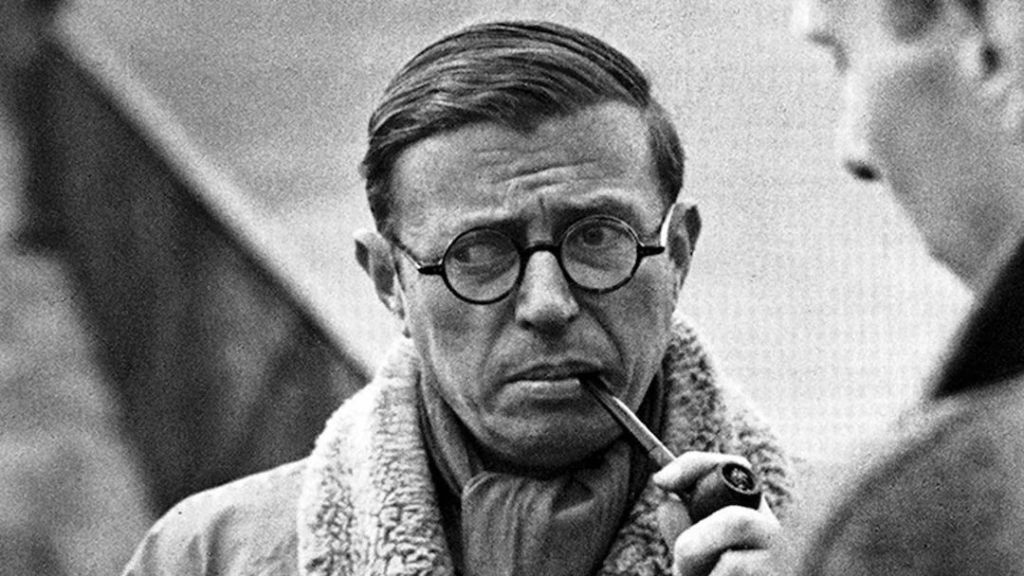
Remember Jean-Paul Sartre’s statement that the basic philosophic question is that something is there, rather than that nothing is there. The first basic answer is that everything that exists has come out of absolutely nothing. In other words, you begin with nothing. Now, to hold this view, it must be absolutely nothing. It must be what I call nothing-nothing. It cannot be nothing-something or something-nothing. If one is going to accept this answer, it must be nothing-nothing, which means there must be no energy, no mass, no motion, and no personality.
My description of nothing-nothing runs like this. Suppose we had a very black blackboard that had never been used. On this blackboard we drew a circle, and inside that circle there was everything that was—and there was nothing within the circle. Then we erase the circle. This is nothing-nothing.
You must not let anybody say he is giving an answer beginning with nothing and then really begin with something: energy, mass, motion, or personality. That would be something, and something is not nothing. The truth is, I have never heard this argument sustained, for it is unthinkable that all that now is has come out of utter nothing. But theoretically, that is the first possible answer.
The second possible answer in the area of existence is that all that now is had an impersonal beginning. This impersonality may be mass, energy, or motion, but they are all impersonal, and all equally impersonal. So it makes no basic philosophic difference which of them you begin with. Many modern men have implied that because they are beginning with energy particles, rather than old-fashioned mass, they have a better answer.
Salvador Dali did this as he moved from his surrealistic period into his new mysticism. But such men do not have a better answer. It is still impersonal. Energy is just as impersonal as mass or motion. As soon as you accept the impersonal beginning of all things, you are faced with some form of reductionism. Reductionism argues that everything there is now, from the stars to man himself, is finally to be understood by reducing it to the original, impersonal factor or factors.
The great problem with beginning with the impersonal is to find any meaning for the particulars. A particular is any individual factor, any individual thing—the separate parts of the whole. A drop of water is a particular, and so is a man. If we begin with the impersonal, then how do any of the particulars that now exist—including man—have any meaning and significance? Nobody has given us an answer to that.
In all the history of philosophical thought, whether from the East or the West, no one has given us an answer. Beginning with the impersonal, everything, including man, must be explained in terms of the impersonal plus time plus chance. Do not let anyone divert your mind at this point. There are no other factors in the formula, because there are no other factors that exist.
If we begin with an impersonal, we cannot then have some form of teleological concept. No one has ever demonstrated how time plus chance, beginning with an impersonal, can produce the needed complexity of the universe, let alone the personality of man. No one has given us a clue to this. —- From He is There and He is Not Silent, 1972

 Catholic Critique