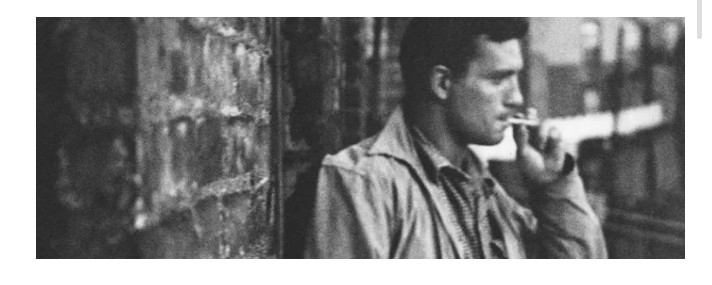
“Jack Kerouac was born Jean Louis Lebris de Kerouac in 1922 and grew up in the small working-class town of Lowell, Massachusetts. His ancestors were French-Canadians, and in his later years his genealogy would become very important to him, as the many references to it in his writings and interviews attest. He believed that his ancient ancestors were Celts who had come from Ireland first to Cornwall and then to Brittany.
He identified with the Vendean royalist rebels who opposed the French revolution, who fought for “above all the reopening of their parish churches with their former priests.” From there his ancestors crossed the ocean to the new world, settling in Canada. He also believed that he had Iroquois blood. Many of Kerouac’s novels concern his childhood in Lowell. There is Dr. Sax, written almost simultaneously with On The Road, which is a kind of childhood mythology centered around a mysterious figure called Dr. Sax and a “world serpent” as in Nordic mythology. There is also Visions of Gerard, a moving tribute to his older brother who died of rheumatic fever at nine years of age.
Finally, Maggie Cassidy is the sweet story of a high school romance in a small town. His mother Gabrielle was a devout Catholic, and she passed her piety on to her son. The Catholic tradition and worldview was one of the largest and most enduring influences on Kerouac, and although he is more often remembered today for his brief but public proclamation of Buddhism in the late 1950s, he never really left the Church.
When the Paris Review asked him why he wrote about Buddha but not Jesus, he responded incredulously, “I’ve never written about Jesus? … all I write about is Jesus.” He was not being flip — the themes and concerns of Catholic theology run very deep all throughout his works. His early concern with matters of faith is well-documented in Windblown World, his work journals from the writing of The Town and the City, which make clear that he saw his writing as a service to God, and that he approached his craft with the discipline of a monk.
Columbia University at that time was.the headquarters of the Frankfurt School.of critical theory, which had moved to.New York in 1935, after being kicked out.of Europe by the National Socialists. The.young, healthy, and patriotic Jack Kerouac.thus found himself right at ground zero of Antonio Gramsci’s “long march through the institutions.” He writes indignantly in Vanity of Duluoz, “what did Columbia College offer me to study in the way of a course of theirs called Contemporary Civilization but the works of Marx, Engels, Lenin, Russell and other assorted blue-printings that.look good on blue paper and all the time the architect is that invisible monster known as Living Man?”
⁶Like many others, he experimented with Blake’s maxim that “the road of excess leads to the palace of wisdom.”
Seduced and Repulsed
One of the most popular movements of the time was Existentialism, which spoke to these pervasive feelings of insecurity with its themes of alien-
ation, despair, absurdity, and meaninglessness. This is the intellectual climate that Kerouac found at university, and he was both seduced and repulsed by it. On the one hand, it resonated with the tragic view of life that he had developed both from Catholicism and from his experiences of poverty, hardship, and death. On the other, his vitalist impulses towards joy and ecstasy and celebration instinctively rebelled against it.
These two opposing moods or currents warred inside of Kerouac all his life. Both found expression in his writing – a surging, vigorous love of life, and a compassionate sadness that stemmed from a recognition of life’s impermanence and fragility. In his best moments, he achieves a kind of healthy balance that is akin to the tragic joy of the ancients. But all too often he veers too far in one direction or the other, oscillating between manic hyper-appreciation and hopeless melancholy.
— from Jack Kerouac and the Decline of the West by Semmelweiss
Note; I was born and lived most of my life in Jack Kerouac’s hometown, Lowell, Massachusetts. Though my friends and I never met him, he was something of an omnipresent specter to my closest friend then, Dennis Murphy, who introduced me to his writing, and a few others of us. We knew he ended a mess. But we also knew that he boasted of being Catholic on national television near the end of his life, he prayed on his knees the Stations of the Cross behind Lowell’s Franco-American School, a nun told me, and earlier he broke from the Uber decadence of Ginsberg and the other Beats. His greatest love was his mother. They waited on each other for many years and he loved her to the end..
“…and may the souls of the faithfully departed Rest in Peace” +

