By Victor Bruno | New Oxford Review, October 2025
Victor Bruno is an author whose writing has been featured in VoegelinView, The Political Science Reviewer, In Medias Res, Sacred Web, The Fortnightly Review, and elsewhere. He has two books published in Portuguese, the latest being René Guénon Revelado (2023). He also writes the newsletter Cartas da Tradição on Substack.
He probably didn’t need to do it. At first glance, he doesn’t look the part. He has a warm smile, a rosy complexion, and eyes that have a happy, joyful glint. He seems to embody the expression “good man.” In his official portrait he’s wearing the traditional black episcopal regalia and the venerable San Damiano pectoral cross. Had he used Pope Francis’s “pastoral cross,” showing not the Crucified Christ but Christ the Shepherd, you could perhaps say, “Well, we all saw it coming.” But he didn’t, so you couldn’t.
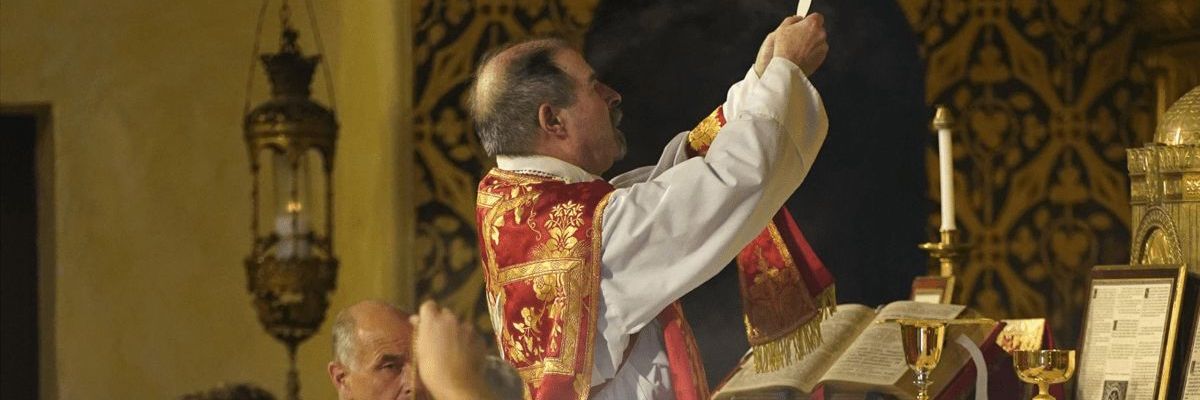
Nevertheless, that smiling, seemingly harmless and reasonably moderate new bishop, the Most Excellent Michael T. Martin, O.F.M. Conv., pulled the plug on the Traditional Latin Mass in the Diocese of Charlotte, North Carolina.
Juridically, Bishop Martin was more than justified. In his official statement, he said he was doing nothing more than implementing, as obedience to Rome required, the norms of Traditionis Custodes, Pope Francis’s controversial motu proprio that put an end to the liberties of Summorum Pontificum, Pope Benedict XVI’s motu proprio that allowed parish priests to celebrate the Traditional Latin Mass (TLM) without episcopal approval. This meant sending all TLMs in his diocese to a chapel in Mooresville, some 30 miles from downtown Charlotte. Though His Excellency said “the name of the chapel is yet to be determined,” it has a name. It’s the Freedom Christian Center, formerly a Protestant gathering place.

Could the bishop have been any clearer? The TLM is not welcome in his diocese. What followed was fierce uproar. There was no shortage of commentators giving their views on the subject, and the absolute majority was negative. The traditionalist community is, after all, as vocal as it gets on the Internet.
Disagreement and animosity are one thing, especially in a diocese where traditionalism has a deep foothold. But the controversy has revealed — yet again — the strange beliefs among traditionalists that Catholicism is the TLM, meaning that an assault against the Mass is an assault against the Church herself, and that access to the TLM is a God-given right. In fact, popular author Peter Kwasniewski wrote a book titled Reclaiming Our Roman Catholic Birthright (2020). Kwasniewski is the dean of what might be called “TLMism,” the branch of traditionalism that’s centered on the primacy of the TLM, and his book is not about religious vs. civil life, or the natural law vs. the secular state, all traditional Catholic issues. It’s about the Mass.
In Kwasniewski’s view, Catholics have a birthright to the Church’s traditions, and these coalesce in the old liturgy, which, he says in his book The Once and Future Roman Rite (2022), “took centuries to reach perfection.” Drawing on St. Vincent de Lérins, Kwasniewski argues that the Church goes through a growth (profectus) from infancy to maturity, like a biological entity. However, unlike in biology, there’s no decay and death in the Church’s case because she is the Church of Christ, who conquered death. “Her liturgy likewise,” Kwasniewski says, “develops under the guidance of Divine Providence, under the breath of the Holy Spirit, the Lord and the giver of life, making present anew the mysteries of the glorified Christ who has conquered death and lives forever. As a consequence, this liturgy, in its broad lines and beloved details, grows from strength to strength, from glory to glory, until it reaches a stature that may be considered its mature form, like that of a thirty-three-year-old man” (emphasis in original).
In other words, after reaching the fullness of age, the liturgy will cease to change. Then, at the end of time, the liturgy will be absorbed into the heavenly liturgy.
A peculiar understanding of the axiom lex orandi, lex credendi (the law of what is prayed is the law of what is believed) buttresses this view, which squares the Church with the TLM, in which liturgical development and ecclesiastical development are one and the same thing. The law the Church prays today, however, is almost universally prayed at the New Mass, the post-Vatican II Mass of Paul VI, which is, per Kwasniewski, corrupt (see below). Thus, he would say, the majority of today’s Catholics believe in a corrupt Church. Since the “official” Church chose to give up on the TLM for a corrupted liturgy, she is now “beside” herself.
This explains, in brief the mistrust the better part of TLMists feel toward Rome and its representatives. Non-traditional priests are the enemy, bishops are the enemy, most cardinals are the enemy, and even (and especially) the pope is the enemy. No need for him to be the current pope; Pius XII is an enemy to some, owing to his bulldozing of the octaves and changing the Holy Week liturgy in the 1950s. TLMists call this “recognizing but resisting” the visible hierarchy. They feel they have no other choice but to congregate around the TLM as the exceptional source of public life in the Church.
In short, TLMists exist in relative separation from the Church as institution and magistery, viewing her as corrupted and generally untrustworthy. If applying the word corrupt to the Church — the One, Holy, Catholic, and Apostolic Church — raises eyebrows, let it be known that that’s how Kwasniewski describes the New Mass, the Church’s ordinary form of worship, in Noble Beauty, Transcendent Holiness (2017). He calls it “a corruption from which the Church needs to be restored.”
Subscribe to the New Oxford Review
~~


 Catholic Critique