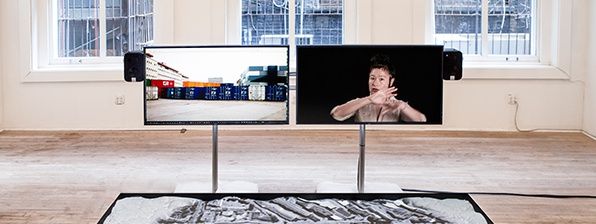
Digital media analyst Hito Steyerl in another context has stumbled onto important, undeniable truths. She writes,
In this new age of artificial stupidity, technological disruption has turned destructive. Its greatest victim is reality itself.
“This rise of artificial stupidity is the antithesis of, or rather the millions of shabby little cousins to, artificial intelligence. Just as socialism in practice has been a far cry from the glorious promises of revolutionaries, artificial stupidity is a mediocre and greedy version of the sublime machine intelligence intended to elevate and improve human life.
All sorts of minor communication applications are artificial stupidities. And though they may not seem impressive, their real-world effects are baffling: the destruction of public discourse and the polarization of populations; wages and hours managed by algorithms; customer service, clerical, counseling or legal work eliminated by virtual assistants or chatbots.
Even simple things, such as buying a ticket for a plane, train or concert, have become arduous and frustrating chores in an era of targeted, opaque pricing. Instead of a common reality and a set of rules that apply to everyone, we have frustration, dysfunction and a waste of precious time and energy.
And automation is not alone in chipping away at modern society. The few platforms that effectively own the digital communication sphere today operate without serious checks and balances, or even basic competition in an open market. Their algorithms are proprietary and unknown. There are few alternatives, if any, for consumers.
The result is an endless cycle of broken news and quarter-truths, stretched and repurposed ad nauseam, because in the age of artificial stupidity, truth is traded for popularity and reach.
The norms of reality TV have found a foothold in the digital age. The point is not that there is no reality — the point is that it’s every fact for itself, competing against all others, while social media multiply alternative versions of it. If you don’t like the reality you are facing, there is always another one, custom-made for your preferences.
This is our real, existing digital world: nothing more than hourly waves of feverish and toxic agitation, played out over stale mainstream [media] that discourage innovation and experimentation, drown in excruciating advertisements and drain people’s attention and souls.

An unpopular truth cannot survive online in such a world, because traction is privileged over veracity. And to artificially stupid automatons and algorithms, reality is defined as brute quantity, by ranking, ratings and elimination.
The truth doesn’t fit into that mold.
The truth is a piece of work with unruly and messy details that nevertheless require attention and never fully add up. It is usually much too complicated to be entertaining, and it may not be to everyone’s liking at all. It may not make things easier or more efficient — quite the opposite, in fact. If truth is not a marketable item, like clean environments or livable neighborhoods, the platforms that manage digital communication seem to show little interest in maintaining it, letting broken news propagate…
There are many short-term solutions to help prevent the further onslaught of broken news. Challenging or regulating monopoly platforms is one of them. Making their algorithms transparent and open to public assessment, legislation and debate is another. We can ban bots and anonymous accounts from social media, and strengthen institutions with durable and tested rules to establish and confirm facts.
But we cannot have our factuality cake and eat it too. Truth will rarely be popular or profitable. To expect its popularity to correspond to its veracity is not even artificially stupid, but just stupid.” — NYT Dec. 5, 2018
And I would only add, not merely stupid but also dangerous to psyches and moral governance.
Hito Steyerl (born 1 January 1966) is a German filmmaker, moving image artist, writer, and innovator of the essay documentary.[1] Her principal topics of interest are media, technology, and the global circulation of images. Steyerl holds a PhD in philosophy from the Academy of Fine Arts Vienna.[1] She has been a professor of Current Digital Media at the Academy of Fine Arts in Munich since 2024.[2] Until 2024, she was a professor of New Media Art at the Berlin University of the Arts, where she co-founded the Research Center for Proxy Politics, together with Vera Tollmann and Boaz Levin.[1][3]

