
Updated. What is the political Left hiding? “The French Revolution is the model”.
In this long-overdue episode of the New Discourses Podcast, host Dr. James Lindsay takes you through the main body of the Manifesto of the Communist Party: preface, chapter one, and chapter two. In a subsequent episodes (Volume Two in this mini-series) he will cover a later addition called “The Principles of Communism.” There is a lot here, and you won’t want to miss it.
An American-born author, mathematician, and professional troublemaker, Dr. James Lindsay has written six books spanning a range of subjects including religion, the philosophy of science and postmodern theory. He is a leading expert on Critical Race Theory, which leads him to reject it completely. He is the founder of New Discourses and currently promoting his new book “Cynical Theories: How Activist Scholarship Made Everything about Race, Gender, and Identity―and Why This Harms Everybody,” which is currently being translated into more than fifteen languages.
Note: Despite near total agreement everywhere else I do not agree with Lindsay’s brief remarks regarding his understanding of Distributism, as if the Catholic understanding of it is but a step away from Marxism. But more on that at a later date.
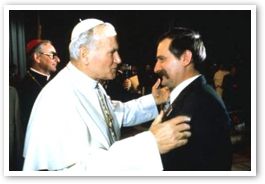
Saint Pope John Paul II and Lech Walesa
The year 1979 marked the beginning of the end for communism.
In January, Deng Xiaoping, having seized power just weeks before, began the economic reforms that would remake Chinese communism. On June 2, 1979, Pope John Paul II returned for his first papal visit to Poland with a more ambitious agenda. He wanted the Soviet communism in his homeland, and throughout Europe, utterly destroyed.
Ten years on, on June 4, 1989, history witnessed the fulfillment of those visions. In China, the 1980s were a decade of rapid economic growth, as the Chinese communists abandoned the supposed heart of communism, common ownership and the class struggle. Deng and his accomplices opted to keep the totalitarian politics. As the winds of liberty swept across the globe in the spring of 1989, Chinese protesters gathered to demand something more than just liberalized markets. They wanted liberty. Deng’s vision did not include that, and so the Chinese communists massacred their own people in Tiananmen Square.
In any other year, it would have been simply expected. The Maoist regime had been killing its people by the millions for decades. With a resumé of forced famines, laogai, cultural revolution, systematic suppression of all religious, political and legal liberties, monstrous violations of human rights in the name of population control — how else would one have expected the Chinese regime to react? It was thought that perhaps Deng had brought a new era, as though a desire for export-led development might lead to an importation of respect for human rights.
It didn’t. As Deng wound down his public life it was clear that the Chinese were willing, even eager, to jettison the central-planning economics that made communism unsustainable. That was the limit of the tyrant’s indulgence. To defend their totalitarian power, the Chinese would crush under their tanks anyone who thought liberty was more than just the freedom to sell cheap goods overseas. Twentyfive years later, the economy is still growing in China, but the winds of liberty still do not blow there. The air in China is both metaphorically and literally unbreathable, the polluted price the Chinese have paid for economic development in a totalitarian state.

On the day the tanks rolled over bodies in Tiananmen Square, millions of Poles were queuing up to vote in the first authentically democratic elections behind the Iron Curtain. Solidarity swept those elections, and before the year was out the winds of liberty had blown down the Berlin Wall. The next year Lech Walesa, the hero of Solidarity, was elected president of Poland and the year after that, the entire evil empire was gone, as the Soviet Union ceased to exist.
Given the choice between continuing sycophancy to a tyrant state and honouring Poland’s heroes, world leaders yesterday averted their eyes from Beijing and were present in Warsaw instead.
The lesson of June 4, 1989, is that history is never given. It is shaped by the courage or cowardice of people who can always make a choice…
“We remember how, when an Iron Curtain descended, you never accepted your fate,” U.S. president Barack Obama told his Polish audience. “When a son of Poland ascended to the Chair of Saint Peter, he returned home, and here, in Warsaw, he inspired a nation with his words — ‘There can be no just Europe without the independence of Poland.’ And today we give thanks for the courage of the Catholic Church and the fearless spirit of Saint John Paul II.”
The lesson of June 4, 1989, is that history is never given. It is shaped by the courage or cowardice of people who can always make a choice — even if that choice brings confinement, as it did for Walesa, or carnage, as it did in Tiananmen Square. China is not cursed by fate to remain a tyrant state, oppressing its people, even as neighbouring India is democratic, and Russia has been shorn of its empire.
That lesson is positively confirmed by Poland, where all the dramas of the 20th century took place. On June 4, 1989, Poles declared, in effect, that the horror of Europe’s 20th century, birthed in the First World War and Bolshevik Revolution, was over. With deference to Churchill and the English, and to the allies who mark the 70th anniversary of D-Day tomorrow, history will definitively judge that the Polish decade from June 2, 1979, to June 4, 1989, was indeed the 20th century’s finest hour.
Twenty-five years on, the choice facing nations remains as it was that day: Will our common life be marked by liberty ordered to moral truth, or by coercive power, even violence? The drama of June 4th remains and will shape the 21st century.
Saint Pope John Paul II and Lech Walesa. (More on dechristianization…)
~~~
Karl Marx[a] (German: [ˈkaʁl ˈmaʁks]; 5 May 1818 – 14 March 1883) was a German philosopher, political theorist, economist, journalist, and revolutionary socialist. He is best-known for the 1848 pamphlet The Communist Manifesto (written with Friedrich Engels), and his three-volume Das Kapital (1867–1894), a critique of classical political economy which employs his theory of historical materialism in an analysis of capitalism, in the culmination of his life’s work. Marx’s ideas and their subsequent development, collectively known as Marxism, have had enormous influence.”
Friedrich Engels[a] (/ˈɛŋɡəlz/ ENG-gəlz;[3][4][5] German: [ˈfʁiːdʁɪç ˈɛŋl̩s]; 28 November 1820 – 5 August 1895) was a German philosopher, political theorist, journalist, and revolutionary socialist. He was also a businessman and Karl Marx‘s lifelong friend and closest collaborator, serving as the co-founder of Marxism.”

