… and the New Pseudo Praxis.
Perhaps the most critical and classical difference between all forms of Protestantism and Catholicism lay in their respective understandings of the relationship between faith and good works. For Catholics, God’s saving work in Jesus Christ – the fruit of unmerited grace – issues in a changed heart and a life of good works; for a changed heart is, in Catholic theology, the very reason Christ died for us; that is, to make us holy unto salvation (Heb.4:12)
For classical Protestants, good works and holiness are of little or no consequence so far as one’s justification / salvation is concerned, for that is seen as the result of faith alone. Good works are merely attendant to faith and a sign of one’s justification which is wrought in believers by the predestined good pleasure of God in Christ Jesus.
Catholics and many Lutherans in recent years, it is said, have made significant progress toward seeing that the old formulas actually intended to say much the same thing (neither side denied the freedom of God’s grace or the need for holiness, for example) but each accented these important aspects and consequences in historically different ways. I don’t intend to revisit that precise argument here. But the old polemic is relevant in new contexts which is what I wish to point out.
In every era of the Church there have been various heresies and errors allowed by God to test His people and to bring about a clarification of revealed teaching. Our age is no exception. I would like to focus on two of these which, in some ways, are two sides of the same coin.
First, there is the sad fruit of an old development which, in some serious ways, has come home to roost. I am speaking here of the divergence of theology from sacred tradition and spirituality.
Secondly, there is the temptation to substitute good works, or praxis, for the Gospel itself, rather than seeing it as the indispensable fruit of the Gospel leading to salvation (Eph 2:8-10).
This is a new take on the old Pelagian heresy which sees grace as the fruit of our own autonomous free will and good works.
Long ago theology began separating
more and more in some circles from spirituality in the West. With the development of Catholic universities especially, and their emphasis on
theology as the queen of the sciences, there increased a temptation to reduce theology to an autonomous and largely academic discipline, practically apart from Christ. Thomas a Kempis in his The Imitation of Christ warned against this. Others did too.
Now, to the extent that theology is “faith seeking understanding,” it is legitimate, of course, that certain persons are called to serve the Church by specializing in theology in all of its many categories, whether that be dogmatic, Christological, moral, liturgical, spiritual, mystical, pastoral, and so on.
Theologians serve the Church by responsibly and faithfully putting new questions often posed by changing times to the Deposit of Faith, thus enabling the Living Magisterium (the Holy Father and the college of bishops with him) to authoritatively clarify revelation when it deems it right or necessary to do so.
No Pope or theologian, however, works for himself alone, and any notion of a novel and personal theology which a theologian seeks to set against the magisterium of the Church, is inherently contradictory from a traditional Catholic point of view. Such a notion of theology violates the principle of the Church’s communion, which is in no way competitive with, or contradictory to, the Church’s hierarchical constitution.

Thus a bona fide theologian should be called and affirmed by the Church, with Papal approval. He (or she, it is understood) does not call himself. The hierarchy must affirm the calling and recognize the theology as traditionally it’s own. For this is a high calling indeed. And when the theologian understands his vocation as being one in service to and facilitating the Church’s own communion, then there is maintained that proper unity between spirituality and theology.
True theology is humble, obedient, and places its findings before the Church. It does not insist on its own a priori correctness. Such a notion would be unthinkable. If contradictions appear to exist it sometimes prefers to wait for more reflection and clarification.
But alas, this unity can hardly be taken for granted today. Today we see far too many theologians and others operating as aggressive apologists for the zeitgeist, as though they could reduce revelation and all previous understandings of Faith and dogma to the historically conditioned ash heap, and re-creating brand new theologies on their own. This is far from the time-honored libertas of the Fathers, the legitimate differences between various approved schools of sacred theology which presupposed the Deposit and communion of Faith.
Under consideration here are new and radical points of departure which seek to redefine the Gospel itself; for example, in such fundamental matters as sex and gender and the notion of what constitutes family (and thus in each case the very nature of creation’s order).
When the Magisterium must finally correct such notions, often demonstrating great patience before doing so, we often hear these theologians crying foul, bandying about inflammatory words like “inquisition”. That such rhetoric is nonsense is shown by that very patience of the magisterium
when such radical notions could very well be justifiably subject to serious sanctions. Sometimes it takes several pontificates before a final decisive judgment is made.
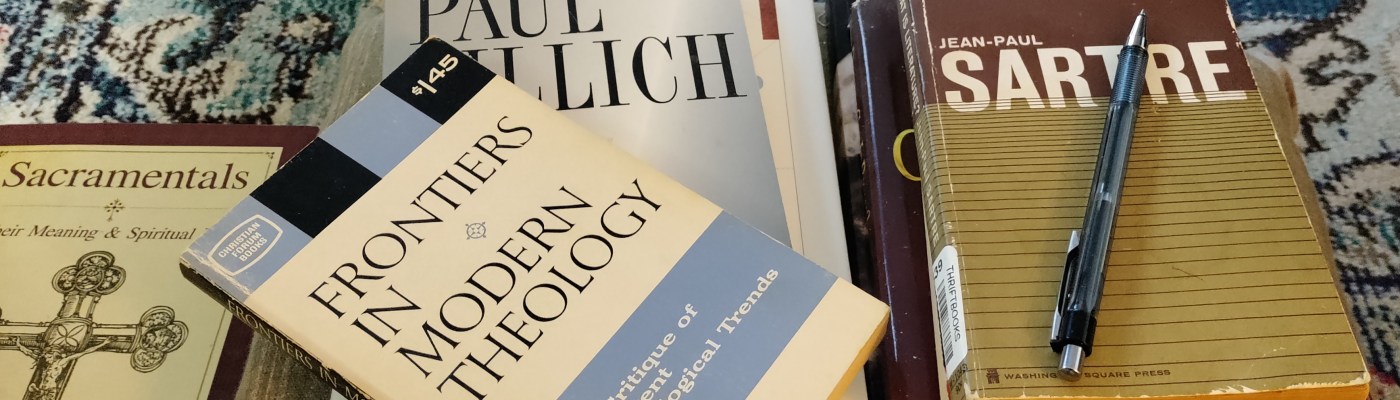
The fact is, it is possible to love theology more than God. Indeed it is possible to enjoy theology and theologizing and not even believe in the fundamentals of the Faith traditionally and biblically understood (consider Paul Tillich and Hans Kung for examples).
Today we hear theologians embracing and baptizing eccentric ideologies in conformity with the latest cultural trends, whether denouncing alleged “Patriarchal” theology or decrying “Augustinian / Fall” theology, proffering new species of faith in their place in which old theological terms and concepts are either dismissed outright or filled with new meanings. New “models of theology” have become common in Progressivist circles today.
Then there are others who proclaim that all religions are in essence metaphysically one. In such circles (sometimes at very high levels), which exist even in Catholicism today, we often find a rejection of Catholic biblical morality, the natural law, and a revealing obsession on sexual matters in which traditional moral theology is represented as antiquated.
Such is the language of those who seek a “new Jesus,” a “new Gospel” and “another Spirit” through a scissors and paste approach to biblical theology born of an alien application of so-called historical criticism (2 Cor 11:4).
Finally, and this brings me full circle to the opening comments about faith and works. A characteristic of “Progressive” cult theologies is the specious opposition between the Gospel of Mercy and the Deposit of Faith, which opposition is alien to Scripture and the whole Catholic tradition.
Judas himself may have appeared merciful, but his heart was far from the true teaching of Jesus.
The Church does indeed show a perennial love for the poor in this world, for this is the Way of her Lord and of the prophets before him. She has shown this love for over two thousand years in all of her Works of Mercy. She continues His healing and reconciling ministry in the world, until the end of time.
In more recent times, with the advent of nuclear weapons and the actual and potential destruction of whole civilian populations, not to mention the threat to the entire planet, a planet which has become so much smaller due to advances in transportation and communications, she has had to examine ever more closely the ways in which peoples seek to resolve conflicts. In so doing she has sought to apply the same Gospel’s message of peace in greater and greater contexts as the necessary alternative to war. The Church we know is come to proclaim liberty to the oppressed and to give release to the captives (Lk. 4:16-24). We are indeed called to be peacemakers (Mt 5:9).This is the teaching and fruit of the Gospel of Jesus Christ.
But when theologians or activists substitute good works for Church teachings, for the moral and natural laws, they sadly prostitute the fruits of the faith and sanctifying grace for their own selfish ends. Love then becomes a ruse, a cover and bait to deceive people away from the Church in the name of the Church.
We must never cease to show the Church’s preferential love for the poor. We laymen and laywomen, especially, must be involved in the corporal and spiritual works of mercy in imitation of our Lord who is the Light of a broken world. Even the sick can offer their sufferings for others in and through Christ Jesus (Col 1:24). But we must not follow false gods and directions which can only lead to the collapse of our spiritual immune systems and a pseudo peace which is in fact spiritual death. Truth and love are inseparable (Eph 4:15) and alone make us free. — SH

 Catholic Critique