
“We live in the time of no room, which is the time of the end. The time when everyone is obsessed with lack of time, lack of space, with saving time, conquering space, projecting into time and space the anguish produced within them by the technological furies of size, volume, quantity, speed, number, price, power and acceleration. The primordial blessing, “increase and multiply,” has suddenly become a hemorrhage of terror.
We are numbered in billions, and massed together, marshalled, numbered, marched here and there, taxed, drilled, armed, worked to the point of insensibility, dazed by information, drugged by entertainment, surfeited with everything, nauseated with the human race and with ourselves, nauseated with life.
As the end approaches, there is no room for nature. The cities crowd it off the face of the earth. As the end approaches, there is no room for quiet. There is no room for solitude. There is no room for thought. There is no room for attention, for the awareness of our state. In the time of the ultimate end, there is no room for man. Those that lament the fact that there is no room for God must also be called to account for this. Have they perhaps added to the general crush by preaching a solid marble God that makes man alien to himself, a God that settles himself grimly like an implacable object in the inner heart of man and drives man out of himself in despair?
The time of the end is the time of demons who occupy the heart (pretending to be gods) so that man himself finds no room for himself in himself. He finds no space to rest in his own heart, not because it is full, but because it is void. Yet if he knew that the void itself, when hovered over by the Spirit, is an abyss of creativity…. He cannot believe it. There is no room for belief.
There is no room for him in the massed crowds of the eschatological society, the society of the end, in which all those for whom there is no room are thrown together, thrust, pitched out bodily into a whirlpool of empty forms, human specters, swirling aimlessly through their cities, all wishing they had never been born. In the time of the end there is no longer room for the desire to go on living.
The time of the end is the time when men call upon the mountains to fall upon them, because they wish they did not exist. Why? Because they are part of a proliferation of life that is not fully alive, it is programmed for death. A life that has not been chosen, and can hardly be accepted, has no more room for hope. Yet it must pretend to go on hoping. It is haunted by the demon of emptiness.
And out of this unutterable void come the armies, the missiles, the weapons, the bombs, the concentration camps, the race riots, the racist murders, and all the other crimes of mass society. Is this pessimism?
Is this the unforgivable sin of admitting what everybody really feels? Is it pessimism to diagnose cancer as cancer? Or should one simply go on pretending that everything is getting better every day, because the time of the end is also—for some at any rate—the time of great prosperity? (“The Kings of the earth have joined in her idolatry and the traders of the earth have grown rich from her excessive luxury” (Revelations 18:3).
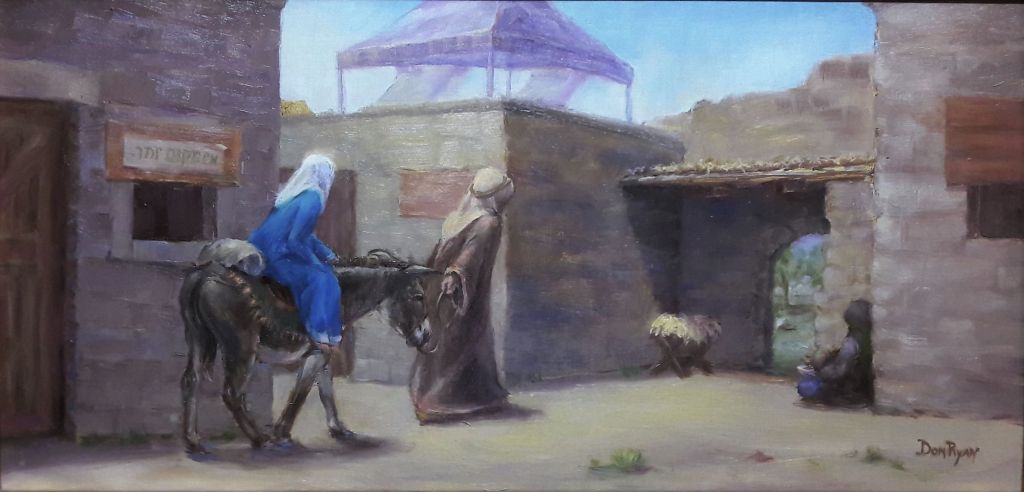
Into this world, this demented inn, in which there is absolutely no room for Him at all, Christ has come uninvited. But because He cannot be at home in it, because He is out of place in it, and yet He must be in it, His place is with those others for whom there is no room. His place is with those who do not belong, who are rejected by power because they are regarded as weak, those who are discredited, who are denied the status of persons, tortured, exterminated.
With those for whom there is no room, Christ is present in this world. He is mysteriously present in those for whom there seems to be nothing but the world at its worst. For them, there is no escape even in imagination. They cannot identify with the power structure of a crowded humanity which seeks to project itself outward, anywhere, in a centrifugal flight into the void, to get out there where there is no God, no man, no name, no identity, no weight, no self, nothing but the bright, self-directed, perfectly obedient and infinitely expensive machine.
For those who are stubborn enough, devoted enough to power, there remains this last apocalyptic myth of machinery propagating its own kind in the eschatological wilderness of space—while on earth the bombs make room!
But the others: they remain imprisoned in other hopes, and in more pedestrian despairs, despairs and hopes which are held down to earth, down to street level, and to the pavement only: desire to be at least half-human, to taste a little human joy, to do a fairly decent job of productive work, to come home to the family … desires for which there is no room.
It is in these that He hides Himself, for whom there is no room.
The time of the end? All right: when? That is not the question. To say it is the time of the end is to answer all the questions, for if it is the time of the end, and of great tribulation, then it is certainly and above all the time of The Great Joy. It is the time to “lift up your heads for your redemption is at hand.”
It is the time when the promise will be manifestly fulfilled, and no longer kept secret from anyone. It is the time for the joy that is given not as the world gives, and that no man can take away. For the true eschatological banquet is not that of the birds on the bodies of the slain. It is the feast of the living, the wedding banquet of the Lamb.
The true eschatological convocation is not the crowding of armies on the field of battle, but the summons of The Great Joy, the cry of deliverance:
“Come out of her my people that you may not share in her sins and suffer from her plagues!” (Revelations 18:4).
The cry of the time of the end was uttered also in the beginning by Lot in Sodom, to his sons-in-law: “Come, get out of this city, for the Lord will destroy it. But he seemed to them to be jesting” (Genesis 19:14). To leave the city of death and imprisonment is surely not bad news except to those who have so identified themselves with their captivity that they can conceive no other reality and no other condition. In such a case, there is nothing but tribulation: for while to stay in captivity is tragic, to break away from it is unthinkable—and so more tragic still.
What is needed then is the grace and courage to see that “The Great Tribulation” and “The Great Joy” are really inseparable, and that the “Tribulation” becomes “Joy” when it is seen as the Victory of Life over Death. True, there is a sense in which there is no room for Joy in this tribulation. To say there is “no room” for The Great Joy in the tribulation of “the end” is to say that the Evangelical joy must not be confused with the joys proposed by the world in the time of the end—and, we must admit it, these are no longer convincing as joys. They become now stoic duties and sacrifices to be offered without question for ends that cannot be descried just now, since there is too much smoke and the visibility is rather poor.
In the last analysis, the “joy” proposed by the time of the end is simply the satisfaction and the relief of getting it all over with … That is the demonic temptation of “the end.”
For eschatology is not finis and punishment, the winding up of accounts and the closing of books: it is the final beginning, the definitive birth into a new creation. It is not the last gasp of exhausted possibilities but the first taste of all that is beyond conceiving as actual.”
Thomas Merton, Raids On the Unspeakable
Note: Citing what I regard as a significant insight from an important author clearly does not imply an unconditional endorsement of the author’s entire philosophy or theology
+
+ Thomas Merton: A Devout Meditation in Memory of Adolph Eichmann
+ 20th Century Apocalypse: Feuersturm
+ Nixon tries to justify the bombing of Dresden
+ “No Conceivable…Justification”. Aerial warfare’s “dreadful weapons”
+ The Real Holocaust Narrative
+

+ Pilate asked, Are you the king of the Jews?
+
Catholic Critique
-30-
In sum then, this editor and sinner sides with Christ and the Cross — against all hubris, errors, Marxist principalities and powers — ever in sympathy with all persons of good will, whatever their persuasion and place on the journey of existence; ever in solidarity with the poor and sick of this world . Amen.
5.15.25. SH.
+ August 22, 2025: Pope Leo XIV casts out nature worship from Progressive local churches


[…] Thomas Merton, in Raids on the Unspeakable (essay quoted in full here) […]