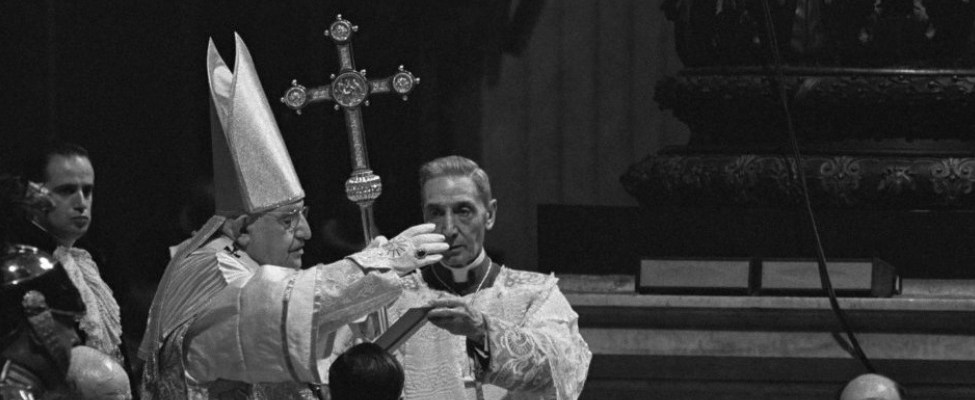
See also, John Paul II, Benedict XVI, and a New World Order.
Our complex theological predicament, which only the hierarchical Church may, in time, formally adjudicate.
By Stephen Hand.
2015. If Francis and Cardinal Kasper have taught us anything over the past few years, it’s that without resurrecting that final “checkmate,” which popes from the beginning used to protect the Faith from grave errors and outright heresies (I’m referring to the Anathema*), our problems will only repeat themselves, over and again.
Even the “Vatican Enforcer” Cardinal Joseph Ratzinger / BenedictXVI, who I believe was, in his own way, trying to dig our way out of trouble, never showed any indication that he disagreed with John XXIII who, in introducing the Second Vatican Council, said that in the past (like St. Paul, Gal 1:7-9) the Church condemned errors
“with the greatest severity. Nowadays, however, the spouse of Christ prefers to make use of the medicine of mercy rather than of severity. She considers that she meets the needs of the present day by demonstrating the validity of her teaching rather than by condemnations.”
Benedict was conservative. But he handled doctrinal errors mostly as academic problems that could be resolved through the dialectical give-and-take of academic discussion, and an occasional magisterial document—but largely without teeth. There was also in him, as in John Paul II, sometimes a confounding of personal theological opinion and the Catholic magisterial Tradition.
To Benedict’s great credit he made room for the criticisms of more traditional Catholics (some of which criticism he shared). And he even infuriated Progressives by making room in the Church again for the traditional Tridentine Latin Mass of the Saints and by expressing disdain for so much that passed for liturgy today. He deplored the widespread wrecking of altars and the often bizarre new Church architecture which spread across the world after Vatican II.
He was a quiet, conservative, intellectual man with classical tastes. But he was manacled by an unwillingness to break with pope John’s “medicine of mercy” approach. To do so would have made him seem like a repudiator of the “pastoral” Council itself.
And those “Progressives” who opposed his Conservative preferences took complete advantage of that failure.
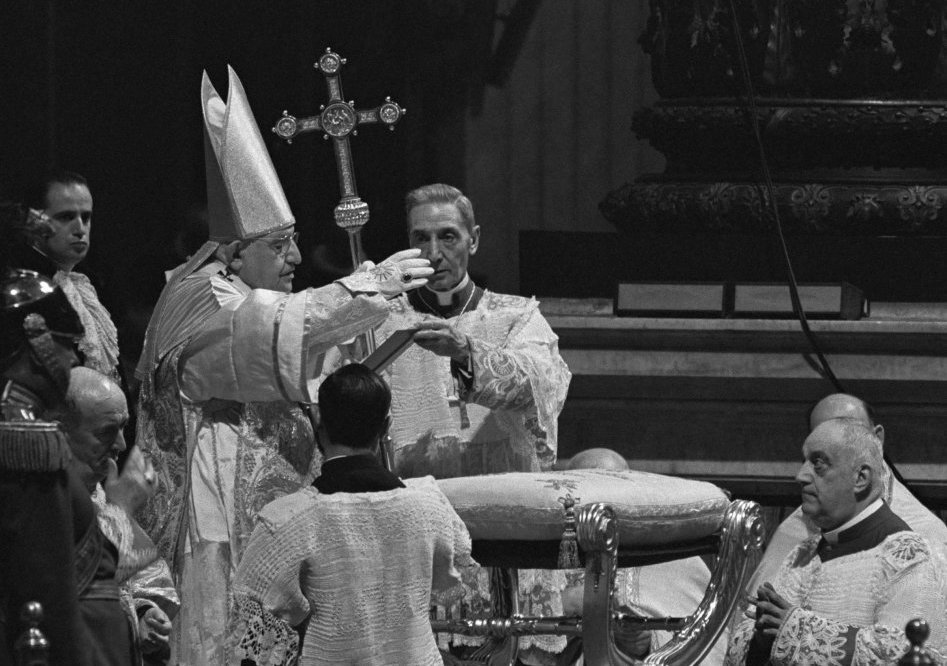
And so today we have lived to see chaos and incoherence ensue as the moral and dogmatic bedrocks of the Catholic Church have been made to tremble beneath our feet.
Our problem is hardly a deficit of mercy, or of new practical applications of it when in harmony with the Catholic dogmatic Tradition. It is far more.
Relativistic, dialectical and pluralistic
In the final analysis one might say that whatever their own personal preferences, even some (hardly all) Conservatives today can be, like Progressives, subjectivists (accepting opposing principles) and pluralistic theologically (few calls are heard from them for the revival of the traditional Anathema for instance). And therefore some of them (us) can be part of the problem. Many Progressives in turn, strange to say, are conservative in taste. Not all are wild or morally corrupt. Progressives too have their flanks and Parties. They even get some theological truths —which traditionalism has neglected or mistaken— right.
Benedict XVI, like John Paul II, was Conservative in some ways and yet Progressive in other ways.
Progressivist Subjectivism
Subjectivists (and all strident, pure Progressives are enthusiastic subjectivists) tolerate even truth, as long as error is also allowed its room to breathe. This is the error of Enlightenment liberalism with its worship of liberty, with which Vatican II sought to make peace. It is relativistic, dialectical and pluralistic.
The only thing that is anathema to such subjectivists is the Church’s traditional Anathema. Because that would rule them and their Enlightenment errors out quickly, if the Church’s Sacred Tradition and dogmatic patrimony is revived as the standard. Conservatives should openly deplore this fact more than they do.
Progressivism, subscribing to the Enlightenment historical-critical method of Scripture analysis (so-called, though hardly objective) teaches that dogmas naturally “evolve,” a notion that was condemned over and over by pre-conciliar Popes because “Jesus Christ is the same yesterday, today, and for ever” (Heb. 13:7). To implicitly suggest, as many modernists have done, that the Church got Our Lord wrong (and to imagine new ‘christ’s in new theologies) is simple unbelief and tacit neo-Arianism, a characteristic of modern Progressivism. Some go so far as to suggest with their Liberal Protestant counterparts, that St. Paul was the first to misunderstand who Jesus is, another condemned notion.
I’ve always accepted Vatican II as a legal Council protected by the Holy Spirit against unambiguous formal heresy. Michael Davies, for instance, taught the same. But was it always wise in its human formulations? Clearly not. It is a dilution, born of a naive or pernicious strategy that sought to reconcile opposite principles under a mischievous concept labeled “pastoral”. Both traditionalists and neomodernists took part. Ambiguity then has divided the Church and plunged her into incoherence.
On his deathbed it is reported that John XXIII said: “It is not that the gospel has changed; it is that we have begun to understand it better.”
Well, I suppose he thought so. But that this thought was preemptively condemned by Vatican I (one) does not seem to have occurred to him:
“…that meaning of the sacred dogmas is perpetually to be retained which our Holy Mother the Church has once declared. Nor is that meaning ever to be departed from, under the pretense or pretext of a deeper comprehension of them.”
And,
“Let then the intelligence, science, and wisdom of each and all, of individuals and of the whole Church, in all ages and at all times, increase and flourish in abundance and vigor; but simply in its own proper kind, that is to say, in one and the same doctrine, one and the same sense, one and the same judgment (Vincent of Lerins, Common. n, 28).”
Today
And over 50 years later? The story is so well known it is almost unnecessary to sketch what so many have known for so long (and none of this is in any way to deny the profound influences and impact of decadent cultural trends which had been building since the Second World War):
Religious Orders have been more than decimated, the new liturgy seems to have banished much sense of the Holy, the very Sacred, which was always a main grace-filled draw for Catholics and for very many outside the Church. Homilies today are all too often anemic at best or outright heretical at worst. Mass attendance has consequently plummeted in massive numbers, to the point where in the West churches close everywhere and once vibrant parishes are forced to merge every day. And this is to say nothing of morally corrupted clergy and Religious.
Theology today at the seminary, college and university levels ranges from the relatively orthodox to the incoherent trendy, to the outright heretical. And of course this means bishops and priests inevitably reflect that confusion in the pulpits and so laypersons hardly know what to think.
It was (until the 1960’s) always understood that dogmatic truth, derived from the Apostles and Sacred Scripture (and preserved in the traditional liturgy) must at all costs be protected as *the* most sacred trust. It was and is called The Deposit of Faith.
St. Paul warned against tampering with this treasure or watering it down in any way. Nor can we make doctrinal peace with opposing principles.
Gal 1:8 “If any one is preaching to you a gospel contrary to that which you received, let him be accursed (gk. “anathema”).”

There was never any perceived opposition between the Deposit of Faith and Charity and Mercy. Which is why pope John’s “new” prescription of mercy, cited above and echoed today by the openly Progressive-friendly Francis, was at first so puzzling after 20 centuries, and today we can see so mistaken or mischievous, a pastoral strategy. I suspect the Conservatives who followed were simply bewildered and / or mistaken while not a few Progressives were knowingly mischievous.
Reform
Catholics must quit conformity with the spirit of the times, restore dogmatic and traditional moral truths based on revelation to their preeminent, indispensable honor as the touchstone of Faith, and cease bizarrely opposing charity to it. And this necessarily will involve declaring many dubious or heretical opinions in theology as incompatible with Sacred Scripture and Catholic Tradition.
Not to do this would be to guarantee only more decline and more infiltrations and to raise even more suspicions with respect to the quality of our shepherds and their commitment to the Gospel of salvation. Without the Anathema Benedict must yield to (or pass over and let recede) Francis’ interpretations (++). This is our crisis. Like political Parties, Vatican II “liberty,” if it goes unchecked, will only guarantee a bizarre succession of Liberals and Conservatives —even to emerge from Papal conclaves.
It is time to end the naive, myopic “pastoral” experiments. Progressivism is devouring the flock.
A Time of Waiting
By and large the modern Traditional Catholic manifesto or hermeneutic has almost always involved the insistence that,
We resist only any dubious non-dogmatic formulations, but must obey when they faithfully transmit sacred tradition.”
It is a reasonable approach to the crises of our time wherein ambiguous, compromised formulations have led to outright collapse in doctrinal comprehension, liturgy and traditional piety.
In my opinion, it is going too far to summarily dismiss Vatican II as outright heresy or errors from first to last, a plot pure and simple, rather than (as I see it) an ill-advised (even if good intentioned and Holy Spirit-protected) Council that may have been naive and compromised in parts, an impossible mixture of neo-modernist tendencies alongside clear affirmations of Tradition, and thus not strong and careful enough—despite all official clarifications— to check the mischievous or malicious. The presence of “Progressive” / Modernist forces, we see now, doomed a happy reception of Vatican II from the start because it sought in places an impossible truce with the Progressivist principles (see bottom note) which Popes had previously and decisively condemned as contrary to Catholic Faith.
Therefore it makes sense for Catholics to see ourselves in a time of waiting, waiting for an official “reconnecting” more explicitly ++ to our traditional Deposit of Faith, liturgically, theologically, and spiritually, even if, as Benedict predicted, we must become a much smaller witness in the public squares of this world.
It is a simple fact that all Catholics who reject pernicious Progressivism in favor of Tradition are Traditional Catholics (whether certain traditionalist cliques like to think so or not). And Progressivist errors must be condemned. Officially. Again.
The best Traditional leaders and authors, including Romano Amerio, Klaus Gamber and Michael Davies aimed essentially in this direction. And it is, especially after Francis, up to us and our children to complete it, and, most importantly, to live it. —- Stephen Hand, 2015. [Updated.]
(++) With respect to Pope Francis, I am speaking here only of the dangers of theological progressivism and not detracting from any good Francis may have done (for example the financial reforms at the Vatican bank in a Vatican culture where traditionally the pope has “had less authority than a bishop in his diocese’). My criticism is intended to be constructive by affirming the Law of Non-Contradiction and the confusions that arise from stretching it to the breaking point. After he is gone the Church alone will doubtless review the papacy of Pope Francis vis a vis Sacred Scripture and Tradition and make a judgment. The hierarchical Church alone is competent to make such a necessary review.
— Dr. Ralph Martin on the Vatican II Controversy
— Dr. Martin: Where we are being led
— Constructive Criticism vs. Pope Bashing. Michael Lofton.
Cardinal Pell’s Pessimistic Assessment of the Pontificate of Francis: “The Christo-centricity of teaching is being weakened; Christ is being moved from the centre”. — Read it all
Other Considerations
In the Encyclical Humani Generis Pius XII declared
“It is clear how false is a procedure which would attempt to explain what is clear by means of what is obscure”. (#21)
The CLARITY of Sacred Tradition, then, trumps vagueness, ambiguity, or dubiously phrased doctrinal statements in modern theology.
Still, we are taught there can never be another, new “Church” alongside the only true, visible and hierarchical Church which has always existed, the Church which Our Lord bequeathed to mankind, even if heresies may fester in persons within, sometimes in great numbers and for long periods as in the terrible Arian crisis of old. As St. Augustine said,
“…no man ought to sever himself from the unity of the Church before the time of the final separation of the just and unjust, merely because of the admixture of evil men in the Church” —Saint Augustine, On Baptism, Against the Donatists, Bk. IV, The Complete Works of Saint Augustine. Ch.12.19, (1407). Emphasis added.
— Progressivism: Loving Theology More Than God
— Theological Progressivism. What it is.
— Fr. Gerald Murray: Can you criticize a pope?
Benedict XVI said: “The Pope is not an absolute monarch whose thoughts and desires are law“:
“This power of teaching frightens many people in and outside the Church. They wonder whether freedom of conscience is threatened or whether it is a presumption opposed to freedom of thought. It is not like this. The power that Christ conferred upon Peter and his Successors is, in an absolute sense, a mandate to serve.
The power of teaching in the Church involves a commitment to the service of obedience to the faith. The Pope is not an absolute monarch whose thoughts and desires are law. On the contrary: the Pope’s ministry is a guarantee of obedience to Christ and to his Word. He must not proclaim his own ideas, but rather constantly bind himself and the Church to obedience to God’s Word, in the face of every attempt to adapt it or water it down, and every form of opportunism.
Pope John Paul II did this when, in front of all attempts, apparently benevolent to the human person, and in the face of erroneous interpretations of freedom, he unequivocally stressed the inviolability of the human being and of human life from the moment of conception until natural death. The freedom to kill is not true freedom, but a tyranny that reduces the human being to slavery.
The Pope knows that in his important decisions, he is bound to the great community of faith of all times, to the binding interpret- ations that have developed throughout the Church’s pilgrimage.
Thus, his power is not being above, but at the service of, the Word of God. It is incumbent upon him to ensure that this Word continues to be present in its greatness and to resound in its purity, so that it is not torn to pieces by continuous changes in usage.”
Benedict XVI
Homily
May 7, 2005
— See also Cancelling Pope Benedict
— Archbishop Ganswein says Progressivist forces trying to destroy Benedict’s life and work
— Cardinal Danneels Admits to Being Part of ‘Mafia’ Club Opposed to Benedict XVI
— What Did Pope Francis Say About Sinners, Baptism and the Communion of Saints?
__________
— Is the Novus Ordo Mass valid? Does the Church have the authority to make such changes as we see in the Novus Ordo Mass?
Yes, de fide to each question, per the Council of Trent Session XXI Ch.2, 16 July 1562.
— Does this mean that the changes made in the Novus Ordo Mass were always wise?
Clearly not. Moreover, Progressivist forces have invaded the sanctuary. The Council of Trent only guarantees the validity of the Sacrament, the substance being explicitly preserved (see Session XXI, ch.2 which follows below).
Progressivists do not all really accept all that the Second Vatican Council or subsequent papal Eucharistic documents teach regarding Eucharist, liturgy, or traditional Church teaching in general. The Novus Ordo should at last be made universally to conform to what the Council actually teaches if it is to bear better fruit.
“There must be no innovations unless the good of the Church genuinely and certainly requires them.” — The Consitution on the Sacred Liturgy, the Second Vatican Council
Why the Traditional Latin Mass?
Not because it “restores a sense of the sacred” which many are understandably nostalgic for, but because it fully and sacredly preserves, protects, teaches and recapitulates explicitly the entire unchangeable Catholic Faith at each and every Mass. And this is why it is the greatest sign which Progressivism (aka neomodernism) fears above all else: Lex orandi, lex credendi,
“The law of praying [is] the law of believing,” is the sacred motto of our Christian Faith, which means that it is our prayer which leads to traditional belief and liturgy which leads to Traditional theology.
— Thomas Storck on our moment and imperative in liturgical history
Summorum Pontificum Not Motivated by Lefebvre Schism
Benedict XVI: “The reauthorization of the Tridentine Mass is often interpreted primarily as a concession to the Society of Saint Pius X. This is just absolutely false! It was important for me that the Church is one with herself inwardly, with her own past; that what was previously holy to her is not somehow wrong now” [Last Testament in His Own Words, Ignatius Press, 2017, pp. 201-202.
In 2001, Cardinal Ratzinger [Benedict XVI] had stated:
“Personally, I was from the beginning in favour of the freedom to continue using the old Missal, for a very simple reason: people were already beginning to talk about making a break with the pre-conciliar Church, and of developing various models of Church—a preconciliar and obsolete type of Church, and a new and conciliar type of Church. This is at any rate nowadays the slogan of the Lefebvrists, insisting that there are two Churches, and for them the great rupture becomes visible in the existence of two Missals, which are said to be irreconcilable with each other. It seems to me essential, the basic step, to recognize that both Missals are Missals of the Church, and belong to the Church which remains the same as ever” (Looking Again at the Question of the Liturgy, pp. 148-9, emphasis added).
–SH
— (1) Cf. The Charitable Anathema, by Dietrich von Hildebrand. Roman Catholic Books, Harrison, NY, (c) Alice von Hildebrand, 1993
_________
The Council of Trent. Session XXI Ch.2; 16 July 1562
“This holy council instructed by the Holy Ghost, who is the spirit of wisdom and understanding, the spirit of counsel and godliness, and following the judgment and custom of the Church, declares….
The power of the Church as regards the dispensation of the Sacrament of the Eucharist.
It furthermore declares, that this power has ever been in the Church, that, in the dispensation of the sacraments, their substance being untouched, it may ordain, or change, what things soever it may judge most expedient, for the profit of those who receive, or for the veneration of the said sacraments, according to the difference of circumstances, times, and places.
And this the Apostle seems not obscurely to have intimated, when he says; Let a man so account of us, as of the ministers of Christ, and the dispensers of the mysteries of God.
And indeed it is sufficiently manifest that he himself exercised this power,- as in many other things, so in regard of this very sacrament; when, after having ordained certain things touching the use thereof, he says; “The rest I will set in order when I come.”
Wherefore, holy Mother Church, knowing this her authority in the administration of the sacraments, although the use of both species has,- from the beginning of the Christian religion, not been unfrequent, yet, in progress of time, that custom having been already very widely changed,- she, induced by weighty and just reasons,- has approved of this custom of communicating under one(o) species, (p) and decreed that it was to be held as a law; which it is not lawful to reprobate, or to change at plea sure, without the authority of the Church itself.”
Session XXI Ch.2; 16 July 1562
++ The aim in placing this essay is entirely to solicit prayers for Pope Francis, for ourselves, and for the whole Church. The Catholic principle is clear:
“Although it clearly follows from the circumstances that the Pope can err at times, and command things which must not be done, that we are not to be simply obedient to him in all things, that does not show that he must not be obeyed by all when his commands are good.To know in what cases he is to be obeyed and in what not, it is said in the Acts of the Apostles: ‘One ought to obey God rather than man’; therefore, were the Pope to command anything against Holy Scripture, or the articles of faith, or the truth of the Sacraments, or the commands of the natural or divine law, he ought not to be obeyed, but in *such* commands, to be passed over.” — (Summa de Ecclesia, Juan Cardinal De Torquemada — 1388 – 26 September 1468, emphasis mine)
See also, John Paul II, Benedict XVI, and a New World Order.
<!


Reblogged this on eastelmhurst.a.go.go.
[…] — Contra Mr. Jones: John XXIII, Benedict XVI and Francis […]
[…] — John XXIII, Benedict XVI and Francis […]