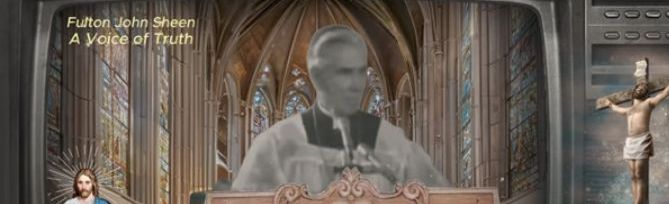
How God Transformed Broken Lives With Checkered Pasts, or Worse, Into Spiritual Treasures.
“… a remarkable sermon by Archbishop Fulton J. Sheen. With his captivating speaking style and profound content, Fulton Sheen takes us on a journey of exploring faith and the meaning of life. Listen and feel the eternal wisdom from one of the most renowned preachers in Catholic history.”
“Sanctify them though the truth. Thy Word is Truth” — Jn. 17:17
~~~
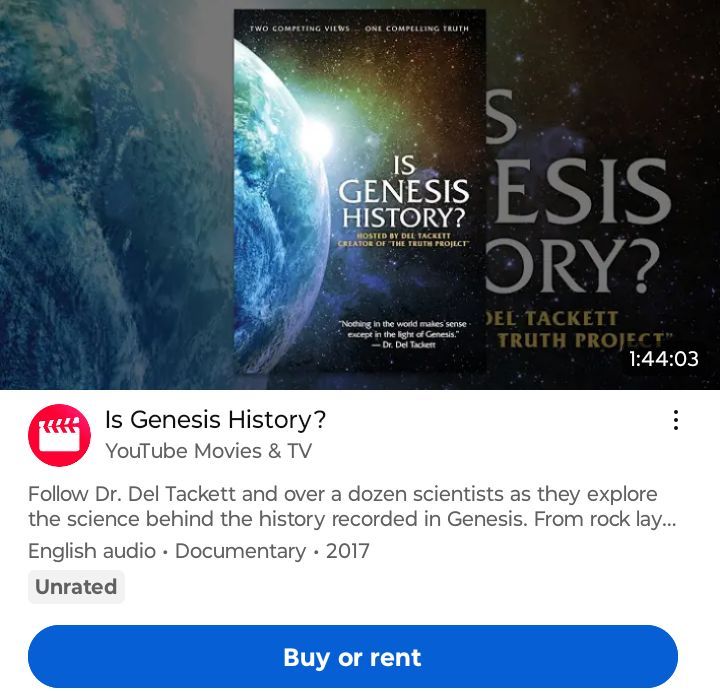
Is Genesis History?

Follow Dr. Del Tackett and over a dozen scientists as they explore the science behind the history recorded in Genesis. From rock layers to fossils, from lions to stars, from the Bible to artifacts, this eye-opening film will transform the way you see the world.
“Pulling of the thread of history can be done with anything: business, science, technology, government, education – everything is linked back to real people and events that lived and happened sometime in the past. We could even say that the present is unchangeably connected to the past through an unbroken chain of real individuals.
That seems to be the view of the writers of the New Testament. They regularly refer back to people and events that happened long before them but which are still connected to their lives in the first century AD.
This is one of the key assumptions of our project on Genesis: people like Paul, Luke, Jesus, Peter, and John refer to the people and events of Genesis as real history. They talk about them like we talk about historical people and events that had an impact on our lives today.
What exactly do the writers of the New Testament say about the people and events of Genesis? It’s helpful to see what they actually say, so let’s plow through a number of interesting quotes.
Genesis according to Jesus
One of Jesus’ favorite methods was to ask people if they had read a passage from the Old Testament. This is a good approach: start with the text. In talking about divorce, Jesus asks: “Have you not read that He who created them from the beginning made them male and female, and said, ‘Therefore a man shall leave his father and his mother and hold fast to his wife, and the two shall become one flesh’?” (Matthew 19:4-5)
Jesus obviously had read Genesis 1 and 2 because He’s quoting it. We don’t often think about Jesus reading the Old Testament, but He did. As a well-taught Jewish boy in the first century, He would have gone through the normal Torah instruction all boys His age did.
He knew that Genesis says Adam and Eve were created on the sixth day of creation. According to Jesus, that sixth day of creation was “from the beginning,” a phrase we hear a number of times in the New Testament. It refers to the beginning of creation as recorded in Genesis 1.
In other words, Jesus is pointing out that Adam and Eve were real people who were created in the beginning to be married only to each other. He wants to remind His listeners when they were created so they would know it has always been that way; as a result, their pretensions to divorce were against the creation order established at the start of all things. According to Jesus, Adam and Eve were two real people created to be married at a real time, and his listeners would be wise to understand the importance of that.
In another passage, Matthew records how Jesus condemns the pharisees and scribes for their blatant hypocrisy. Not one to mince words, He tells them God sent them the prophets to kill “so that on you may come all the righteous blood shed on earth, from the blood of righteous Abel to the blood of Zechariah the son of Barachiah…”(Matthew 23:35) According to Jesus, Abel was a real person whose blood was shed by his brother, but whose punishment would fall onto all those who rejected God’s prophets.
Finally, right before His death, Jesus tells His disciples key details about His return saying: “For as were the days of Noah, so will be the coming of the Son of Man. For as in those days before the flood they were eating and drinking, marrying and giving in marriage, until the day when Noah entered the ark, and they were unaware until the flood came and swept them all away, so will be the coming of the Son of Man.” (Matthew 24:37-39)
I find this interesting for a number of reasons. First, not only does Jesus know the catastrophic historical events recorded in Genesis 6 and 7, but He also knows His audience is familiar with them. Their prior understanding of the flood’s unexpected, total destruction is the basis for His comparison.
Second, Jesus describes the normal actions of the people living in Noah’s day as “unaware” that a flood was coming. This is how we hear people describe natural disasters; they are consistently surprised by them. It is an interesting note of historical authenticity that plays into His comparison.
Third, Jesus says the flood swept them all away. The fact that Jesus is linking an event where “all flesh died that moved on the earth, birds, livestock, beasts, all swarming creatures that swarm on the earth, and all mankind” to His eventual return, means something about that return. It’s going to be big, and it’s going to affect everyone.
According to Jesus, Noah, the ark, and a global flood that killed all the birds, beasts, and people on the earth, were as historically real as His second coming. They are a historical preview of coming attractions that everyone would be wise to remember in terms of their timing and scope.
This is one of the many reasons the idea that Noah’s flood was a local flood somewhere in the Middle East is a misguided interpretation. It does not fit the language of Genesis, well-known to both Jesus and His disciples, which is central to His comparison. Were the flood recorded in Genesis just local, it would make Jesus’ comparison be that ‘my return is going to be local, and it’s going to affect a few living creatures.’ But that’s not what either Jesus or Genesis says.
The fact that Jesus was well acquainted with the actual words of Genesis and knew them to be real history is why it is such a powerful statement. If Noah was not real, or if everyone in the world was not killed, or if the flood was not global, then Jesus’ comments make no sense. As He might say to a modern audience debating Noah and the extent of the flood, “Have you not read what I said about them?”

 Catholic Critique