A new book takes on the throughline from the rise of 20th-century eugenics to Silicon Valley.
JULIA MÉTRAUX, Mother Jones.
“Elon Musk’s calls for a so-called “efficient” US government—including wanting to end the already endangered right to work from home, a disability accommodation for many—are less surprising when you view him as a techno-eugenicist.
The eugenicists of the early 20th century used medical violence like forced hysterectomies in a pseudoscientific campaign to prevent “inferior” immigrants from entering the US, and push certain groups —especially disabled, non-white, and otherwise marginalized people—out of the gene pool.
Big Tech successors like Musk and PayPal billionaire-turned-arms dealer Peter Thiel have overtly promoted fraudulent race science, with Musk amplifying users on X who argue that people of European descent are biologically superior. In response to another user’s deleted post suggesting that students at historically Black institutions have lower IQs, Musk posted, “It will take an airplane crashing and killing hundreds of people for them to change this crazy policy of DIE”—diversity, equity, and inclusion, misspelled. In 2016, Thiel buddied up to a prominent white nationalist, and, the same year, was said by a Stanford dorm-mate to have complimented South Africa’s “economically sound” system of racial apartheid.
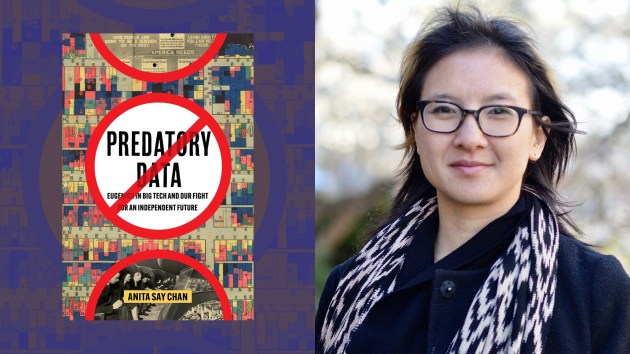
her new book Predatory Data, from the University of California Press, University of Illinois Urbana-Champaign information sciences and media studies professor Anita Say Chan looks at the history and current use of data in devaluing human beings along eugenicist lines.
I spoke to Chan about the history of predatory data in the United States, why the moral and ethical implications of data collection remain a crucial subject, and how we can fight against its misuse.
Can you share a bit about how data has been used, historically, to cast many disabled people, immigrants, and people of color as being part of the “undeserving poor”—and how that continues today?
For large parts of history, poverty was seen as a largely inevitable phenomenon brought about from a general condition of scarcity. While a “soft” version of poverty as individual failure might have attributed poverty to laziness or immoral behavior, eugenics introduced a “harder” version of a biologically determined undeserving poor as a central object of data collection.
Eugenic researchers labored, and grew a global disinformation movement, across the late nineteenth and early twentieth centuries to demonstrate poverty not as the result of scarcity or structural exploitations, as labor reformers then argued, but as the result of inherited deficiencies that directly limited intellectual potential, encoded harmful and immoral personal proclivities, and circumscribed economic achievement. In the US, varied datafication methods—from IQ exams and immigrant literacy tests, to criminal databases, biometric archives—were deployed by eugenic researchers in an effort to not just track and surveil the poor, and to argue for their segregation from so-called “fit” populations, but to collect data that eugenicists insisted would prove the higher incidences of moral, physical and mental “unfitness” among the poor.
Our contemporary datafication systems continue to do this today—not only by allowing their growth to be fueled by the expansion of online platforms and social media systems that minimize protections for minoritized users, but by enabling the amplification of political violence against minorities in the interest of protecting their profits.
With figures like Elon Musk playing major roles in the upcoming Trump administration, do you think conversations about how data is used have become more important?
I’ve already seen an uptick in communities working to get new laws passed at the local level to require greater public oversight over the acquisition of new surveillance technologies by police and city authorities… Continue

 Catholic Critique