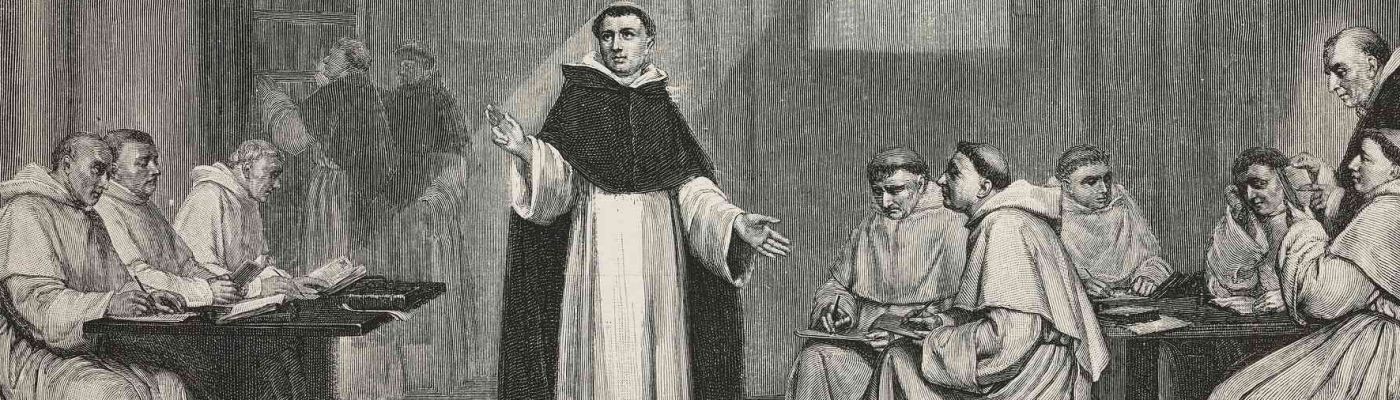
“We ought not to be swayed by the authority of the writer, whether he be a great literary light or an insignificant person, but by the love of simple truth. We ought not to ask who is speaking, but mark what is said.” — Thomas a Kempis, The Imitation of Christ, Bk. 1 Ch.5
A man quibbles with me,
“You quote heretics.
You quote dubious Catholics!”
…as if I rubber stamp
their every opinion
or wandering.
St. Thomas’ teachings, we all know, or should know, are everywhere studded with the writings of even pagan thinkers and poets; he quoted troublesome Catholics like Origen who taught the condemned errors of Universalism and the preexistence of souls. Other problems could be cited.
Thomas Aquinas and Pagan Virtue
In this connection, David Decosimo is Assistant Professor in the School of Theology and the Graduate Division of Religion at Boston University. He works at the intersection of religion, ethics, and politics. His prize-winning first book, Ethics as a Work of Charity: Thomas Aquinas and Pagan Virtue appeared in 2014. His research spans medieval Christianity and Islam, moral philosophy and theology, theory and philosophy of religion, and political philosophy. He is currently working on two books. One, an interpretation of the centuries-long, global tradition of Christian ethical thought, is nearing completion. The other, No Lord but God: Domination and Freedom in Christianity and Islam, elucidates the ways these two traditions have conceived and realized political freedom and advances a dialectical, pragmatist vision of liberty.
AT THE HEART OF THOMAS’S ETHICS is a deceptively simple claim, drawn from Aristotle: “The good is what all desire” (NE 1).
In Summa theologiae, the claim first appears a few questions in when Thomas uses it to help explain the relationship between goodness and esse, or existence (I 5.1).
Later, in I.II, he says this proposition funds the first principle (primum principium) of practical reason, which holds the same place in action as the law of noncontradiction has in any understanding at all (I.II 94.2).
… Perhaps most significantly, because of the way in which it connects all persons to God, this claim forms the basis in his thought for the recognition and appreciation of any virtue wherever it may be found. It specifies with regard to moral capacities and action what is common to humans as humans—whether Christians or not.
Put differently, it sets the low threshold for pagan virtue, the minimum excellence present in any human act, no matter the agent. Thomas’s claim that the good is what all desire helps ground a capacious and generous recognition of pagan virtue in a somewhat surprising way: on the basis of an irreducibly theological ethics.
In fact, it is not merely a theological but a profoundly Trinitarian and Christocentric vision that founds and propels his recognition of pagan virtue. This richly Scriptural and robustly Augustinian outlook not only enables but actually impels him to welcome and even celebrate the virtue of the outsider.
Moreover, this vision itself represents the union of Augustinian and Aristotelian insights—and this where we might least expect: in Thomas’s Trinitarianism and his very conception of Christian theology. Striving to be Aristotelian by being Augustinian and vice versa, Thomas, I argue, views creaturely perfection as participation in the Son, good-seeking as Christ-seeking, and, for that reason, he welcomes Aristotle as a genuine seeker, trusted teacher, and wise friend.” — Ethics as a Work of Charity: Thomas Aquinas and Pagan Virtue (Encountering Traditions)
Again, at this website I do not rubber stamp all of the opinions of authors I quote or highlight. I take what I consider the wheat and leave the chaff. — SH

 Catholic Critique