
The Forgotten Common Medieval Habit of ‘Two Sleeps‘.
“For centuries, humans slept in two distinct shifts, separated by a period of nighttime activity. In this video, we explore the fascinating history of biphasic sleep, a once-common practice where people divided their nights into a “first sleep” and a “second sleep.” — Medieval Sleep.
BBC. 9 January 2022: For millennia, people slept in two shifts – once in the evening, and once in the morning. But why? And how did the habit disappear?
For a start, first sleeps are mentioned in one of the most famous works of medieval literature, Geoffrey Chaucer’s The Canterbury Tales (written between 1387 and 1400), which is presented as a storytelling contest between a group of pilgrims. They’re also included in the poet William Baldwin’s Beware the Cat (1561) – a satirical book considered by some to be the first ever novel, which centres around a man who learns to understand the language of a group of terrifying supernatural cats, one of whom, Mouse-slayer, is on trial for promiscuity.
But that’s just the beginning. Ekirch found casual references to the system of twice-sleeping in every conceivable form, with hundreds in letters, diaries, medical textbooks, philosophical writings, newspaper articles and plays.
The practice even made it into ballads, such as “Old Robin of Portingale. “…And at the wakening of your first sleepe, You shall have a hot drink made, And at the wakening of your next sleepe, Your sorrows will have a slake…”
Biphasic sleep was not unique to England, either – it was widely practised throughout the preindustrial world. In France, the initial sleep was the “premier somme”; in Italy, it was “primo sonno”. In fact, Eckirch found evidence of the habit in locations as distant as Africa, South and Southeast Asia, Australia, South America and the Middle East.
How did it work?
From as early as 21:00 to 23:00, those fortunate enough to afford them would begin flopping onto mattresses stuffed with straw or rags – alternatively it might have contained feathers, if they were wealthy – ready to sleep for a couple of hours.
A couple of hours later, people would begin rousing from this initial slumber. The night-time wakefulness usually lasted from around 23:00 to about 01:00, depending on what time they went to bed. It was not generally caused by noise or other disturbances in the night – and neither was it initiated by any kind of alarm (these were only invented in 1787, by an American man who – somewhat ironically – needed to wake up on time to sell clocks). Instead, the waking happened entirely naturally, just as it does in the morning.
The period of wakefulness that followed was known as “the watch” – and it was a surprisingly useful window in which to get things done. “[The records] describe how people did just about anything and everything after they awakened from their first sleep,” says Ekirch.
Under the weak glow of the Moon, stars, and oil lamps or “rush lights” – a kind of candle for ordinary households, made from the waxed stems of rushes – people would tend to ordinary tasks, such as adding wood to the fire, taking remedies, or going to urinate (often into the fire itself).
For peasants, waking up meant getting back down to more serious work – whether this involved venturing out to check on farm animals or carrying out household chores, such as patching cloth, combing wool or peeling the rushes to be burned. One servant Ekirch came across even brewed a batch of beer for her Westmorland employer one night, between midnight and 02:00. Naturally, criminals took the opportunity to skulk around and make trouble – like the murderer in Yorkshire.
But the watch was also a time for religion.
For Christians, there were elaborate prayers to be completed, with specific ones prescribed for this exact parcel of time. One father called it the most “profitable” hour, when – after digesting your dinner and casting off the labours of the world – “no one will look for you except for God”.
Those of a philosophical disposition, meanwhile, might use the watch as a peaceful moment to ruminate on life and ponder new ideas. In the late 18th Century, a London tradesman even invented a special device for remembering all your most searing nightly insights – a “nocturnal remembrancer”, which consisted of an enclosed pad of parchment with a horizontal opening that could be used as a writing guide…
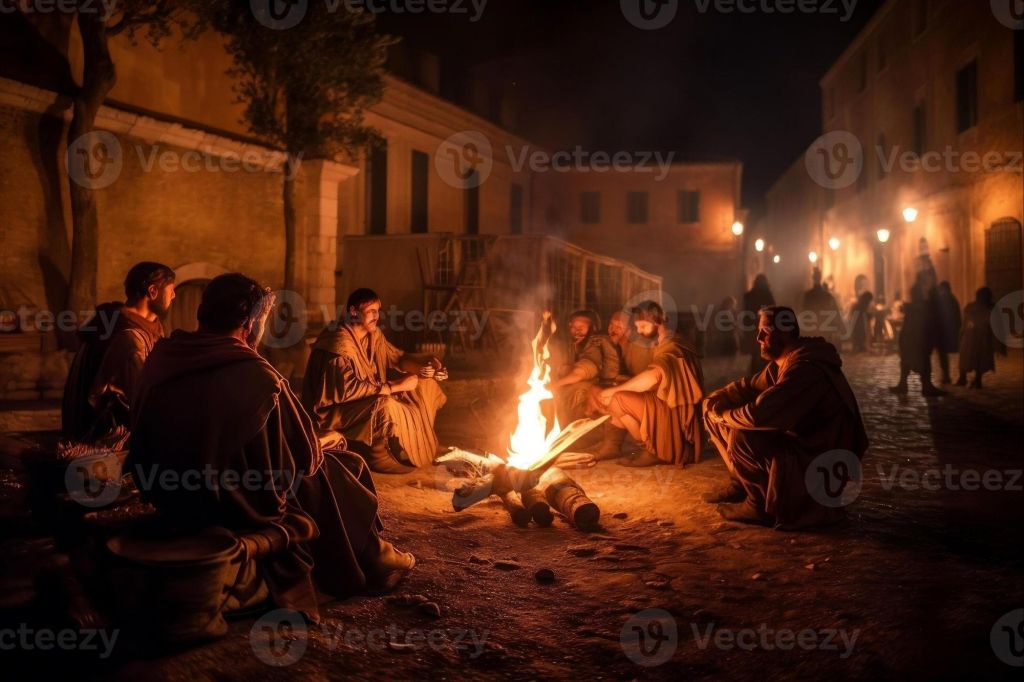
Once people had been awake for a couple of hours, they’d usually head back to bed. This next step was considered a “morning” sleep and might last until dawn, or later. Just as today, when people finally woke up for good depended on what time they went to bed.
According to Ekirch, there are references to the system of sleeping twice peppered throughout the classical era, suggesting that it was already common then. It’s casually dropped into works by such illustrious figures as the Greek biographer Plutarch (from the First Century AD), the Greek traveller Pausanias (from the Second Century AD), the Roman historian Livy and the Roman poet Virgil.
Later, the practise was embraced by Christians, who immediately saw the watch’s potential as an opportunity for the recital of psalms and confessions. In the Sixth Century AD, Saint Benedict required that monks rise at midnight for these activities, and the idea eventually spread throughout Europe – gradually filtering through to the masses.
But humans aren’t the only animals to discover the benefits of dividing up sleep – it’s widespread in the natural world, with many species resting in two or even several separate stretches. This helps them to remain active at the most beneficial times of day, such as when they’re most likely to find food while avoiding ending up as a snack themselves.”
__________
+ Breaking Points: Expert Reveals Truth About Fluoride in Drinking water

