Tertiaries, i.e., the Third Order. By Robert Ludlow and James Meyer.
Editor’s Note: The following article was adapted from Robert Ludlow’s “St. Francis and His Revolution,” which appeared as an editorial in THE CATHOLIC WORKER (January 1953, and reprinted in Thomas Cornell and James Forest [eds.], A PENNY A COPY, New York: The Macmillan Company, 1968, pp. 150-154) and James Meyer, SOCIAL IDEALS OF ST. FRANCIS, St. Louis: B. Herder Book Co., 1938. Numbers in brackets refer to pages in the Meyer book.] — The Voluntaryist (sic).
My own position with respect to peacemaking is similar to that of Popes John Paul II and Benedict XVI. I am, then, in principle not an absolute pacifist. I am called, relying on God for courage, to protect my “neighbor,” even at the expense of danger to myself, if he or she is assaulted. I may turn the other cheek where I myself am concerned, but I cannot stand by and force my neighbor to do the same.
But this is a very long way from the pretexts used by my (and other) governments time and again in my lifetime to justify armed belligerence towards other peoples when it appears clear that power and greed have often been the dominant motives. —SH
St. Francis’ Revolution by Robert Ludlow and James Meyer
“Those who place their hopes in political means … might do well to pause in this busy world of ours and think somewhat on St. Francis of Assisi and the method of St. Francis. “St. Francis,” states Father James Meyer, “effected his revolution on an entirely different field. To effect the change he did not kill a single human being, he sequestered not a single man’s property, closed up not one man’s business, inaugurated no new banking policy, initiated not a single repressive measure, wrote not a single law into the codes of the day,” …
St. Francis, who eschewed violence and politics, was more instrumental in effecting the downfall of an undesirable social system, than any politicians of his day, or any committees, or any organized group of dissidents. [27]
Says Father Meyer,
“Francis struck at the iniquity of it – especially with two provisions of the rule of the Third Order. One was the provision that the Tertiaries must not bear arms, the other was that Tertiaries must bind themselves with no oath, except where duly constituted authority rightfully required it.” [37]
“They are not to take up lethal weapons, or bear them about, against anybody.”
And it must be remembered that literally thousands of lay people joined the Third Order, so much so that the feudal lords were besides themselves with wrath and appealed to Rome to stop this madness. This madness which deprived them of serfs because the Third Order members refused to bear arms or take oaths of fealty to the lords. …
Of St. Francis, Meyer adds:
“Coercion … of another person against the latter’s convictions was as repugnant to him as sin. Violence had no appeal to him, not even against the Saracen or bandit. Similarly, whatever amounted to compulsion, such as reducing his neighbor to a plight where self preservation demanded his surrender to terms, was odious to him … .” [33]
He was similarly opposed to repressive measures “because when you use violent repressive measures, you challenge secret resentment; what the victims cannot do in public they do in secret.” [25]
St. Francis realized that reform cannot be a mass produced affair. [10] What did he do? How did he come to head a movement?
By dint of minding his own business! [27]
His first and consuming thought was of doing the thing that should be done by himself – not getting the other fellow to do it, much less of making the other fellow do it against his will. [28]
That is the lesson of the life of St. Francis. That is the nub of the Franciscan way of life. [30]
It consists in knowing to the full our responsibilities and carrying them out regardless of cost to ourselves and regardless of what anybody else may do. [43] Thus we end these pages where we began them – with the stress on individual effort.”
~~~
In summary
“The Tertiary resolves (1) To commit no sin of heart or hand for the sake of goods of fortune. (2) To observe moderation in acquiring and enjoying all goods of fortune. (3) To share his goods of fortune with God and neighbor“. — Rule
“St. Francis,” states Father Meyers, “effected his revolution on an entirely different field. To effect the change, he did not kill a single human being, he sequestered not a single man’s property, closed up not one man’s business, inaugurated no new banking policy, initiated not a single repressive measure, wrote not a single law into the codes of the day, indicted no political instrument.”
But, it will be objected, that is all very well and good. It is an area of life that was open to the technique of St. Francis, but we are concerned with the political, with economic systems, with day to day living, and what else is there but that we should go about those things in the only way we know how? We must elect our man and then you will see our ideas realized.Yet this is precisely the point-St. Francis, who eschewed violence and politics, was more instrumental in effecting the downfall of an undesirable social system than were any politicians of his day, or any committees, or any organized groups of dissidents.
And it must be remembered that St. Francis regarded the rule of the Third Order to be a rule that was applicable to the ordinary Christian.
It was no specific rule for the clergy; it was meant for all of the laity.
And how popular is this pacifism of St. Francis today, how popular with the Franciscans? How popular is this with the members of the Third Order today? How many of them know the sixteenth rule of the Third Order,
“They are not to take up lethal weapons, or bear them about, against anybody.”
Can we imagine the revolution it would cause should this rule be enforced among members of the Third Order so that they would as a matter of course, become conscientious objectors?
But the same fate has befallen this idea of St. Francis as has happened with much else that he taught. Not only has this been true of St. Francis but pretty much of all the pacifism in the Church. It has been made “harmless.”
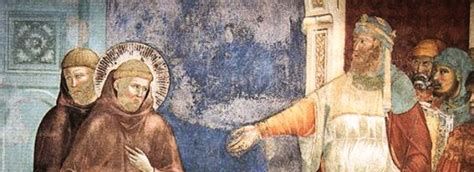
Top painting: Francis and the Sultan.

 Catholic Critique