And ‘Being Beethoven‘ a BBC documentary chronicling his genius, tragedies and glory. Also, Damian Thompson asks why didn’t Beethoven go to Mass? Too, How did Beethoven feel about Napoleon? And Missa Solemnis.
Beethoven and the Catholic Church
.By Michael De Sapio.
Crisis Magazine.
Ludwig van Beethoven, Johann Sebastian Bach, and Wolfgang Amadeus Mozart form the great trinity of Western classical composers. Of the three, it is Beethoven whose religious beliefs have proven the most elusive. We know all about the devout Lutheranism of Bach, who wrote his music “for the glory of God and the refreshment of the soul”; and Mozart was a practicing Catholic, as his letters make clear. Beethoven, by contrast, was reticent about expressing his religious convictions. He is often portrayed as a child of the secular-humanist Enlightenment—a freethinking individualist whose beliefs were Deistic in nature and who had little need for church or creed. Yet Beethoven was baptized and raised a Catholic, from a Rhineland Catholic family that had emigrated from Flanders two generations before. What precise ties did this musical giant—the composer of one of the greatest Catholic Masses of all time—have with the Catholicism of his birth?

Beethoven’s letters and notebooks give testimony to his strong belief in a personal God. One of his favorite books was a work by a Lutheran pastor called Reflections on the Works of God and His Providence Throughout All Nature, an example of the early-Romantic love of the natural world (often incorrectly labeled “pantheism”) which fed into such Beethoven works as the Pastoral Symphony. Other Beethoven quotations about God—particularly those written during the agonizing onset of his deafness—emphasize his nearness and his understanding of suffering, in language that often recalls the Psalms. Christ is invoked as a suffering fellow-man (if not as Son of God). Beethoven also frequently wrote religious inscriptions and titles on his compositions: “Grateful thanks to the Almighty after the storm,” “Holy song of thanksgiving of a convalescent to the Deity.”
Beethoven’s mother was described as devout, and the composer started his musical life at the age of ten playing the organ at early morning Masses in Bonn. Morally, Beethoven was very upright, even “puritanical” according to some writers. Nonetheless, it is not clear that the adult Beethoven went to Mass regularly or practiced any Catholic devotions (when he became guardian to his nephew Karl, he saw to it that the boy went regularly to the sacraments). In mid-life Beethoven appears to have developed an interest in Hinduism and other eastern religions, quoting their religious texts in his notebooks. The quotations emphasize the transcendence and pure essence of God and are, in fact, not far from the doctrines of the Old Testament.
It’s worth mentioning that one of the specialists to whom Beethoven went to treat his deafness was a Catholic priest, a Pater Weiss, who had gained a reputation in Vienna as a sort of wonder worker with the deaf. —Continue…
Why didn’t Beethoven Go to Mass?
Damian Thompson associate editor of The Spectator writes,
“Ludwig van Beethoven had a profound faith in God. He was born and raised a Catholic and on his deathbed he asked to receive the Last Rites. He told the priest, ‘I thank you, ghostly sir – you have brought me comfort.’ One of his closest friends, Archduke Rudolf of Austria, was made a cardinal (before being ordained priest and bishop, something inconceivable today).
“To mark Rudolf’s enthronement as Archbishop of Olomouc in 1819, Beethoven wrote a great Mass, and took such trouble over the setting of the Latin words that he delivered the work three years late. Yet, so far as we know, not once did the adult Beethoven actually attend a church service. Why?

Beethoven and Napoleon
“Once upon a time, Beethoven idolised Napoleon Bonaparte, viewing the French military leader as the embodiment of democratic freedom for the common people. But when Napoleon crowned himself Emperor of France in 1804, Beethoven furiously accused ‘le petit caporal’ of turning tyrant himself, and violently scratched the word ‘Bonaparte’ (the original title) from the cover of his Third Symphony …More
+ How Beethoven’s 15-minute Wellington’s Victory was composed to humiliate Napoleon Bonaparte…
+ What did Beethoven inspire besides almost everything?
Missa solemnis
… Today, the Missa Solemnis is generally considered to be one of the most remarkable works of Christian liturgical (relating to public worship) music ever conceived. It is also a summation of Beethoven’s mature compositional style.
A self-consciously great work
Beethoven’s initial excuse for composing the Missa Solemnis had been a commission in 1819 for a Mass to accompany the enthronement of his friend, patron and composition pupil, Archduke Rudolph, as the archbishop of Olmütz (now Olomouc, Czech Republic). But he became so engrossed in the creative challenge that he ran some three years late in finishing it.
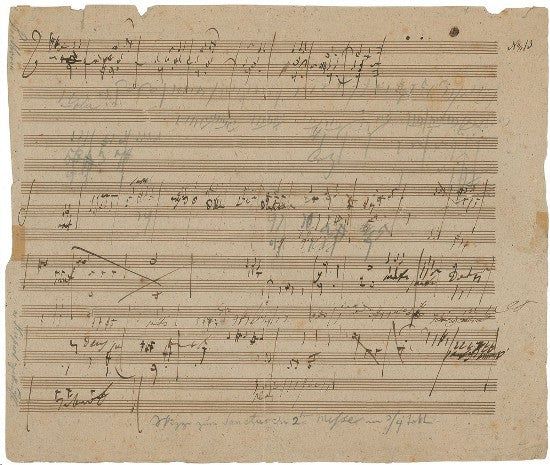
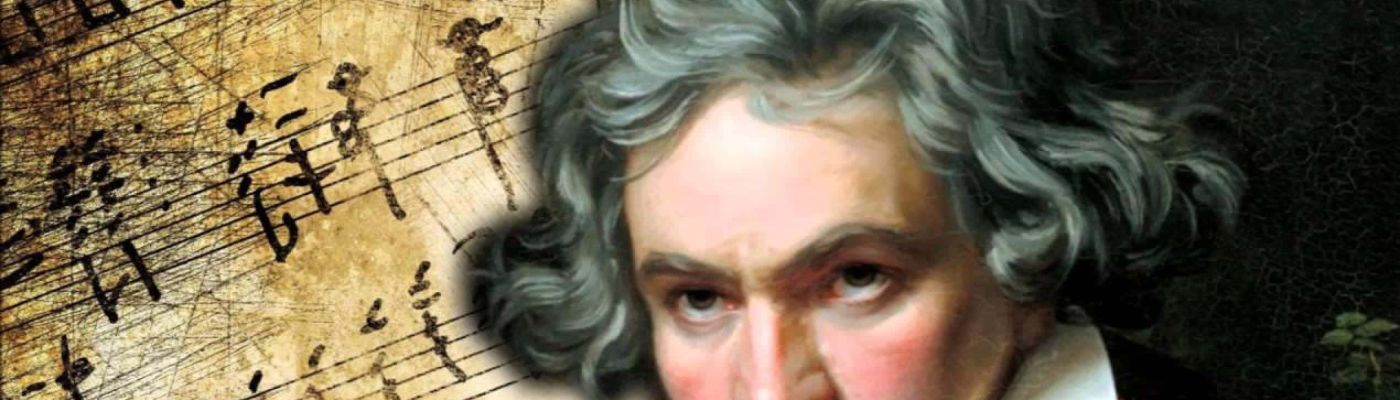
In part, this was because he seemed very aware of its potential to be a work of lasting significance. He later claimed to his publishers it was also his best composition. His favourite (and most famous) portrait shows him in the act of writing it.
+
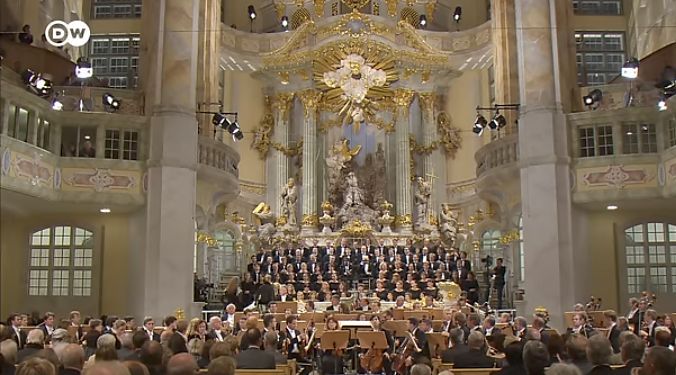
Missa Solemnis, Fabio Luisi, Staatskapelle Dresden, Chorus of the Sachsiche Staatsoper
“A solemn mass with a symbolic character: The Frauenkirche in Dresden hosted its first public concert to mark its reopening on November 4, 2005. The program included Beethoven’s Missa solemnis, performed by the Staatskapelle Dresden and the Chorus of the Sächsische Staatsoper Dresden, conducted by Fabio Luisi. The soloists were Camilla Nylund, Birgit Remmert, Christian Elsner and René Pape.” (Listen below).