
Debunking centuries of Anti-Catholic history
Joshua Charles wrote on ‘X’,
“Many of the atheist “Enlightenment” attacks on Christianity are regurgitated versions of earlier protestant lies about the Catholic Church.
When you realize how badly so many of us have been lied to, you can’t unsee it.”
Rodney Stark writes,
“It seems pertinent to point out that I did not set out to write this book from scratch. Rather, in the course of writing several other books on medieval history as well as on early Christianity, I kept encountering serious distortions rooted in obvious anti-Catholicism—the authors often explicitly expressed their hatred of the Church. Having written asides in these earlier books on many of the examples listed above, I finally decided that the issue of distinguished anti-Catholic history is too important and its consequences too pervasive to be left to these scattered refutations. So I gathered, revised, and substantially extended my previous discussions while adding new ones.
In doing so, I have not attempted to “whitewash” Church history. In these same earlier books, I wrote at some length on such matters as corrupt clergy, brutal attacks on “heretics,” and on more recent misdeeds and shortcomings of the Church, such as covering up for pedophile priests and the misguided advocacy of liberation theology. But no matter how much importance one places on these negative aspects of Church history, it does not justify the extreme exaggerations, false accusations, and patent frauds addressed in the chapters that follow.
Faced with this enormous literature of lies, I have heeded the words of Columbia University’s Garrett Mattingly (1900–62), “Nor does it matter at all to the dead whether they receive justice at the hands of succeeding generations. But to the living, to do justice, however belatedly, should matter.”11
You may be wondering, if these are notorious falsehoods, why do they persist? In part because they are so mutually reinforcing and deeply embedded in our common culture that it seems impossible for them not to be true. One easily assumes that in our “enlightened” times, surely these claims would have been rejected long ago if they were false.
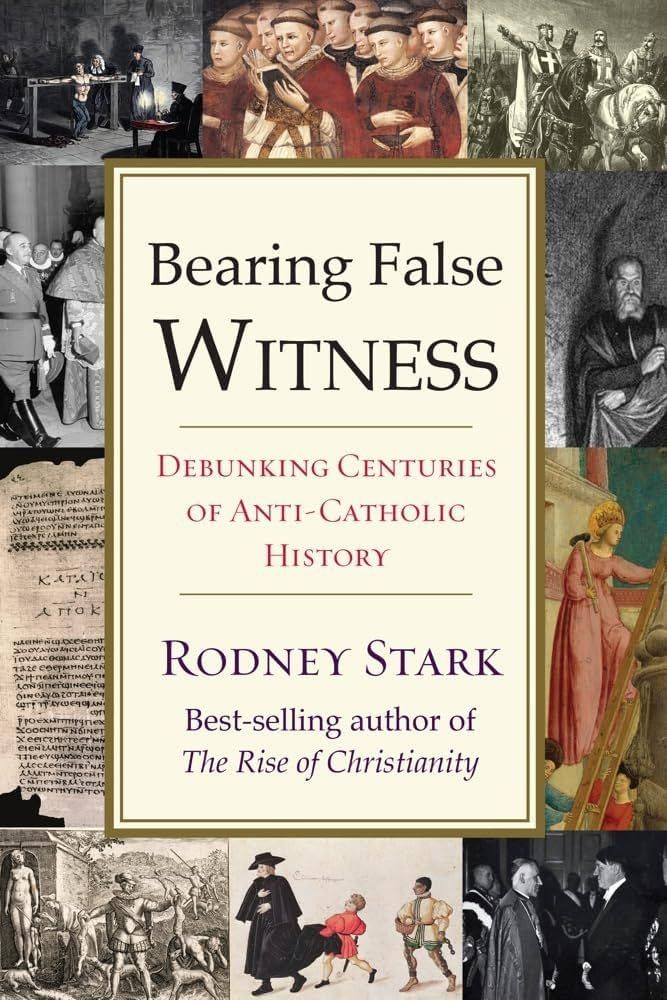
I confess that when I first encountered the claim that not only did the Spanish Inquisition spill very little blood but that it mainly was a major force in support of moderation and justice, I dismissed it as another exercise in outlandish, attention-seeking revisionism. Upon further investigation, I was stunned to discover that in fact, among other things, it was the Inquisition that prevented the murderous witchcraft craze, which flourished in most of Europe during the sixteenth and seventeenth centuries, from spreading to Spain and Italy. Instead of burning witches, the inquisitors sent a few people to be hanged because they had burned witches. Be assured that you will not be asked to take my word on these refutations.
Get the book and / or Audible version
“In this stunning, powerful, and ultimately persuasive book, Rodney Stark, one of the most highly regarded sociologists of religion and the best-selling author of The Rise of Christianity, argues that some of our most firmly held ideas about history, ideas that paint the Catholic Church in the least positive light, are in fact fiction. Why have we held these wrongheaded ideas so strongly and for so long? And if our beliefs are wrong, what is the truth? In each chapter Stark takes on a well-established anti-Catholic myth, gives a fascinating history of how it became the conventional wisdom, and presents a startling picture of the real truth.
Dr. Rodney Stark is one of the leading authorities on the sociology of religion. He grew up in Jamestown, North Dakota, where he began his career as a newspaper reporter. Following a tour of duty in the US Army, Stark received his PhD from the University of California, Berkeley, where he held appointments as a research sociologist at the Survey Research Center and at the Center for the Study of Law and Society. For many years, the Pulitzer Prize nominee was professor of sociology and professor of comparative religion at the University of Washington. In 2004 he became Distinguished Professor of the Social Sciences and co-director of the Institute for Studies of Religion at Baylor University.
Stark has authored more than 150 scholarly articles and 32 books in 17 different languages, including several widely used sociology textbooks and best-selling titles like The Rise of Christianity: How the Obscure, Marginal Jesus Movement Became the Dominant Religious Force in the Western World in a Few Centuries; The Triumph of Faith: Why the World is More Religious Than Ever; The Triumph of Christianity: How the Jesus Movement Became the World’s Largest Religion; God’s Battalions: The Case for the Crusades; A Star in the East: The Rise of Christianity in China; and The Victory of Reason: How Christianity Led to Freedom, Capitalism, and Western Success.

 Catholic Critique