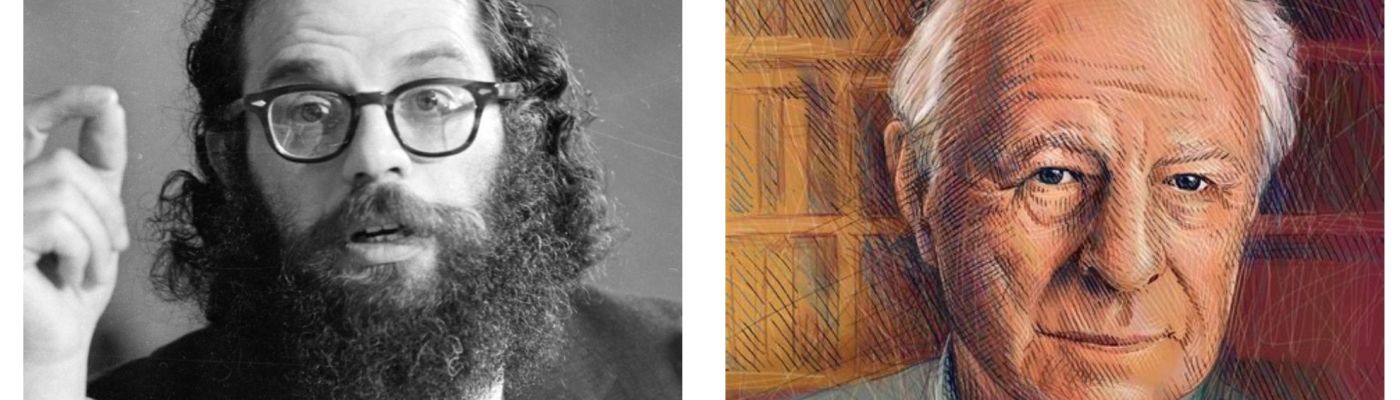
By Norman Podhoretz. Sex, drugs, America, the middle class, and “poetry power”: reflections on a literary entanglement of 50 years’ duration.
by Norman Podhoretz, 1997.
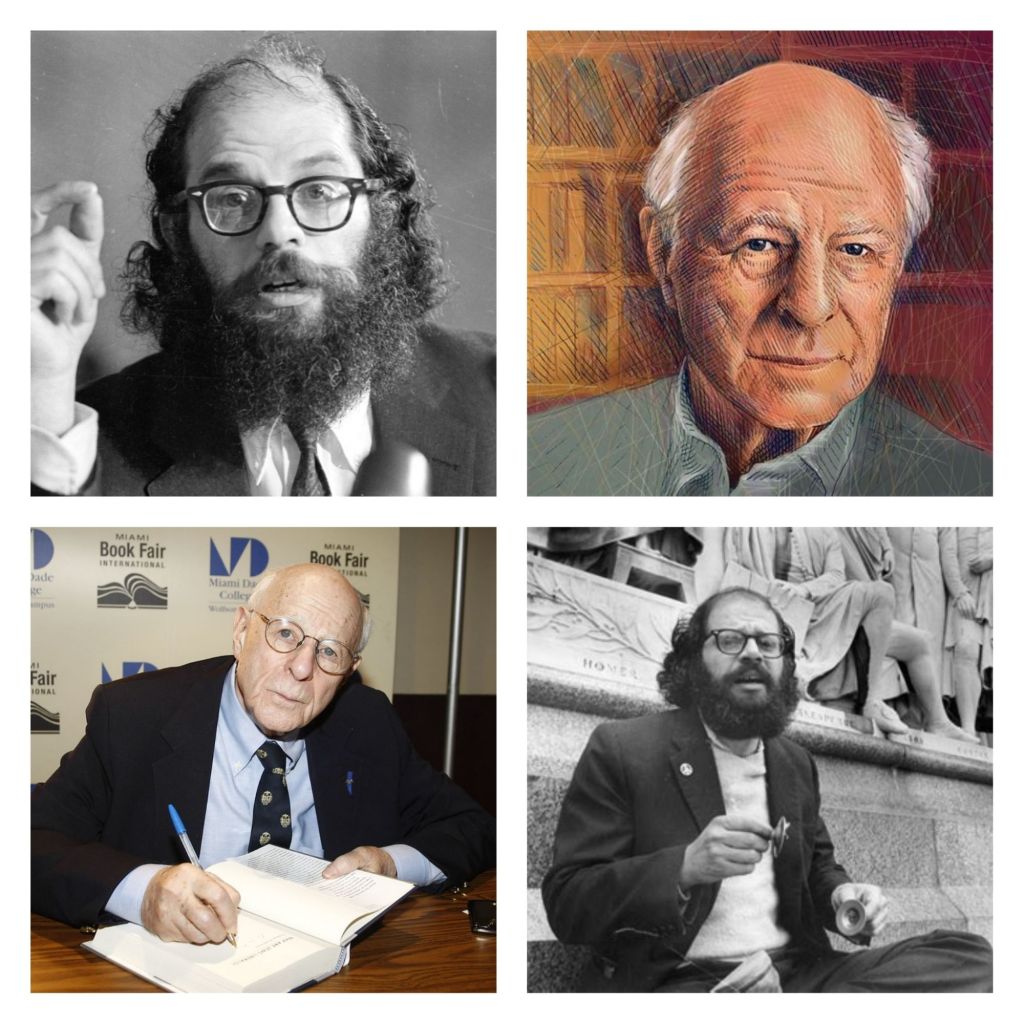
“Allen Ginsberg, Master Poet of Beat Generation, Dies at 70,” proclaimed the headline on the front page of the New York Times for April 6, 1997. Reading it, I was moved more deeply than I would have expected—not to grief (though an unmistakable touch of sadness did briefly make a surprise appearance) but rather to an overwhelming feeling of wistfulness. It came over me that I had known this man for a full 50 years—50 years!—and that for at least 40 of them I had been at war with him and he with me. It came over me too that even now, with Ginsberg himself carried off the field, his work and its influence would still be there and the war would still go on.
Perhaps the best place to begin in telling the story of that war is a Saturday night in the fall of 1958, when I was twenty-eight and had just left the editorial staff of COMMENTARY to work on a book while also trying my luck as a freelance writer and editor. At about 7:30 P.M., after hanging around all day in the sloppy old clothes I usually wore on weekends, I shaved, put on a clean white shirt with a button-down collar, a rep tie, and a three-piece charcoal-gray flannel suit from Brooks Brothers, and headed down by subway from the Upper West Side of Manhattan to an apartment in Greenwich Village, where Ginsberg and his friend and literary sidekick Jack Kerouac were waiting for me to arrive.
I had never met Kerouac before, but Ginsberg I had first encountered when we were both undergraduates at Columbia in 1946. As a freshman, aged sixteen, I had submitted a long poem about the prophet Jeremiah to the college literary magazine of which he, nearly twenty and in his junior (or senior?) year, was an editor, and to my great delight he had accepted it for publication.
Many years later, I happened upon that poem, and it set my teeth on edge. It also got me wondering how so crude an imitation of Walt Whitman could have met with the approval of Ginsberg, who (like almost every other aspiring young poet in the English-speaking world) was in those days still trying, and quite successfully, to sound like T.S. Eliot. But from a recent glance through the first section of his Selected Poems: 1947-1995,1 I have discovered that he was already making moves toward his famous rejection of Eliot in favor of my then-beloved Whitman. Might he have thought that I was on to something new?
If so, he could not have been more mistaken. When he later abandoned Eliot for Whitman, he was defiantly repudiating what was then the academically correct model and aggressively embracing an unfashionable and largely frowned-upon tradition. (I say “largely” because even at the height of Eliot’s influence, Whitman had his defenders, among them one of Ginsberg’s Columbia mentors, Mark Van Doren, whom I vividly recall raising his eyes to heaven and waxing rhapsodic over “Whitman’s great poems about death.”) I, on the other hand, was only just becoming acquainted with Eliot, and I did not yet know enough to know how retrograde my Whitmanesque frenzies actually were.

It was not long, however, before I found out, and as I did, I also began to suspect—with a little help from teachers and friends—that I was better at writing about poetry, and about literature in general, than I was at writing poems. And so, having launched my literary career at Columbia with the publication of a poem which in later years made me cringe, I ended it as a senior with the publication of a precociously poised and accomplished critical essay which, when I came upon it in later years, made me smile.
From Columbia I went on to three years of graduate study at Cambridge University in England. While there, I began publishing reviews and essays in academic journals and intellectual magazines on both sides of the Atlantic: Scrutiny and Essays in Criticism in England, and COMMENTARY and Partisan Review in America. After leaving Cambridge for a two-year hitch in the army, I took a job as a junior editor at COMMENTARY and resumed writing about contemporary literature not only for highbrow journals but for more popular magazines as well, including the New Yorker, the Reporter, and the New Republic.
_____________
By this time Ginsberg and I had long parted company, and in more ways than one. At Columbia, my friends tended to be straight in both senses of that term, whereas Ginsberg, a middle-class Jewish boy from New Jersey in the process of discovering himself as a homosexual, fell in with an assortment of hustlers, junkies, and other shady or disreputable characters who were always getting themselves and him into trouble.
Prominent among the latter was Kerouac, a Columbia dropout who had already run afoul of the law through a friend of his named Lucien Carr, whom he had originally met through Ginsberg. Carr had stabbed a former homosexual lover to death in the course of repelling an advance, dumped the body into the Hudson River, and then sought out Kerouac to help him dispose of the evidence. Thanks to the botch they made of the job, Carr wound up in prison, though Kerouac, who had been arrested as a material witness, got off scot-free. Shortly thereafter, Ginsberg and Kerouac were caught in bed together in Ginsberg’s room in one of the college dormitories. Ginsberg protested (truthfully, it seems) that they “hadn’t done anything,” but his pleas of innocence fell on deaf ears, and he was hit with a year’s suspension.
This was Ginsberg’s version of the episode. The official reason for the suspension, however, was not a sexual dalliance with Kerouac but a prank Ginsberg had played on a cleaning woman who, he claimed, had refused to wash the windows of his room.
To retaliate against her, writes one of his biographers, Michael Schumacher2(confirming the story as I heard it around the Columbia campus), Ginsberg “had traced the words Butler has no balls into the grime, Butler being Nicholas Murray Butler, president of the university.” Furthermore, suspecting the cleaning woman of anti-Semitism, he had with characteristic perversity “also printed the legend ‘Fuck the Jews’ into the dirt, and capped off the display with drawings of a skull and crossbones and male genitalia.” In those far-off unenlightened days, this was, as the dean of the college put it in a letter to Ginsberg’s father, an “enormity,” and by itself grounds for disciplinary action.
His exile over, Ginsberg was readmitted to Columbia, but before long he had progressed from getting himself suspended for undergraduate prankishness to getting himself arrested for possession of stolen goods. According to his obituary in the Times, they were found in his apartment where they had been stored by one Herbert Huncke, a con man who was Ginsberg’s Virgil in exploring the lower depths of Times Square and with whom he was then living; according to contemporaneous Columbia rumor (again confirmed by Schumacher), they were in a car in which Ginsberg was a passenger and which attracted the attention of the police when the driver (a friend of Huncke’s) brilliantly turned the wrong way down a one-way street.
This time Ginsberg was in serious danger of going to jail, but thanks to the intervention of several Columbia professors, including Lionel Trilling and Mark Van Doren, he was sent to a psychiatric institution instead. The eight months he spent there were subsequently put to good literary use in “Howl,” the poem that would make him famous upon its publication in 1956 in a little paper-covered booklet entitled Howl and Other Poems.

_____________
Not having seen Ginsberg since Columbia, and not having heard much about him in the intervening years, I had at first been a little surprised to receive an advance copy of Howl together with a note from him suggesting that I review it. Evidently, though, he had kept close enough track of me to know that I was now an established critic and therefore in a position to do him a certain amount of good.
I never did review Howl itself, but within the next year or so I wrote no fewer than three highly critical pieces—one for the New Republic, another for Partisan Review, and a third for Esquire—about the group which had originally been hailed as the “San Francisco Renaissance” but which soon came to be much better known as the Beat Generation. Ginsberg was one of its two main leaders and spokesmen. The other was Kerouac, whose novel On the Road was now being acclaimed as the counterpart in prose to the literary and cultural revolution heralded in verse by the title poem of Howl.
Of the three pieces I wrote about the Beats, the one that appeared in Partisan Review under the title “The Know-Nothing Bohemians” made the most noise. There my main literary target was not Ginsberg but Kerouac. Through a detailed analysis of his prose (the “spontaneous bop prosody” Ginsberg had sung his praises for creating), I tried to demonstrate that this “prosody” was a cover for Kerouac’s “simple inability to express anything in words”:
The only method he has of describing an object is to summon up the same half-dozen adjectives over and over again: “greatest,” “tremendous,” “crazy,” “mad,” “wild,” and perhaps one or two others. When it’s more than just mad or crazy or wild, it becomes “really mad” or “really crazy” or “really wild.”
And the “same poverty of resources,” I went on to show, was apparent in his treatment of character and plot.

Neither in “The Know-Nothing Bohemians” nor anywhere else did I make any comparable literary charges against Ginsberg. The reason was that in my judgment Ginsberg, unlike Kerouac, was a genuinely gifted writer. Even as an undergraduate at Columbia, he had won my admiration with the amazing virtuosity that enabled him to turn out polished verses in virtually any style: love lyrics with an Elizabethan flavor, heroic couplets in the manner of Dryden and Pope, sonnets or rhymed stanzas reminiscent of Keats and Shelley. Now, through a fusion of Walt Whitman, Christopher Smart, William Blake, and William Carlos Williams, he had evidently found his own true voice. Hysterical and unmodulated, it was not a voice I liked; nor did I believe that the poems constituted the great literary breakthrough Ginsberg vociferously kept insisting he had achieved. Nevertheless, I could not help being impressed by the sureness of his rhythms and his phrasing in “Howl,” and by the wit, the humor, and the unexpected imaginative leaps that enlivened some of the other poems in this little collection, especially “America” and “A Supermarket in California.”
Consequently, in the New Republic, where the first of my pieces about the Beats was published, I singled out Ginsberg as one of the three good poets of the San Francisco Renaissance (the other two were the now almost entirely forgotten Robert Duncan and William Everson, a.k.a. Brother Antoninus). In that piece I characterized “Howl” as a “remarkable poem” whose “assault on America is a personal cry that rings true” and whose “hysteria is tempered with humor,” and a year later I also exempted Ginsberg from the severe literary strictures I directed at Kerouac in “The Know-Nothing Bohemians.”
_____________
By then, however, I had changed my mind about the extent to which Ginsberg was implicated in what I called the “ethos” of the Beat Generation. In the New Republic, I had said that Ginsberg shared with all the other writers of the San Francisco group “the conviction that any form of rebellion against American culture . . . is admirable,” and that he too regarded “homosexuality, jazz, dope-addiction, and vagrancy as outstanding examples of such rebellion.” But unlike the rest, Ginsberg did not, I thought, “glamorize” the “dope-addicts, perverts, and maniacs” he wrote about, and this struck me as an important and redeeming difference.
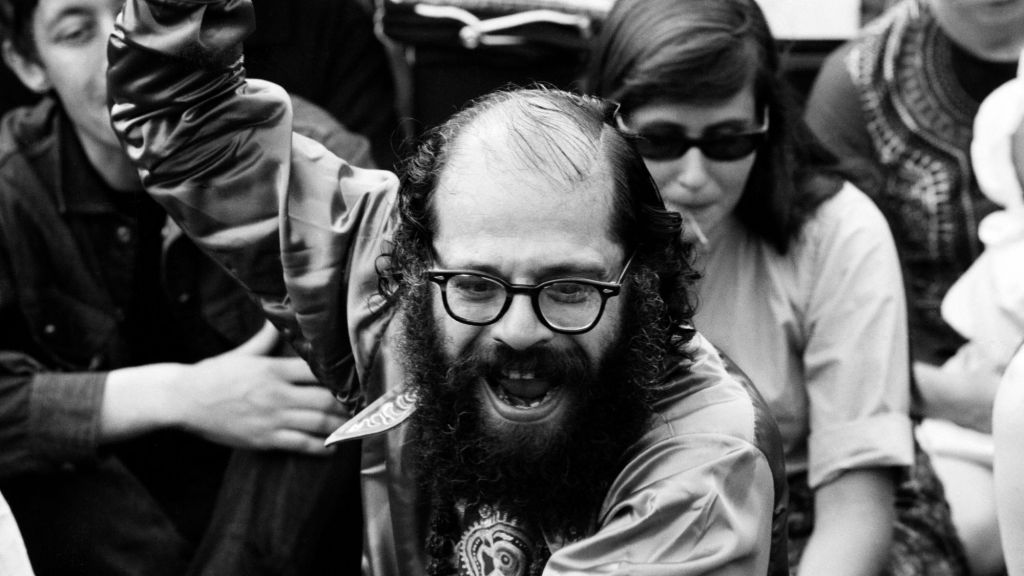
On further reflection, and after closer study of Howl and Other Poems, I realized that I had been misreading Ginsberg here. It now became clear to me that he was just as undiscriminating as Kerouac in his wholesale embrace of the Beat ethos, and that the two of them together were placing themselves at the head of a “revolt of the spiritually underprivileged and the crippled of soul” against “normal feeling and the attempt to cope with the world through intelligence.” Indeed, Ginsberg, I held, was in certain respects a more sinister figure than Kerouac:
At one end of the spectrum, [the Beat] ethos shades off into violence and criminality, mainline drug addiction and madness. Allen Ginsberg’s poetry, with its lurid apocalyptic celebration of “angel-headed hipsters,” speaks for the darker side of the new bohemianism. Kerouac is milder [though he too] is attracted to criminality.
Having thus forged a link between the Beats and “the spread of juvenile crime in the 1950’s,” I concluded with a ringing declaration of war:
Being against what the Beat Generation stands for has to do with denying that incoherence is superior to precision; that ignorance is superior to knowledge; that the exercise of mind and discrimination is a form of death. It has to do with fighting the notion that sordid acts of violence are justifiable so long as they are committed in the name of “instinct.” It even has to do with fighting the poisonous glorification of the adolescent in American popular culture. It has to do, in other words, with one’s attitude toward intelligence itself.
This was a scathing indictment, and it bothered Ginsberg so deeply that he would never get over it. And I mean never: here, for example, is the first paragraph of an article about him that was published in the New York Times on the occasion of his seventieth birthday, only six months before he died:
Sometimes the poet Allen Ginsberg still fantasizes about his old Columbia College friend Norman Podhoretz, who became the conservative editor of COMMENTARY magazine. In Mr. Ginsberg’s fantasies, Mr. Ginsberg is yelling at Mr. Podhoretz that the CIA is selling drugs in Los Angeles and yelling that Mr. Ginsberg’s epic poem “Howl” cannot be read on the radio during most daylight hours because of federal limitations on obscenity. And he is warring with Mr. Podhoretz, who once called Beat poets like Mr. Ginsberg “knownothing bohemians,” about the very nature of poetry itself.
_____________
It was on that Saturday night in 1958 that all this yelling first began, and more than a quarter-of-a-century later, in 1985, Ginsberg would tell an interviewer how and why it did:
Podhoretz had written his attack on Kerouac and what he called “the know-nothing bohemians,” this big chunk of leaden prose which people took very seriously as a statement of civilized values. It was in Partisan Review, but then the idea spread like trench mouth and finally wound up filtering down to Life magazine and the Luce empire. . . . Kerouac’s response was, “This is really too bad. That guy’s article will probably wind up confusing a lot of people, and he himself is confused. Why don’t we have him to tea?” So we called up Podhoretz and invited him over.
The call, which was placed not by Ginsberg himself but by Kerouac’s girlfriend, I at first thought must be a practical joke (“I’m here with Allen and Jack who would like you to come see them tonight”). But then Ginsberg got on the line, and the minute I recognized his voice and realized that this was no joke, practical or otherwise, I caught myself desperately fishing for some graceful way to avoid what was sure to be a very unpleasant encounter. No such luck: the fear of seeming cowardly (in my own eyes as much as in his) was at least as strong as my apprehensions over the nasty scene he was undoubtedly preparing for me, and curiosity then also weighed in to tip the scales in favor of accepting this unexpected and wholly unwelcome challenge.
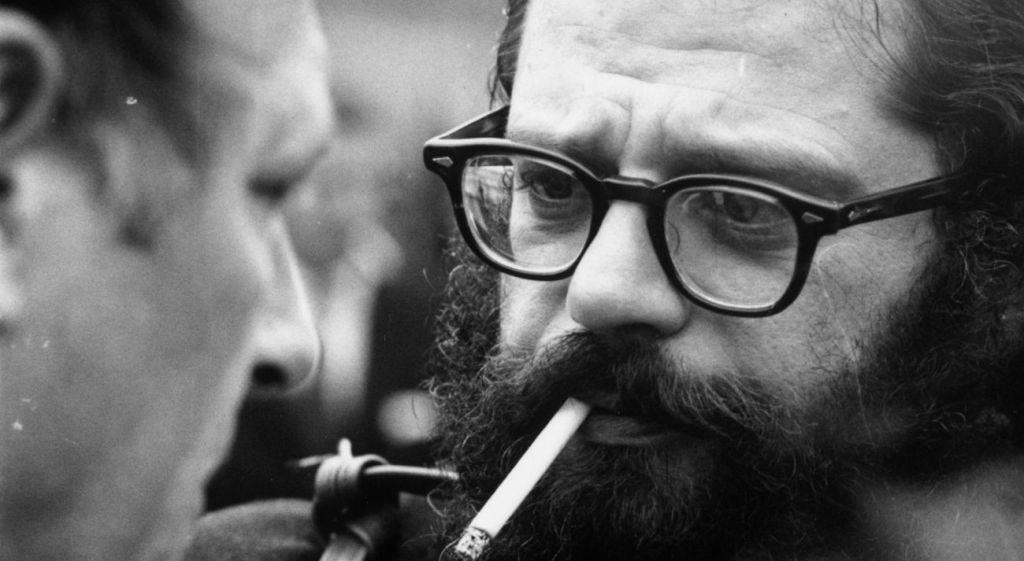
But no sooner had I done so than it occurred to me that if I were to arrive at his apartment needing a shave and dressed in threadbare chino pants and a rumpled old shirt, it would be as if I were donning the enemy’s uniform for a foray into his own territory. Worse yet, I might in some sense seem to be currying favor. And then there was another consideration. In “Howl” Ginsberg said that among the “best minds” of his generation who had been driven mad by “Moloch” (that is, life in America) were those “who were burned alive in their innocent flannel suits . . . & the mustard gas of sinister intelligent editors.” I suspected that he might have been thinking of me in invoking those “sinister intelligent editors,”3 and so changing into the uniform of “Moloch” before sallying forth from the Upper West Side to the Village seemed the only honorable and self-respecting thing to do.
Ginsberg’s apartment turned out to be much as I would have imagined it: a walk-up in an aging building, sparsely furnished, and badly in need of a paint job. Though he had not yet become a Buddhist, he was already “into” Eastern mysticism, and he was sitting on the floor in what looked to my admittedly inexperienced eyes like some approximation of the lotus position. In addition to Kerouac, there were two other people present whom Ginsberg (in what I took to be a sophomoric affront to my bourgeois expectations) never bothered introducing. One of them was obviously the girl who had placed the call; the other was a young man who seemed to be paired up with Ginsberg. I no longer remember the girl’s name, though I do remember that she said not a word the entire evening and lacked only the knitting to complete the impression of a Madame DeFarge making sure that I would be sent to the guillotine when the revolution finally came. As for the young man, he was (as I discovered through the simple expedient of asking him) Peter Orlovsky, to whom Ginsberg would remain married for all practical purposes other than sexual fidelity for the rest of his life.
Kerouac was even handsomer in the flesh than in the pictures of him that had been appearing for months in such mass magazines as Life and Time. Unlike the others, all three of whom (especially Orlovsky) were predictably and ostentatiously scruffy, his clothes, though casual, were neat and clean. Abnormally conscious as I was at that moment of the issue of personal appearance, and accustomed to the photographs in which he always had a two- or three-day growth of beard, I was also amazed to find him clean-shaven. Had he perversely cleaned himself up for this meeting, just as I had done?
_____________
I had anticipated a tense and unpleasant evening, and Ginsberg did not disappoint me. The festivities began with his aggressive insistence that I smoke marijuana with them. I refused—not, as Schumacher claims, because doing so would have been “tantamount to a passing of the peace pipe between factions of warring tribes,” but for the same reason I had shaved and changed my clothes before setting out. Presumably relying on Ginsberg’s recollection (which had me acting “a little stiff but polite”), Schumacher also claims that “the encounter was civil.” But there again he gets it wrong.
In later life, Ginsberg would adopt a sweet and gentle persona, but there was nothing either sweet or gentle about the Allen Ginsberg I had last seen at Columbia ten years earlier, and those qualities were even less evident in the Allen Ginsberg I met again that night. As an undergraduate he had been arrogant and brash and full of an in-your-face bravado; now, just into his thirties, he was still all those things and more, but there was also a fury in him that I had not detected in the past. “In those days,” as he himself would later recall, “I’d go into towering rages over literary matters because I was in the middle of a big fight with the whole New York establishment . . . and I was on my high horse.” Tonight it was I in whom “the whole New York establishment” was concentrated, and the rage was directed at me.

Some months earlier, the novelist Herbert Gold, who had also been at Columbia with us, had accused me of betraying what he considered one of my main responsibilities as a literary critic. I had written admiringly about the early critical essays of Edmund Wilson; but, Gold said, instead of following the example the young Wilson had set in supporting and encouraging the novelists and poets of his generation, all I ever did was attack or belittle the work being produced by my own contemporaries.
Ginsberg (for all I know having discussed the matter with Gold) now lashed out at me in similar terms. All night long he hectored and harangued me for my stupid failure to recognize both Kerouac’s genius and his, and the more I fought back, the harder he tried to make me see how insensitive I was being. It was I, he kept railing, who was the know-nothing, not they.
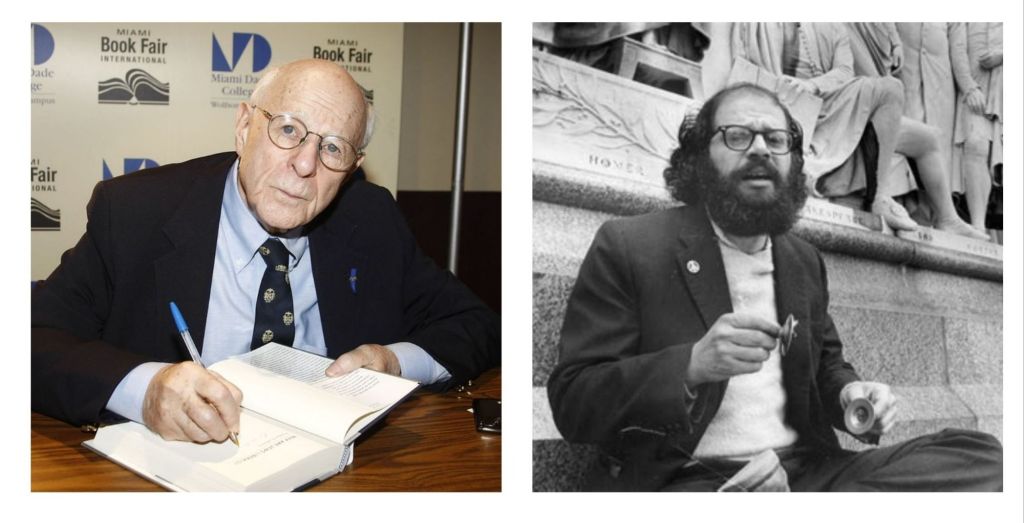
Rather than rely on what is after nearly 40 years a hazy memory, I want to quote from a letter Ginsberg wrote shortly before this encounter. It was to another mutual friend of ours from Columbia, the poet and critic John Hollander (through whom we had, in fact, first met), and it gives a very good picture of what he would say that night and the tone in which he would say it:
[Podhoretz lacks] even the basic ability to tell the difference between prosody and diction (as in his . . . diatribes on spontaneous bop prosody confusing it with the use of hiptalk not realizing it refers to rhythmical construction of phrases & sentences). I mean where am I going to begin a serious explanation if I have to deal with such unmitigated stupid ignorant ill willed inept vanity as that—someone like that wouldn’t listen unless you hit him over the head with a totally new universe, but he’s stuck in his own hideous world, I would try, but he scarcely has enough heart to hear—etc etc—so all these objections about juvenile delinquency, vulgarity, lack of basic education, bad taste, etc etc, no form, etc I mean it’s impossible to discuss things like that—finally I get to see them as so basically wrong (unscientific) so dependent on ridiculous provincial schoolboy ambitions & presuppositions and so lacking contact with practical fact—that it seems a sort of plot almost, a kind of organized mob stupidity—the final camp of its announcing itself as a representative of value or civilization or taste—I mean I give up, that’s just too much fucking nasty brass.
But if the task was so hopeless, why did Ginsberg go ahead and try to explain himself to me anyway? According to Schumacher, he did it not because he aspired to win my “approval of [his] literature or life-style,” but because I was an “influential member of the new critical establishment, and . . . it would have been, in terms of literary politics, a coup if [Ginsberg] had been able at least to gain a measure of respect from the camp” I represented.
No doubt this consideration did play a part. (So relentless a self-promoter was Ginsberg that as he lay dying he would ask his agent to do something about getting his latest collection reviewed in the New York Times Book Review.) And yet, as I could sense even then, and as his weirdly unremitting fixation on me was to prove, he did crave my approval of his work, and even of his “life-style.” For he did not limit himself that night to literary matters or to throwing the accusation of know-nothingism back in my face. He also harped on, and expressed incredulity over, my defense of the “square” way of life (or what today would be called middle-class values) against the Beat assault.
_____________
Here Schumacher for once gets it right when he says that I “was hearing nothing of . . . Ginsberg’s harangues against middle-class living and values.” Intransigent as I was in turning a deaf ear to his literary counterattack, I was even more determined to stand my ground on the moral and cultural issue between us.
This was not because I was an uncritical admirer of “middle-class living and values.” As it happens, in that period I was full of complaint about the “flabbiness of middle-class life” in Eisenhower’s America (even using that very phrase in “The Know-Nothing Bohemians”). I also thought that my own generation was much too sober and mature for its own good, and (in a piece for the New Leader in 1957) I had predicted that we might soon “decide to take a swim in the Plaza fountain in the middle of the night.”
Yet whatever I may have intended in invoking the example of F. Scott Fitzgerald and the youthful spirit of the 1920’s symbolized by his drunken hijinks, it was certainly not the “know-nothing bohemianism” of Ginsberg and Kerouac. Indeed, to judge by the way I was living my own life, it was not any kind of bohemianism at all. At the age of twenty-six, the year Howl and Other Poems was published, I had married a woman with two very small children, thereby assuming responsibility for an entire family at one stroke; and by the time “The Know-Nothing Bohemians” appeared in 1958, a third child had come along (with a fourth to follow in due course). To support this growing family, I relied on three different sources of income—a full-time job as an editor, free-lance writing at night and on weekends, and lecture engagements whenever I could get them.
Inevitably, then, and along with everything else, it was myself I was defending in fighting the Beats. Ginsberg sensed that there was an extraliterary personal element in my opposition, but in his various attempts over the years to pin it down so that he could dispose of it once and for all, he kept looking in the wrong place. For instance, in a 1987 interview, he would attribute my hostility to disappointed ambition:
So then . . . Norman realized that . . . he wasn’t [a poet]. So he had to go some different way for power, and he got very perverse thoughts and started taking revenge on poetry power.
To still another interviewer in the 80’s, he would add an almost comically desperate variation on this theme:
Now, [Podhoretz] may have justifiably resented me because when I was twenty and editing the Columbia Review I’d published a poem of his by cutting it in half to the good part without asking him, which was a mistake, a very juvenile stupidity on my part.4
But the truth was that my gratitude to Ginsberg for publishing my poem far outweighed my shock at his editing of it; and if I was ever “taking revenge” on anything connected with him, it was not on his verse but on what he himself called his “vision,” which, as he would eventually come to recognize, was “provocative and interesting” to me.
How could it not have been? As against the law-abiding life I had chosen of a steady job and marriage and children, he conjured up a world of complete freedom from the limits imposed by such grim responsibilities. It was a world that promised endless erotic possibility together with the excitements of an expanded consciousness constantly open to new dimensions of being: more adventure, more sex, more intensity, more life.
Freedom from limits

God knows that as a young man full of energy and curiosity, and not altogether averse to risk, I was tempted by all this. God knows too that there were moments of resentment at the burdens I had shouldered, moments when I felt cheated and when I dreamed of breaking out of the limits I had imposed upon myself. Yet at the same time, I was repelled by Ginsberg’s world. In the abstract, he spoke for freedom from the oppressions of arbitrary social constraints. But his own work made no bones about the concrete consequences of this freedom: they were madness, drug addiction, and sexual perversity.
In praising him at first for not “glamorizing” these consequences, I had failed to grasp just how radical he really was. But now I finally understood that to his antinomian mind, going mad in America was the only way to be sane, to get high on drugs was the only way to be sober, and to “scatter their semen freely to whomever come who may” was the only way to experience sex.
I was, to say the least, no antinomian. Although at that age fantasies of promiscuity were only too appealing to me, I never imagined that there would be anything virtuous or praiseworthy about surrendering to them. And if, in some part of me, I envied “N.C” (Neal Cassady), the “secret hero” of “Howl”—that “cocksman and Adonis” who had “sweetened the snatches of a million girls” and brought “joy to the memory of his innumerable lays”—and if I also resisted the then-regnant Freudian interpretation of “compulsive Don Juanism” as a neurotic symptom, neither did I consider such behavior healthy, let alone heroic. To portray it as such struck me as nothing more than a rationalization—and a morally tawdry and intellectually dishonest one at that.5
_____________
Where homosexuality was concerned, Ginsberg did not so much glorify as beatify it. Thus, using the most graphic terms for buggery and fellatio, he attached the epithet “saintly” to homosexuals engaged in these practices and also described them as “human seraphim.” (In this as well as in other matters, Ginsberg was probably influenced by the use of similar imagery in the novels of the French writer Jean Genet—“another literary cocksucker,” as Ginsberg affectionately called him—who was himself canonized as a saint by Jean-Paul Sartre.) Here again, as with heterosexual promiscuity, but with even greater antinomian conviction, Ginsberg was turning the tables and declaring that the perverse was infinitely superior to the normal.
So deeply did he believe this that I even suspected him of having become a homosexual not out of erotic compulsion but by an act of will and as another way of expressing his contempt for normal life. This suspicion was less silly than it may sound. Unlike most of the other closeted homosexuals I had known at Columbia, Ginsberg never gave off any hint or indication that he was anything but straight (and, indeed, as I learn from his biographers, he slept with a fair number of women while he was in his twenties). Nor was I alone in taking Ginsberg for straight. Even someone as close to him as Neal Cassady thought that (as Ginsberg himself put it in an early poem) “I was not a queer at first.”
While I am at it, I might as well also admit to another outlandish suspicion I once entertained about Ginsberg’s homosexuality. This one, having more to do with literature than with ideology, was put into my mind by a crack that Philip Rahv, the co-editor of Partisan Review, once made about Robert Lowell. Always cynical about writers, and especially poets, Rahv professed to believe that the only reason Lowell had converted to Catholicism was out of the hope that it would help him write poetry as good as T.S. Eliot’s after his conversion to Anglicanism. Well then, might not Ginsberg, with his eye on the great romantic tradition of the poète maudit as exemplified by the likes of Arthur Rimbaud, have willed himself into homosexuality out of an analogous hope?
The answer was no. For whereas Lowell left the Church after a while (because, said Rahv with a triumphant smirk, it had failed to do the trick), Ginsberg remained an active and enthusiastic homosexual once he had given up his youthful struggles against it and stopped sleeping with girls.

Not that he ever accepted today’s party line of the gay-rights movement that homosexuality is always inborn and never a matter of choice. Peter Orlovsky, whom he once went so far as to list as his “wife” in his entry in Who’s Who, was, he said, “mostly straight.” Kerouac too, though straight, “was willing to sleep with me occasionally.” So was Neal Cassady. This was the same N.C. who “sweetened the snatches of a million girls,” but he “made a big exception and we slept together quite a bit.” And once Ginsberg became famous, he had no trouble luring “lots of straight young kids” into his bed.
Ginsberg also dissented from another of the current twists in the party line of the gay-rights movement, namely, the idea that homosexuals are exactly like heterosexuals in every respect other than erotic orientation, and that they want all the same things, including monogamous relationships cemented by legally sanctioned marriages. In spite of his relationship with Orlovsky, the Ginsberg of “Howl” would have seen such an embrace of middle-class values as a suicidal surrender to Moloch. Nor did advancing age or the pressures of gay political correctness induce a conversion to monogamy. Even as late as the last week of his life, when his nurse told him he was HIV-negative, he replied, “That’s surprising, given that I’ve had quite a lot lately,” and his very last poem, written when he was on his deathbed, dwelt almost entirely, and in his usual graphic fashion, on his “lovers over half century.”
Of a piece with his beatification of homosexuality was Ginsberg’s glorification of insanity. “I saw the best minds of my generation destroyed by madness,” he announced in the opening words of “Howl”—but destroyed, as we immediately discover, only to be reborn into a state of grace, of sensitivity and wisdom, beyond the reach of anyone really crazy enough or sufficiently beaten down to be considered sane in the kingdom of Moloch. I thought this was heartless nonsense. Far from being in touch with a higher reality, the crazy people I had known—and I had known a few—were cut off in the most frightening ways from themselves and the world around them. There was something cruel about drafting such pitiable creatures into the service of an ideological aggression against the kind of normal life to which they would have given everything to return. And it was all the more heartless for parading itself as compassion.
Then, finally, there was the related issue of drugs. As a young man, I was a fairly heavy drinker, as were most of the literary people I knew. It was regarded as manly to drink a lot, and one took pride in being able to hold one’s liquor. But we never for a moment doubted that drinking was bad for us—that, indeed, was the whole point. Nor did we ever mistake alcohol for an aid to literary composition (“I never try to write a line when I’m not strictly on the wagon,” said Eugene O’Neill, one of the champion literary alcoholics of all time). By contrast, Ginsberg, who wrote “Howl” and a number of other poems under the influence of various drugs, never tired of declaring that they were the route to a higher and deeper consciousness.
From the few serious users I had by then come across, it was obvious to me that this was another egregious lie. Hard drugs like heroin (about which even Ginsberg himself, having “tried it a number of times,” would subsequently develop second thoughts) and hallucinogens like LSD (of which he would always be an enthusiastic propagandist) were dangerous to the mind and crippling to the spirit, quite apart from the degrading dependency they created.
As for marijuana, I knew from my own limited experience with it, and from what I could see of its effect on the mental processes of others, that what it mainly did was generate an illusion of heightened awareness which as often as not issued in the solemn utterance of hackneyed “insights” and pretentious banalities. I accepted that it was not necessarily addictive, but that did not mean it was not habit-forming. Moreover, persuaded by propagandists like Ginsberg that they could try marijuana with impunity, untold numbers of kids were getting hooked on it, and a certain percentage of these, having thus dipped a toe into the drug culture, would soon plunge into the deeper and more dangerous waters of LSD or heroin or cocaine.
_____________
For nearly four hours that Saturday night in 1958, we had at each other on all these issues. As Ginsberg would later recall it, Kerouac tried talking to me but “couldn’t make a dent.” Eventually I “went home and that was the end of it.” As I remember it, however, Ginsberg himself did most of the talking and Kerouac, like his girlfriend, hardly said a word. Nor did I just go home. Some time after midnight, Kerouac suggested that we all troop over to see “Lucien,” who would just be getting off from work. Obviously he was referring to Lucien Carr, who I had thought must still be in jail for the famous murder he had committed back in the 40’s. But it emerged that he had only served a brief term for manslaughter and had been set free many years before. Tired though I was and eager to make an end of what had been a tense and difficult night, I could not resist this chance to meet a legendary figure from my college days. Neither Ginsberg nor the others felt like going out, and so I wound up walking alone with Kerouac to a nearby building in the West Village.

Once, when Hilton Kramer was chief art critic of the New York Times, he found himself seated at a dinner next to Woody Allen who asked him whether he felt embarrassed when he ran into people whose work he had attacked. “No,” replied Kramer, “I expect them to be embarrassed for doing bad work.” Lacking his magnificent self-possession, I have indeed always felt embarrassed in such cases, and there have even been times when I have had to stifle an impulse to apologize. This was one of them. Ginsberg’s defense of Kerouac as a writer had, just as he later said, failed to “make a dent” on me; if anything, the aesthetic arguments in support of “spontaneous bop prosody” seemed even more nonsensical coming from Ginsberg’s mouth than they had coming from his pen. But, disconcertingly, Kerouac was as likable in the flesh as he was repellent in print. In contrast to the seething Ginsberg, who went at me with everything he had, Kerouac (in spite of being the aggrieved party) was so easygoing and charming that I could not help regretting the nastiness with which I had treated him and wishing I could say that I had been won over and now saw his novels in a new light.
But of course I could not and did not say this. Instead, what I did as soon as we were alone together was to ask him about growing up in New England in a French-Canadian family. Since this was a subject about which I was genuinely curious and he was happy to talk, the ploy worked, and by the time we reached our destination, my discomfort had all but disappeared—only to be replaced by disappointment over Lucien Carr. In my teenage imaginings, he had been a larger-than-life character; but the man I now met seemed colorless, and he surprised me even more by having a wife and a child (or possibly two). If not for the pervasive air of squalor, the place might have been taken for a conventional bourgeois establishment, and the lingering traces of romance that had been attached to him faded away forever in the hour or so I spent there in his company.
It was about 3 A.M. when Kerouac and I left together. He walked me to the subway station in Sheridan Square and we parted with pleasant words which stood in the sharpest possible contrast to the ominous parting words Ginsberg had flung at me a few hours earlier just as I was leaving his apartment: “We’ll get you through your children!” …. Continue
~~~
+ “You Can See God by Sniffing the Gas in a Cotton”— Allen Ginsberg
Incidental Note: I hail from the city of Kerouac, Lowell, Massachusetts, and in the early years used to pray in the same grotto to our Lady of Lourdes behind the Franco American School where Kerouac in his later years also prayed before the Stations of the Cross (on his knees it was said) for his older brother Gerard who died in 1926. He was described as a “serious child who was devoted to his mother, who played an important role in his life. She was a devout Catholic, who instilled this deep faith into both her sons.[18] He later said she was the only woman he ever loved.[19] After Gerard died, his mother sought solace in her faith, while his father abandoned it, wallowing in drinking, gambling, and smoking[18]. On May 17, 1928, while six years old, Kerouac made his first Confession.[22] For penance, he was told to say a rosary, during which he heard God tell him that he had a good soul, that he would suffer in life and die in pain and horror, but would in the end receive salvation.[22] This experience, along with his dying brother’s vision of the Virgin Mary (as the nuns fawned over him, convinced he was a saint), combined with a later study of Buddhism and an ongoing commitment to Christ, solidified the worldview which informed his work.[22] —Wikipedia
My uncle Mike was acquainted with him from a Lowell bar (Nicky’s I think it was called) before Kerouac left the state. Mike described him as a nice guy who could be seen drinking by himself. Kerouac appeared with William F. Buckley Jr. on Firing Line where he described himself after breaking with Ginsberg and the others as a loyal American Catholic not amused by the hippies of the sixties.
He never overcame the alcoholism which in part claimed his life.
“On the morning of October 20, 1969, in St. Petersburg, Florida, Kerouac was working on a book about his father’s print shop. He suddenly felt nauseated and went to the bathroom, where he began to vomit blood. Kerouac was taken to St. Anthony’s Hospital, suffering from an esophageal hemorrhage. He received several transfusions in an attempt to make up for the loss of blood, and doctors subsequently attempted surgery, but a damaged liver prevented his blood from clotting. He never regained consciousness after the operation, and died at the hospital at 5:15 the following morning, at the age of 47. His cause of death was listed as an internal hemorrhage (bleeding esophageal varices) caused by cirrhosis, the result of longtime alcohol abuse.[76][77] A possible contributing factor was an untreated hernia he suffered in a bar fight several weeks earlier.[78][79][80] His funeral was held at St. Jean Baptiste Church in Lowell, Massachusetts, and he was buried at Edson Cemetery.[81] — SH

