
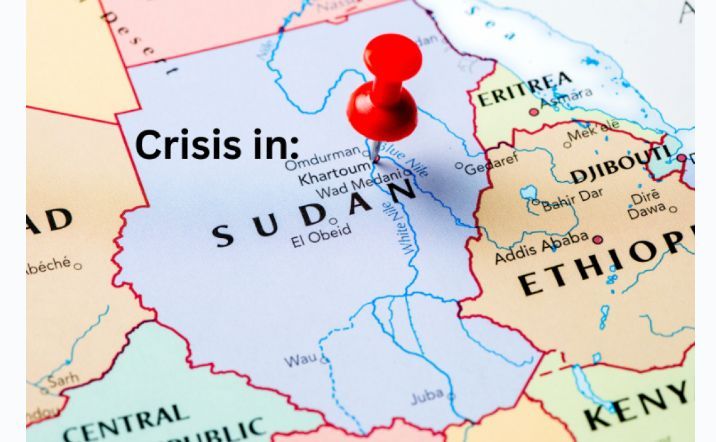
“AT least 750,000 people are on the brink of starvation and death in Sudan, where a devastating civil war has left over half the country’s 48 million people in a situation of chronic hunger, the global authority on famine says.
At least 14 areas across the country are near famine, including some in the capital, Khartoum, according to the latest figures from the Integrated Food Security Phase Classification (IPC), a group of experts from UN bodies and major relief agencies that measures hunger and formally declares famine.
The dire update appeared to confirm warnings from aid experts that Sudan is hurtling toward a humanitarian disaster on a scale not seen in decades.
“This is possibly the crisis of a generation,” said Edouard Rodier, Europe director for the Norwegian Refugee Council, who was in western Sudan recently. “I’ve never seen anything like it.”
In a report issued at the end of last month, the group said that 25.6 million Sudanese, or more than half of the population, were in a food crisis. Of them, 8.5 million are acutely malnourished or scrambling to survive while 755,000 are in a “catastrophe” – essentially, famine conditions. — Toronto Star, July 2024
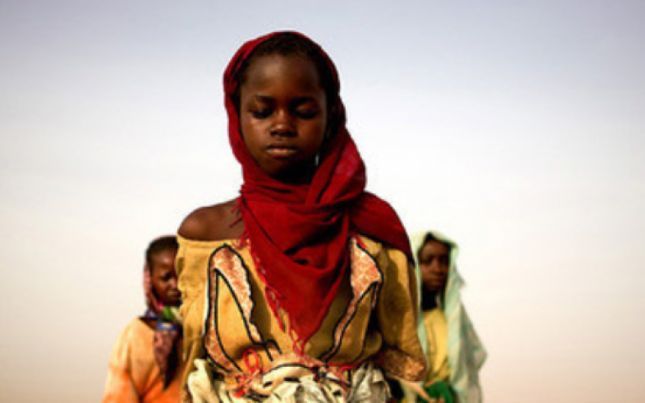
7.1 million people, including an estimated 3.3 million children, are now displaced from their homes across Sudan
Over 9 million children in Sudan—just under 50% of all children in the country—will face severe food shortages
Help the suffering people in Sudan
What does persecution look like in Sudan?
The devastating conflict that broke out in April 2023 is threatening to further undermine the positive steps made towards religious freedom following the ousting of Omar al-Bashir in 2019.
The crisis stems from a power struggle between the National Army and the Rapid Support Forces (RSF). More than 9,000 people have been killed and nearly 6 million displaced. More than 165 churches have closed and others have been destroyed. Churches have also reported human rights violations such as rape, kidnap and looting.
There are long-term concerns that the conflict will give Islamic extremists a renewed foothold in the country, undoing the reforms made by the transitional civilian government which gave more freedom to Christians, including abolishing the apostasy law and removing Islam as the state religion.
More immediately, those who convert to Christianity from Muslim backgrounds continue to face huge dangers. Some will even refrain from telling their children about Jesus, for fear they may inadvertently disclose their parents’ faith to the local community.
Who is most vulnerable to persecution?
The hostility facing Christians is particularly acute outside the capital, Khartoum. However, the epicenter of the latest conflict is the capital, where most Christians live. Many have been forced to flee, while those who remain may be forced to take sides in the conflict, putting them further at risk.
Many Christians have been attacked indiscriminately in areas such as Darfur, the Blue Nile and the Nuba Mountains region, where government forces and rebel groups are in conflict.
The levels of pressure and violence faced by Christians who are ethnic Africans or converts from a Muslim background are particularly high. Over the years, many have been arrested and charged with crimes such as espionage.” — Open Doors.org
Help the suffering people in Sudan
CAIRO (Reuters) – Sudan’s paramilitary Rapid Support Forces have committed widespread acts of sexual violence in the capital Khartoum, including gang rape and forced marriages, in its war with the armed forces, Human Rights Watch said on Monday.
An HRW report said some attacks had also been attributed to the army, which the RSF has battled since April 2023.
It cited accounts of the RSF holding women and girls in conditions that could amount to sexual slavery, and assaulting them in front of their families.
Reuters has asked the RSF and the army for comment. Both sides have previously denied responsibility for abuses during the war, with the RSF saying it would take preventative measures against human rights violations.
The HRW report quoted one woman living in an area controlled by the RSF as saying that for months she had slept with a knife under her pillow to defend herself, and a midwife saying that fear of RSF raids was constant.
definitely in the areas that the exercise control over,”They do not raid for just looting, they target specific houses because the women are there, they enter and ask for the women and girls in the house,” the midwife said.
“They do not raid for just looting, they target specific houses because the women are there, they enter and ask for the women and girls in the house,” the midwife said.
Help the suffering people in Sudan
WHAT’S THE ROLE OF FOREIGN STATES?
April 12 (Reuters) – A conflict in Sudan that erupted a year ago has wreaked havoc across swathes of the country, unleashed waves of ethnic violence in Darfur, driven millions into extreme hunger and created the world’s largest displacement crisis.
WHAT TRIGGERED THE VIOLENCE?
Tensions had been building for months before fighting between Sudan’s army and the paramilitary Rapid Support Forces (RSF) erupted in the capital Khartoum on April 15, 2023.
The conflict has played into competition for influence in Sudan and the surrounding region among regional and global powers including the United Arab Emirates, Saudi Arabia, Egypt, Ethiopia, Iran and Russia.
Gulf states have previously pursued investments in sectors including agriculture, where Sudan holds vast potential, and ports. Russia has been seeking to build a naval base on Sudan’s Red Sea coast.
The UAE has provided arms to the RSF, according to reporting by U.N. experts, while sources say Iran has flown in military support for the army.
Egypt, itself ruled by military man President Abdel Fattah al-Sisi who overthrew his Islamist predecessor, has deep ties to Burhan and the army.
Western powers, including the United States, had swung behind the transition towards democratic elections following Bashir’s overthrow. Diplomatic attention on Sudan has been limited by the wars in Ukraine and Gaza.
Help the suffering people in Sudan

 Catholic Critique