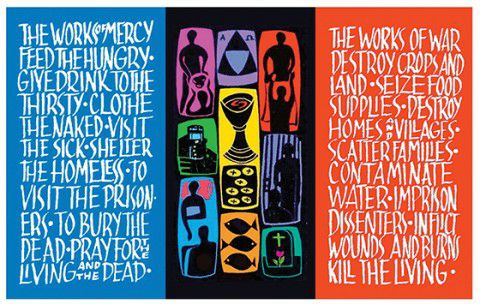
“substituting the worship of Mammon for that of Christ”
“We know in our hearts that Christ has overcome sin and death. We ask ourselves how we can best participate with him in overcoming the iniquity in the cosmos. …We were struck by [Fr. Louis] Bouyer’s statement that,
“Man can recover true life and preserve the cosmos only by rediscovering that a certain voluntary poverty is the condition for possessing the word in a way that will not reduce it to ashes.” (160) Bouyer is speaking here, as did Peter Maurin and Dorothy Day, of the detachment taught to Christians from the time of the early Church.
In a consumer culture, often this vision of voluntary poverty is lost. Bouyer recounts that in earlier centuries, human persons saw the world “as a meaningful cosmos oriented toward transcendence, a sense of which had previously been imparted to our lives by contemplation of the universe.” As early as the fifteenth century, though, and in the following centuries, “we see Christianity degenerate into a mere support or cover for a society which followed instead the bourgeois ideal in a society ‘based directly and perhaps exclusively on money.’”(122)
Bouyer starkly declares that “Wealth became the supreme means of gaining, in this world, not only a much coveted (through rarely if ever attained) security, but also what was to be called comfort… This new civilization was progressively to inactivate all specifically Christian characteristics, simply by substituting the worship of Mammon for that of Christ, while maintaining Christian forms “ (p. 121-122).
This worship of money (avarice, one of the capital sins) is directly related to the destruction of the cosmos through pollution, green house gases, overuse of plastics and other harmful chemicals, the development and sale of terrifying weapons, and for example, the exploitation of the earth to the detriment of poor workers. Few in power are willing to sacrifice their wealth.
Pitfalls in Technique and Technology
Already in 1982 Bouyer published his critique of technology in Cosmos: “Evidence of this explosive and demonic progress of a technology that is good in itself toward an exclusively technological ideal is shown in the increasing tendency to substitute a wasteful economy of conspicuous consumption, destructive of natural resources, for the various economies, now considered obsolete, which allowed or positively promoted renewal of these recourses, by respecting the natural rhythms of plant and animal life.” A danger is that “Not only does it replace the original vitality of the cosmos with an accumulation of machines—in fact turning the entire cosmos and all human society into a monstrous machine operating to no useful purpose.”— P.158, Houston Catholic Worker, excerpt April 2024
Careers of the 1950s gave way, to became jobs in the 1960s-90s. And today, increasingly, we are left to find tasks to do in order to find housing, clothing and find food for our babies.
Top photo: religious art in film from Franco Zeffirelli’s 1977 classic Jesus of Nazareth
+ Fr Louis Bouyer on the Liturgical Reform and It’s Architects