“And fate made everybody equal Outside the limits of the law. Son of a kulak or Red commander, Son of a priest or commissar . . .
Here classes were all equalized, All men were brothers, camp mates all, Branded as traitors every one . . .
—Alexander Tvardovsky, “By Right of Memory”
It all begins on the radical Left.
““I said to him: ‘Vladimir Ilyich, if you come to power, you’ll start hanging the Mensheviks the very next day.’ And he glanced at me and said: ‘It will be after we’ve hanged the last Socialist-Revolutionary that the first Menshevik will get hanged.’ Then he frowned and gave a laugh.”
A Warning
“Three weeks before the October Revolution, Lenin himself was already sketching out an admittedly vague plan to organize “obligatory work duty” for wealthy capitalists. By January 1918, angered by the depth of the anti-Bolshevik resistance, he was even more vehement, writing that he welcomed “the arrest of millionaire-saboteurs traveling in first- and second-class train compartments…”6
Lenin’s vision of labor camps as a special form of punishment for a particular sort of bourgeois “enemy” sat well with his other beliefs about crime and criminals. On the one hand, the first Soviet leader felt ambivalent about the jailing and punishment of traditional criminals—thieves, pickpockets, murderers—whom he perceived as potential allies. In his view, the basic cause of “social excess” (meaning crime) was “the exploitation of the masses.”
The removal of the cause, he believed, “will lead to the withering away of the excess.” No special punishments were therefore necessary to deter criminals: in time, the Revolution itself would do away with them. Some of the language in the Bolsheviks’ first criminal code would have thus warmed the hearts of the most radical, progressive criminal reformers in the West.
Among other things, the code decreed that there was “no such thing as individual guilt,” and that punishment “should not be seen as retribution.”
On the other hand, Lenin—like the Bolshevik legal theorists who followed in his wake—also reckoned that the creation of the Soviet state would give rise to a new kind of criminal: the “class enemy.”
A class enemy opposed the Revolution, and worked openly, or more often secretly, to destroy it. The class enemy was harder to identify than an ordinary criminal, and much harder to reform. Unlike an ordinary criminal, a class enemy could never be trusted to cooperate with the Soviet regime, and required harsher punishment than would an ordinary murderer or thief.
Thus in May 1918, the first Bolshevik “decree on bribery” declared that: “If the person guilty of taking or offering bribes belongs to the propertied classes and is using the bribe to preserve or acquire privileges, linked to property rights, then he should be sentenced to the harshest and most unpleasant forced labor and all of his property should be confiscated.”

From the very earliest days of the new Soviet state, in other words, people were to be sentenced not for what they had done, but for who they were. Unfortunately, nobody ever provided a clear description of what, exactly, a “class enemy” was supposed to look like. As a result, arrests of all sorts increased dramatically in the wake of the Bolshevik coup (*). From November 1917, revolutionary tribunals, composed of random “supporters” of the Revolution, began convicting random “enemies” of the Revolution. Prison sentences, forced-labor terms, and even capital punishment were arbitrarily meted out to bankers, to merchants’ wives, to “speculators”— meaning anyone engaged in independent economic activity—to former Czarist-era prison warders and to anyone else who seemed suspicious.
~

Stalin: Paradoxes of Power by Stephen Kotkin
~
The definition of who was and who was not an “enemy” also varied from place to place, sometimes overlapping with the definition of “prisoner of war.” Upon occupying a new city, Trotsky’s Red Army frequently took bourgeois hostages, who could be shot in case the White Army returned, as it often did along the fluctuating lines of the front. In the interim they could be made to do forced labor, often digging trenches and building barricades.
The distinction between political prisoners and common criminals was equally arbitrary. The uneducated members of the temporary commissions and revolutionary tribunals might, for example, suddenly decide that a man caught riding a tram without a ticket had offended society, and sentence him for political crimes
In the end, many such decisions were left up to the policemen or soldiers doing the arresting. Feliks Dzerzhinsky, founder of the Cheka—Lenin’s secret police, the forerunner of the KGB— personally kept a little black notebook in which he scribbled down the names and addresses of random “enemies” he came across while doing his job.”
Red Terror
Almost as soon as it was created, the Cheka was given an extraordinary task to carry out. On September 5, 1918, Dzerzhinsky was directed to implement Lenin’s policy of Red Terror. Launched in the wake of an assassination attempt on Lenin’s life, this wave of terror—arrests, imprisonments, murders—more organized than the random terror of the previous months, was in fact an important component of the civil war, directed against those suspected of working to destroy the Revolution on the “home front.” It was bloody, it was merciless, and it was cruel—as its perpetrators wanted it to be.
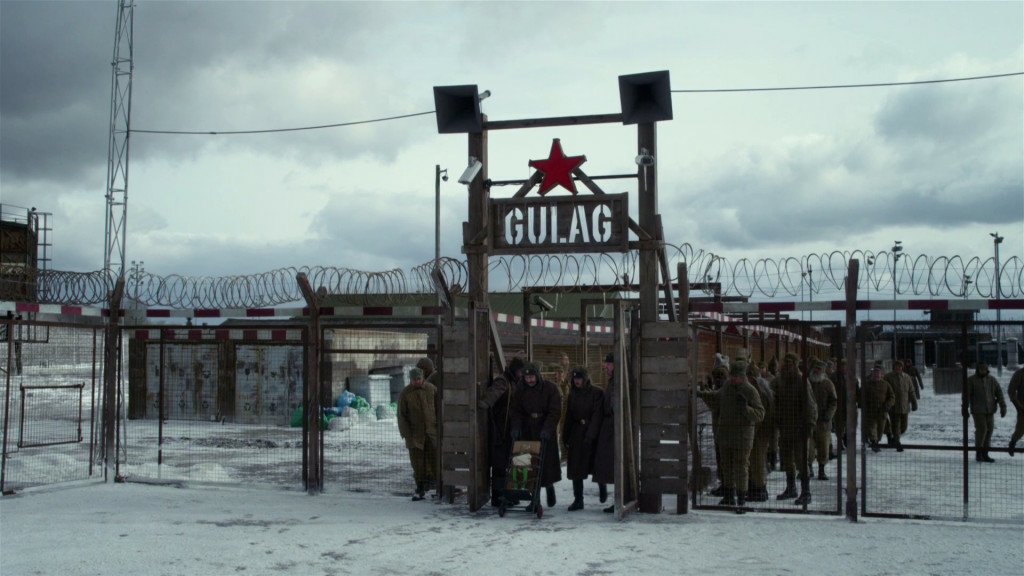
Krasnaya Gazeta, the organ of the Red Army, described it: “Without mercy, without sparing, we will kill our enemies in scores of hundreds. Let them be thousands, let them drown themselves in their own blood. For the blood of Lenin . . . let there be floods of blood of the bourgeoisie—more blood, as much as possible . . .”24 The Red Terror was crucial to Lenin’s struggle for power. Concentration camps, the so-called “special camps,” were crucial to the Red Terror. They were mentioned in the very first decree on Red Terror, which called not only for the arrest and incarceration of “important representatives of the bourgeoisie, landowners, industrialists, merchants, counter-revolutionary priests, anti-Soviet officers” but also for their “isolation in concentration camps.”
Although there are no reliable figures for numbers of prisoners, by the end of 1919 there were twenty-one registered camps in Russia. At the end of 1920 there were 107, five times as many… Mass executions seemed to take place almost at random, and many prisoners recall feeling terrified by the prospect of arbitrary death. Likhachev claims to have narrowly escaped execution in one mass murder in late October 1929.x
— from “Gulag: A History” by Anne Applebaum
(*) The James Lindsay linking is to show the continuity to our time.
+ Mao’s Politics of Compliance

