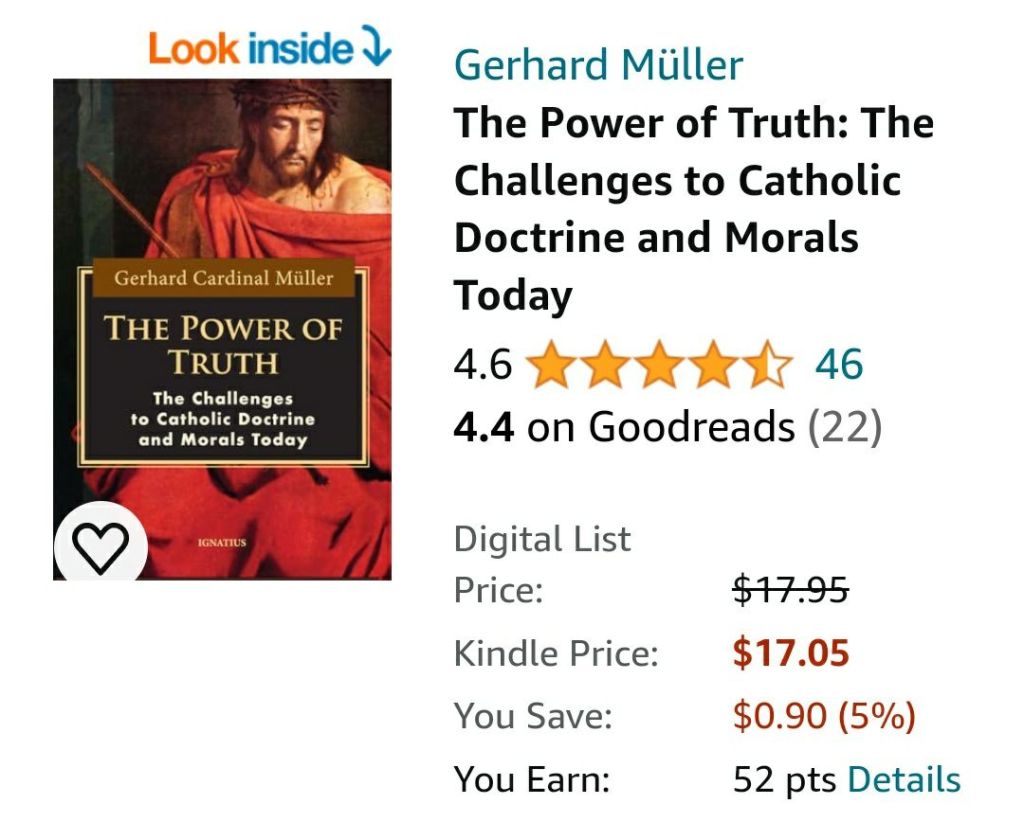
Cardinal Müller, former head of the Vatican’s Congregation for the Doctrine of the Faith under Benedict XVI, asks in his book The Power of Truth, “How do the pope’s Magisterium and the Tradition of the Church relate? When he interprets the words of Jesus, must the pope be in continuity with the Tradition and the previous Magisterium, including that of the most recent popes? Or is it rather the Church’s Tradition that has to be reinterpreted in the light of the pope’s new words? What if there are contradictions?”
Introduction
“The political, cultural, and moral crisis of the West is immense and affects all mankind. There is no generally recognized system of values on which to build. Even crimes against humanity are justified by ideological and pseudo-religious fanatics in order to force acceptance of their demand for totalitarian power. Even in countries with a long, solid tradition of democracy and constitutional law, human rights are being subjugated to the latest majority decision. In how many states are the fundamental human rights observed unconditionally in theory and practice?
In nations where it is a deeply rooted tradition, freedom of religion and conscience is suddenly up for debate. Someone who, for example, rejects the killing of a child in his mother’s womb or assisted suicide because life is an inviolable gift of God, and considers the equation of marriage with sexual relations between persons of the same sex to be a degradation of the lifelong partnership of a man and a woman, can be prosecuted for alleged intolerance. This disaster follows from the denial of objective truth, which is founded in God, the Creator of the world, and in the nature of things and becomes manifest in rational human thought. If truth is merely subjective and finds its criterion only in individual advantage and pleasure, then we have not arrived in the kingdom of freedom but are stranded in the “dictatorship of relativism”.1
This general state of being, intellectually and morally adrift, can be overcome by the Catholic Church only if she points people to “Christ, the Son of the living God” (Mt 16:16) through the spoken words of the pope and the bishops. Catholics—and Christians of other denominations, too, and people of good will—rightly expect from the Church’s Magisterium the testimony of Jesus, the incarnate Son of God. He says about himself that he is the only way to the Father (Jn 14:6). In him personally, truth and life are not constructs of an overwrought intellectual ingenuity dreamed up by mortal, fallible human beings, but rather the forms of the personal encounter with the one true God in his Spirit, who gives life and bestows on us the “glorious liberty of the children of God” (Rom 8:21).
Someone who follows Jesus finds in the obscurities of this earthly existence the sure way to the knowledge of God. To him is given sure instruction on how he should behave toward the world and toward the fellow individuals in his family and in the other forms of communal life. God does not restrict our freedom but rather substantiates it. And the knowledge of the world in the sciences and the analysis of mind, society, and material nature in philosophy are not in contradiction to faith in God as the origin and goal of the entire universe, but rather are a first step toward the knowledge of God and love for him, which first come to perfection in the historical self-revelation of the triune God.
The Church, however, can carry out her mission of leading people to God only if she puts the light that she received from her Lord, not under a bushel basket, but rather on the lampstand (Mt 5:15, Mk 4:21; Lk 8:16; 11:33), so that everyone knows, through the light of Christ, the hope to which they are called.
Reform of the Church exists only as a better preparation of her servants for their mission, and not as adaptation to a “world without God”. Salvation is valid for all peoples. Christ did not declare his solidarity with intellectual and moral blindness so as to be “closer to the people”, as one pastoral cliché says. He is the Emmanuel, the God-with-us, as “Light to the Gentiles and the glory of his people Israel” (cf. Lk 2:32).
The Magisterium of the Church must speak plainly and clearly, not because contemporary man cannot bear the pluralism and immensity of the modern world, but rather because it corresponds to his dignity to receive from God “the glory of the only-begotten Son from the Father, full of grace and truth” (cf. Jn 1:14).
Truth is not an abstract theory in the heads of a few individuals, but rather the ground on which everyone finds stability and strength, and the source from which all can quench their thirst for God and eternal life (Jn 4:14). Only the unambiguous character of the doctrine of the faith makes possible the breadth of the pastoral perspective and an orientation toward the goal, and this is so from every starting point. For God wills the salvation of all mankind and also that everyone should come to the knowledge of God and of the truth of his revelation (1 Tim 2:4).
But how can the Church perform her service to God’s truth and to the salvation of mankind if the credibility of many shepherds and teachers of the faith is shaken by seriously immoral conduct and deliberately caused confusion in their teaching of faith and morals?
The author of this volume gives to current questions an answer that is based on the Word of God in Sacred Scripture and Apostolic Tradition. What is “Catholic” is not the result of chance majorities in synods and personal ideas of the pope and the bishops. The Magisterium is bound to the natural moral law, as well as to the revelation that was concluded in Christ and the Apostles and to the dogmatic decisions of the ecumenical councils and papal ex cathedra decisions.
In various essays on the indissolubility of marriage, on the validity of Humanae Vitae, on the uniqueness of the Church, on ecumenism, on the development of doctrine that rules out any change of doctrine into its opposite, on the possibility of non-Catholic Christians receiving Communion only in danger of death, on priesthood and celibacy, and on other articles of faith, the author, in his capacity as a Catholic bishop and a cardinal of the Holy Roman Church, tries to set forth the necessary clarity of the Church’s salvific doctrine. Our attitude toward the truth revealed to us by God cannot depend on a psychological condition, a conservative or progressive cast of our mind. This politicizing interpretation of all events in the Church results from a preoccupation with power, whereas the faith springs from the truth and unites the Church in Christ.
It is unimportant whether someone feels that the Church’s social teaching and her commitment to freedom and social justice is a good thing and does away with the doctrine about Christ’s divine Sonship as something conservative and dogmatic. In truth, only someone who comes from Christ can be open to the people of today.
Man is ordered to God in time and eternity. Only someone who acknowledges Christ as the mediator between God and mankind can accomplish something positive and constructive for the world, society, and the Church in the light of divine truth. We do not want to hide Christ’s truth from the world out of cowardice and hide our cross and deny the Lord out of human respect.
The Church finds herself in the crisis of faith, like Simon Peter before Christ’s Passion—and he was the first of the disciples, on whom the Lord intended to build his future Church after his victory over sin and death. No one other than Satan demanded that he be allowed to sift the disciples like wheat, so that the wheat is separated from the chaff and maybe even good people fail and no one stands by Christ any more in the midst of temptation, seduction, and persecution throughout the world.
But Jesus prayed for Peter and in him for the whole Church, that their faith would not fail and waver. And in the midst of what is perhaps the greatest upheaval in the Church since the divisions of the sixteenth century and the greatest persecution of Christians in history to date, Jesus says to Peter in our day, and thus to the pope, the bishops, and every individual believer, the liberating word: “And when you have turned again, strengthen your brethren” (Lk 22:32). That we might find support in the faith and overcome the present temptation to apostasy, schism, and resignation, but at the same time not succumb to the danger of overestimating ourselves and relying on our own activity instead of on grace—that is the goal of the present book.”
That we might find support in the faith and overcome the present temptation to apostasy, schism, and resignation, but at the same time not succumb to the danger of overestimating ourselves and relying on our own activity instead of on grace—that is the goal of the present book. –from the Introduction
“You shall know the truth,” Jesus said, “and the truth will make you free” (Jn 8:32). Such is the liberating power of truth. In this book, Gerhard Cardinal Müller, former head of the Vatican’s Congregation for the Doctrine of the Faith, unabashedly defends the truth of salvation taught by Christ and the Roman Catholic Church. He discusses how Catholic teaching addresses present-day crises in the Church and in the world.
This book also includes the cardinal’s recently released Manifesto of Faith. Relying heavily on The Catechism of the Catholic Church, it clarifies certain Church doctrines that have lately seemed to be in doubt.