By Solange Hertz
Any citizen doubting that the Old Religion of the alchemists is the state religion of the U.S. need only make a pilgrimage to the nation’s capital, beginning with the Prayer Room established in the Capitol by joint resolution of Congress in 1954. He will find there for his devotion a small central altar flanked by two seven-branched candelabra, above which rises a stained glass window showing George Washington kneeling. Below the Father of his country is the Great Seal of the United States.

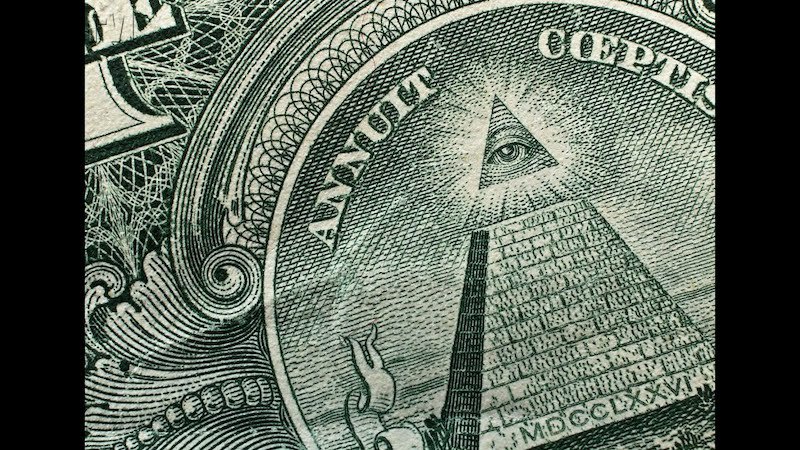
Above him is the truncated pyramid surmounted by the eye of Horus which constitutes the seal of Masonry and the Illuminati. A Masonic Service Association pamphlet informs us that the capital’s three most important monuments – the Capitol, the White House and the Washington Monument – were “all three begun under Masonic auspices; all three had cornerstones laid by Masonic hands; all three have Masonic associations which are a part of history, and the first of its forty cornerstones marking the boundaries of the District of Columbia … was also Masonically laid.”
The famous James Hoban, architect of the White House, also happened to be the first Master of Federal No.1, Grand Lodge of the District of Columbia. A second cornerstone was laid at the Capitol on July 4, 1851, when construction began on the Senate and House wings. We are told, “Deposited in the cornerstone was a composition handwritten by Daniel Webster; in it he stated that the stone was laid by the President of the United States and the Grand Master of Masons.”
The third cornerstone was likewise Masonically laid on Sept. 18, 1932 beneath the east steps, and contained a copper box filled with Masonic relics and records. Lest Catholics think they had no part in these rituals, we must note that the Archbishop of Baltimore’s Masonic brother Daniel Carroll was present at such occasions in an official capacity. His cousin, Charles Carroll of Carrollton, quite gratuitously in his nineties took part in the Masonic ceremony inaugurating the nation’s first railroad, the Baltimore and Ohio, on July 4,1828, by turning over the first bit of earth with a silver spade. He remarked on the occasion, “I consider this among the most important acts of my life, second only to my signing of the Declaration of Independence, if second even to that!” – so clearly did he see how indispensable scientific progress was to the great work of democracy.
“Throughout the Colonies,” says another Masonic pamphlet: Masonry was everywhere active, indirectly as an Order, but directly through its members, in behalf of a nation ‘conceived in liberty and dedicated to the proposition that all men are created equal’; which is one of the basic truths.
Pope Leo XIII Encyclical on Freemasonry
It was not an accident that so many Masons signed the Declaration of Independence, or that Washington and most of his generals were members of the Craft. Nor was it by mere chance that our first President was a Mason, sworn into office on a Bible taken from a Masonic Altar, by the Grand Master of New York. Such facts are symbols of deeper facts, showing the place and power of Masonry in the making of the nation.
Along the Atlantic coast, among the Great Lakes, in the wilderness of the Middle West, in the far South and the far West, everywhere, in centers of population and in little Upper Rooms on the frontier, the Lodge stood alongside the Home, the School and the Church. As the “Old Charges” of Masonry declare, the only religion recognized by Masonry is “that natural religion in which all men agree.”
One of their “Short Talk Bulletins” points out that the signers of the Declaration believe in God, but “He is no sectarian God; He is the Father of all men; He is the energizing and controlling force of the universe.” This is clearly not the Creator, yet, “It was that concept of Deity which Masonry adopted as early as 1723 in Anderson’s Constitutions.” Regarding the U.S. Constitution we read:
That 31 Masons of 55 Deputies had the fundamental teachings of the Fraternity in mind when they labored to produce a fundamental law to act as a cement never to give way, between peoples and States of greatly varying size, power, wealth, industry, climate, ideas and ideals, is not only understandable – it was inevitable.
Thus were all souls in God’s America forced to “meet upon the level and part upon the square” of defined Masonry, whether they realized it or not. The new state religion depended vitally on the Bill of Rights to keep its footing among a population still militantly Christian, especially on the first, fourth and fifth amendments. These guaranteed free exercise of any religion, including the necessary freedom of speech and press and the right to assemble, in order that falsehood might be propagated along with truth; no searching without proper warrants; and indictments for capital crimes only by a Grand jury. Our informant says that without such curbs, “An agent of a government not restrained from interfering with free speech could visit our Lodges, accuse any of us of prohibited speech, and arrest and punishment would follow,” whereas, sheltered by the Bill, “In nearly 16,000 Lodges in the U.S., Freemasons peaceably assemble as often as they desire,” and, “No civil authority may arrest a Freemason, throw him in jail, punish him in any manner, for being a Freemason,” as was still possible in Christian Europe until fairly recently.
+
We are told, “Freemasonry is not, per se, a religion. It is religion in the abstract.” It nevertheless manifested all the characteristics of “a” religion very early (e.g., cult, beliefs, rituals–SH), even a trinitarian one, for curiously enough its theological virtues are three: Liberty, Equality and Fraternity. And these are ordered in turn to three human goals: life, liberty and the pursuit of happiness.
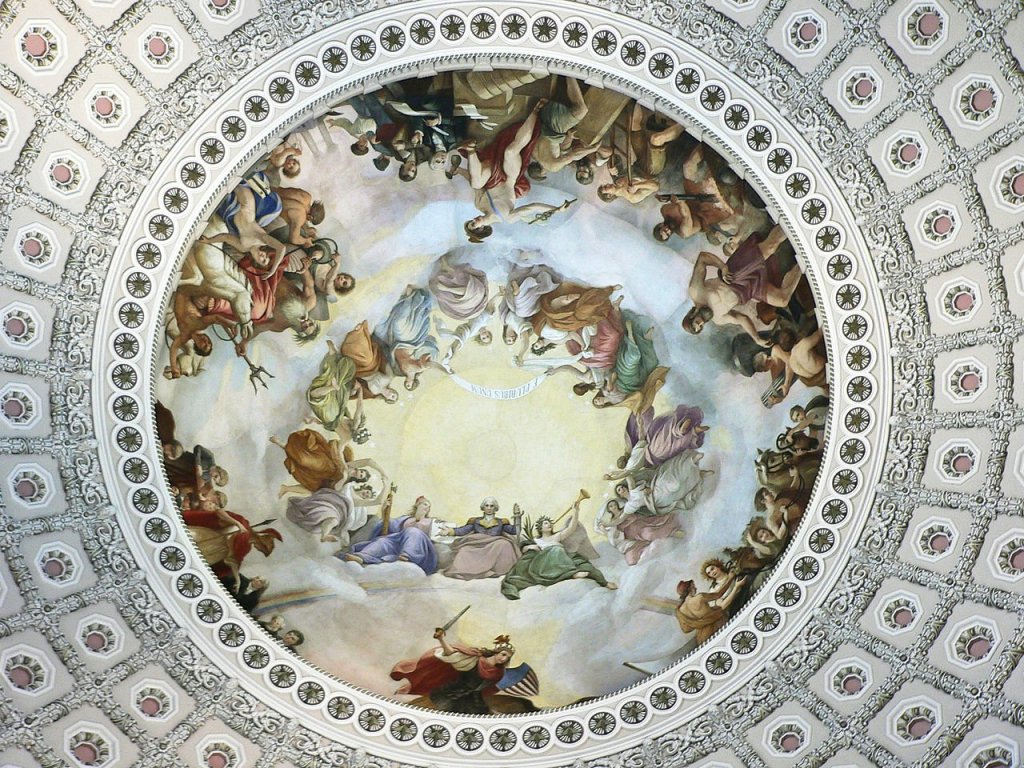
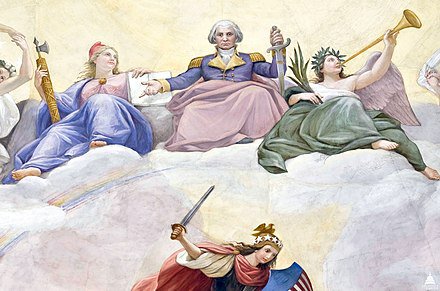
We cannot help but wonder whether Masonry is not the mirror-image of something else. In America Masonry produced its own trinity of persons quickly enough: George Washington, Benjamin Franklin and Thomas Jefferson, who stand today at the apex of an elaborate secular mythology. Washington, popularly known as “Father of his country,” was apparently designated to fill the role of a Jovian God the Father. This is a bit of a joke in Virginia, which was closer to some of his personal activities than other parts of the country. In any case it is as Father that Brumidi blasphemously depicted him on the dome of the U.S. Capitol where he swirls in majesty among the splendors of the new heavens, lording it over an assembled revolutionary iconography where Franklin figures prominently, deep in conversation with Minerva.
Even on earth the atmosphere surrounding Washington was ultra-Masonic, as Masons themselves avow. All the staff officers he trusted were Masons, as were the leading generals. We have Lafayette’s word that,:…
“After I was made a Mason, General Washington seemed to have received a new light. I never from that moment had any cause to doubt his entire confidence. It was not long before I had a separate command of great importance.” Anyone tempted to minimize Washington’s serious connection with the Craft need only read J.F. Sachse’s Washington’s Masonic Correspondence, based on letters in the Library of Congress.

The young, dynamic Thomas Jefferson falls easily into the role of the “Holy Spirit” of America’s new age. Although records of his initiation have not been found, he too is claimed quite rightly by Masonry. In close contact with the most radical intellectuals of the Enlightenment abroad, even the most disreputable, he breathed life visibly into the democratic scriptures then being penned, tracing with his own august finger the words of the Declaration of Independence – not to mention a vast personal correspondence.
Jefferson was a kind of super-Mason, said to have been a high-ranking member of the Illuminati who directed the Great Work from above, and who formed his intimate acquaintance. Not only propagating their doctrine by writing, he contrived to have their insignia engraved secretly on the reverse of the Great Seal of the United States.
By 1933 the Work had progressed to the point where Franklin Roosevelt, his spiritual descendant in the Presidency, could commemorate the New Deal by having the insignia printed on the one- dollar bill in plain sight without the slightest opposition.
As we saw, twenty years later it was occupying the place of honor in the Capitol Chapel. Although by far the oldest of the trio, to Benjamin Franklin must be accorded. the place of “Son.” Not only was he in the United States in the beginning, but in a very real sense the United States was made through him. Certainly without him was made little or nothing that was made. In him the Great Work took on flesh, as it were, and became readily visible to all for the first time.
Where the personally ambitious and money-loving Washington tended to be pedestrian and sanctimonious, and Jefferson preoccupied with words, ideas and sketches, Franklin concentrated on action. As we shall see, he fulfilled for Democracy a function very like the one Lenin performed for Communism. He put the Great Work to work, and to as many as received him, Franklin gave the power of becoming sons of his God.
Master Propagandist

It would be difficult to overrate the natural genius of this extraordinary man. In his Epitaph he calls himself a printer. And so he was, with printing playing much the same role in his life that gold-making played in Alchemy. By its means he put together the first controlled press in America, his Pennsylvania Gazette soon heading a whole network of subsidiaries throughout the Colonies like the New York Journal, the Boston Gazette, and myriad lesser breed. These constituted a Masonic press, staunchly anti-Papist and preaching its own doctrine indefatigably in political dress.
Franklin was a master propagandist. It is well known how he maintained European indignation at fever pitch against the British and loyalist Americans by atrocity stories which could not get by at home, but which he circulated via his fake newspaper the Boston Independent Chronicle, regular “reprints” of which were distributed abroad from Holland. Bernard Fay concludes it was such papers, in conjunction with taverns, the Lodges and the cooperation of certain preachers and merchants which actually fabricated the American Revolution. No informed historian will deny that Franklin was the most unwavering and orthodox of believers in eighteenth century Masonry. His conversion was entire and sincere, his passionate adherence to its tenets having occurred long before he ever joined a Lodge. As a matter of fact, he had to use certain unethical means to get accepted, for the Philadelphia establishment comprising the Lodge of St. John of Jerusalem was openly disdainful of the popular, witty little printer, who furthermore had had the audacity to form a debating society called the Junto, in some ways a rival organization composed of small artisans and proletariat. To make a long story short, he blackmailed the Lodge into admitting him, by printing in his Gazette on December 8, 1730 a report supposedly from London claiming to expose the Masonic mysteries. “Their Great Secret,” it read, “is THAT THEY HAVE NO SECRET AT ALL!”
See also, When the State is Ultimate
A few weeks later Franklin was invited to join, and thereafter the Gazette published only flattering allusions to the Brothers. In 1734 he put out an American edition of Anderson’s Constitutions, the first Masonic book printed in America, and in 1752 planned the new Lodge building. Fay calls him “the soul of this Philadelphia Lodge, and the strongest link between all American Masons.” A gifted linguist and tireless traveler, everywhere he went here and abroad, even in Holland and Germany, he seemed to leave behind him a veritable Franklin cult which canonized his jokes as it did his ideas. He served twice as Provincial Grand Master of Pennsylvania and later for two years as Worshipful Master of the famous French revolutionary Lodge of the Nine Muses, to which he introduced Voltaire. He also became a member of the French Order of St. John of Jerusalem, as well as Honorary Venerable of the Lodges of the Temple at Carcassonne and other provincial cities. Fay believes, “Franklin’s spiritual dictatorship in France would not have varied much from other French eighteenth century fads had he not been the champion of Masonry and its living symbol.” There: Through the Masons he had access to the newspapers which were officially controlled by the Government, but which were really written by the Masons and the philosophers, such as Morellet, Suard and De la Dixmerie, who were all Franklin’s friends.
Practically all of the French newspapers published outside of France were in the hands of the Masons also. Franklin had his writings accepted without any trouble. He excelled as a diplomat, but with this battery behind him, it is easy to see how he was able almost singlehandedly to force the reluctant Louis XVI into the fateful Franco-American Alliance against the British which must have done violence to this pious king’s deepest Catholic principles, and which turned the tide for the Revolution.
Franklin’s links with English Masonry had been even closer, for entwined with his Masonic activities and his publishing enterprises was a flourishing official life. Even under English rule he had risen to the position of Deputy Postmaster General of the English Post Office in America, besides representing several of the Colonies to both Crown and Parliament before the Revolution. As member of the General Assembly of Pennsylvania delegated to the Albany Convention, he submitted a plan for colonial union illustrated, as we have seen, by the first formal effigy of the Ouroboros in America.
As a first consequence, he was charged with raising troops and forts against the Indians in the wilderness. For Franklin and his fellows, Indians were not souls to convert, as they had been for Columbus and the Catholic explorers, but enemies to be driven back or exterminated. While a delegate to the second Continental Congress, he corrected the first draft of the Declaration written by Jefferson, and later was named a member of the Constitutional Convention. With the Carrolls he formed part of the Commission to Canada which hoped to spread the revolt there, and eventually was chosen by Congress as one of three to discuss final peace terms with General Howe. From 1776 to 1785 he served as Ambassador to France, from whence John Adams wrote of him,
“Franklin’s reputation was more universal than that of Leibnitz or Newton, Frederick or Voltaire; and his character more esteemed and beloved than all of them.” Sheer lack of space forbids dwelling on all his other activities. He formed the first real police force in the Colonies, not to mention the fire department, a public library and an academy destined to become the University of Pennsylvania, besides laboring to improve street paving and lighting and hospital services. He even took time to campaign for paper currency and to invent his celebrated “Franklin stove” and countless lesser useful devices.
As we shall see, however, he was no capricious dilettante. His most widely divergent interests were but so many scattered building stones for the greater Work to which he was dedicated. “Under cover of Masonry,” Fay points out, “the Philadelphia sage elaborated his philosophical system, launched his ideas, and launched himself” in truly ouroboric style. Although blessed with little formal education, Franklin was honored by the freedom of the city of Edinburgh and made a Doctor of Laws by the University of St. Andrews. Already a Master of Arts of Harvard, Yale and William and Mary at home, he was also made Doctor of Civil Law at Oxford, where he had so many intimate friends engaged like him in the Great Work.

The Philosophical Society
The organ par excellence suited to his purpose was the American Philosophical Society, founded by him thirty years before the Revolution. Riding the crest of the vogue for science unleashed by Newton’s theories, the Society was designed to assemble the sharpest minds in the Colonies for the promotion of scientific discovery and useful invention. Knowing America’s pathetic craving for her vanished aristocracy, Franklin determined to supply her with one of the mind, drawn entirely from herself and free of allegiances to the ancient Christendom of which the United States never formed a part.
In the aura of the Philosophical Society, Franklin the Sage becomes Franklin the Mage, foremost alchemist of the secular age. Following in the footsteps of Desaguliers and Newton, he would capture the Universal Magical Agent and expose the secret of the universe! Pike spoke of it in the authoritative Morals and Dogma: There is in nature one most potent force, by means whereof a single man, who could possess himself of it, and should know how to direct it, could revolutionize and change the face of the world … this agent … is precisely what the Adepts of the middle ages called the elementary matter of the Great Work. The Gnostics held that it composed the igneous body of the Holy Spirit; and it was adored in the secret rites of the Sabbat or the Temple, under the hieroglyphic figure of Baphomet or the hermaphrodite goat of Mendes. If we are to believe Pike and the alchemists, the Holy Ghost, God himself, is nothing but a supreme natural force, which men have persisted in investing with divinity. For them, penetrating the divine secrets is merely a matter of understanding the workings of nature.
The venerated Emerald Tablets of Hermes lay down as principle that, “What is below is like what is above, and what is above is like what is below, to perpetrate the miracles of one thing.” This is a direct contradiction of the revelation of the Son of God, Jesus Christ, who said, “He that cometh from above is above all. He that is of the earth, of the earth he speaketh” (John 3:31). Of what else can the Serpent speak, to whom God said, “Thou art cursed … and earth shalt thou eat all the days of thy life?” (Gen. 3:14). But, objects Pike: There is a Life-Principle of the world, a universal agent, wherein are two natures and a double current, of love and wrath. This ambient fluid penetrates everything. It is a ray detached from the glory of the Sun, and fixed by the weight of the atmosphere and the central attraction. It is the body of the Holy Spirit, the universal Agent, the serpent devouring his own tail.
With this electromagnetic ether, this vital and luminous caloric, the ancients and the alchemists were familiar. Seen in this context, Franklin’s famous experiment with a kite and a key in a thunderstorm, known to every schoolchild, takes on wholly new and portentous meaning. Now we know what he was after: the “electromagnetic ether” of the alchemists, call it electricity, magnetism, life-force, serpent-power or what we will. We have only Joseph Priestley’s word that Franklin personally performed this risky feat, and if he did, the wonder is that he was not electrocuted, as happened to others. All we have from Franklin’s pen is a detailed description of how to go about it, found in a letter to the London scientist Collinson dated Oct. 19, 1752, where he says that the suggestion he had made in France for drawing lightning from the clouds by means of an elevated rod had been successfully acted on, but that he thinks this kite idea is better. It was well known, as Fisher says, that he had “a rod erected on his house to draw down into it the mystical fire of any passing clouds, with bells arranged to warn him when his apparatus was working.” The bells were in his study and caused his wife considerable uneasiness. Once he was struck senseless trying to electrocute a turkey – a bird he later proposed for our national emblem in lieu of the eagle.
He was only one of many such experimenters in his day, for “magnetism” was not only a craze among the revolutionary elite. It was the major sideshow attraction offered by wandering magicians and charlatans of all kinds on the village greens. As a matter of fact, it was one of these, a Dr. Spencer, who first acquainted Franklin with electricity in his youth. Everyone wanted to feel a shock. In Madrid Franklin’s bitter rival and correspondent, the French priest-scientist Abbé Nollet, managed to electrify a whole regiment at once, and in Italy it was used as a cure for paralysis. Franklin never wrote a book on science, but Collinson kept his letters, and when he published them in 1751 as New Experiments and Observations in Electricity Made at Philadelphia in America, their writer immediately became world famous. After Priestley put out The History and Present State of Electricity in 1767, Franklin actually displaced Newton as first sage of the universe in the popular mind. (Long the declared enemy of establishments political and religious, Priestley had deemed it healthier after the French Revolution to leave England for Pennsylvania, where he declined the chair of chemistry at the University of Pennsylvania in order to devote himself to Unitarianism.)
Franklin’s fame justly rested on his resolution of the burning question of the day: Were lightning and electricity the same thing? In less than four years he demonstrated that they were, simply by showing that their characteristics were identical. He even proved this scientifically, eliminating in the process all the learned jargon concerning the “two kinds” of electricity which a century later Pike was still referring to esoterically as “two natures and a double current, of love and wrath.” He called one positive and the other negative, and designated them by ordinary plus and minus signs.
The New Prometheus
The final triumph of Alchemy seemed imminent. Fay writes, “Lightning had become a plaything for men, and Jupiter, empty- handed, had nothing to do but return to Olympus and make love with Juno. He could no longer frighten human beings.” When Franklin wrote “How to Secure Houses &c. from Lightning,” with lightning-rods springing up all over the Colonies, America entered visibly into the Great Work of perfecting her matter and creating the Perfect State. Science had invented something practical and exciting for the first time; it had made progress which all could see, appreciate and utilize. By this brilliant invention Science had reduced the realms of religion and annexed those provinces which had hitherto belonged to Faith and Prayer. In all countries and in all religions, but especially in America, where man appeared so weak before the overwhelming forces of Nature, earthquakes and electrical storms seemed to be direct and wrathful manifestations of God. The doctrines of the New England clergymen were clear on this point … The most liberal of them admitted that there might be secondary causes, but that thunder had only the primary cause of God and His wrath … The lightning rod … became an object of attack for many churchmen.
No Catholic priests seem to have been among them. The liberal Fr. John Carroll, later a good friend of Franklin and first Bishop in America, would hardly have countenanced such sentimental resistance. So strongly sympathetic was he to the aims and ideals of the revolutionaries that he refused to take his oath of office until Rome agreed to delete from it the episcopal obligation “to extirpate heretics.”
As it is, the ministerial attacks draw only smiles today, when even lightning rods are smiled at; but these churchmen knew instinctively, if for the wrong reasons, that the Enemy was at work here, and they said so. The promethean character of Franklin’s apostolate was not lost on them. The French finance minister Turgot had in fact openly acclaimed Franklin as the new Prometheus, the ancient Gnostic hero of pagan mythology canonized by Aeschylus, who defiantly stole fire from heaven and gave it to man in order to release him from the tyranny of Zeus. The Great Work had just taken a giant stride, whereby modern man was soon to be released forever from his dependence on the Christian God.
By means of electricity, Alchemy would achieve its age-old double objective: complete control of the forces of nature, and the indefinite prolongation of life. Soon, at last, man would create himself. Over a century ago Pike predicted: It is a universal agent, whose supreme law is equilibrium; and whereby, if science can but learn to control it, it will be possible to change the order of the Seasons, to produce in night the phenomena of day, to send a thought in an instant round the world, to heal or slay at a distance, to give our words universal success, and make them reverberate everywhere. To what degree all this has already come to pass, and how closely it has kept pace with the great Apostasy, is ominous. Soon after these words were written, transmutation of matter was accomplished in very fact by Pierre and Marie Curie, and by now the electronic power locked within the atom has been ours for some time.
Eugenics, exploring the secrets of human genes, is expecting to transmute mankind itself into a whole new species, for the New Age must have a New Man. Alchemy has dreamed for centuries of the “homunculus,” the artificial man spontaneously generated from the test tube, from which may issue legions of parentless progeny all enjoying the same bestial “equality” – if only to be destroyed en masse later by some nuclear blast.— from the author’s book, The Star Spangled Heresy

“And they adored the DRAGON … and it was given unto him to make war with the saints, and to overcome them. And power was given him over every tribe, and people, and nation.” (Apoc.13:4-9)

 Catholic Critique