
Book Review.
The Great Facade.
MAY 14, 2004.
James Likoudis.
“This book is a fierce polemic on behalf of a “militant traditionalism.” It is full of sound and fury against those whom the authors label disparagingly as “neo-Catholics,” i.e., those who have steadfastly defended Vatican II and the post-conciliar popes against strident charges that the ecumenical council and popes are to blame for all the horrific abuses and evils besetting the Catholic Church since the day Vatican II first convened.
All the professed “scholarship” adduced in the volume constitutes a severe indictment of an ecumenical council of the Church and the popes charged with the implementation of its declarations and decrees issued to enable the Church to cope with the “acids of modernity” which were already threatening the future of Catholic Christianity in the world. The negative aspects of the “liturgical revolution” have clearly provoked the ire of the volume’s authors, who engage in relentless tirades against the Council and its popes for allegedly betraying Catholic Tradition and practice. Their volume is one long rant against any liturgical change in the Roman rite as well as against Vatican II’s directives concerning ecumenism and interreligious dialogue. The authors write plainly: “The word ecumenism has no real meaning. It is a virus in the Body of Christ” (p. 79).
The book had its origins in the pages of The Remnant, which reacted angrily to Stephen Hand’s pamphlet entitled “Traditionalists, Tradition and Private Judgment.” Interestingly, Stephen Hand had been a former contributor to The Remnant, but could no longer abide its ideological “resistance” to popes and the Council. When the Catholic newspaper The Wanderer published Hand’s criticisms of The Remnant’s insolent manifesto “We Resist You to the Face” (full of rebukes of Pope John Paul II), Messrs. [Chris] Ferrara and [Tom] Woods, Jr. took Mr. Hand to task in the pages of The Remnant as “a useful idiot for the conciliar revolution.” Curiously, Mr. Hand’s name does not appear at all in The Great Façade, even though it is essentially a compilation of articles originally directed against Mr. Hand with additional attacks on other “neo-Catholics.”
There is, however, one important value to be found in The Great Façade for all to see and ponder. It candidly states the “traditionalist” position: “A traditionalist is someone who believes that the postconciliar novelties — especially the new liturgy and the new ecumenism — ought to be abandoned…. Ecumenism and dialogue…together with the new liturgy, are the three basic unparalleled postconciliar innovations of the Church…. The central traditionalist criticism of Vatican II is that it fundamentally changed the Church’s orientation in a direction that tended to undermine her divine mission” (pp. 14, 153).
Traditionalists to this day have never embraced the postconciliar reforms, above all the reform of the liturgy, which they regard as an abuse of papal authority which no pope before Paul VI would have dared to impose upon the Church: “We propose that the time has come to consider whether the Church ought to close the book on Vatican II, thus beginning the process of forgetting that this confusing and divisive Council ever happened” (p. 326).
It should already be evident — even though the authors would claim that traditionalists remain fully loyal to papal authority — that they are actually in direct opposition to the mind of the Church. They also fail to render that obedience traditionally given by Catholics to the doctrinal and disciplinary decrees of ecumenical councils. Typical of the “hermeneutics of suspicion” constantly displayed toward the Council and the popes is the obstinate refusal of the authors to distinguish between the Church’s authentic teachings and the false “spirit of Vatican II.”
The authors’ rabid opposition to the Ordo Missae of Paul VI with their litany of liturgical grievances and complaints finds its culmination in their linking “sexual predators” let loose in the Church with the Novus Ordo! Another object of their displeasure is J. Likoudis and K. Whitehead’s book entitled: The Pope, the Council and the Mass(Catholics United for the Faith, 1981), which defended the legitimacy of an ecumenical council’s authority to reform the rite of the Mass to meet the needs of the faithful. Revealing their affinities for the Society of St. Pius X and its opposition to Vatican II, the authors deny, in effect, that Archbishop Lefebvre and the four bishops he ordained were lawfully declared schismatic by Pope John Paul II.
The authors’ rabid opposition to the Ordo Missae of Paul VI with their litany of liturgical grievances and complaints finds its culmination in their linking “sexual predators” let loose in the Church with the Novus Ordo! Another object of their displeasure is J. Likoudis and K. Whitehead’s book entitled: The Pope, the Council and the Mass (Catholics United for the Faith, 1981), which defended the legitimacy of an ecumenical council’s authority to reform the rite of the Mass to meet the needs of the faithful. Revealing their affinities for the Society of St. Pius X and its opposition to Vatican II, the authors deny, in effect, that Archbishop Lefebvre and the four bishops he ordained were lawfully declared schismatic by Pope John Paul II.
There are many exaggerated and extreme statements found in this volume which has as a major theme the complicity in deconstruction of the Church by “neo-Catholics” (“right-wing liberals” according to the authors). They have become “papolaters” who have “false notions of holy obedience” to the Vicar of Christ and have become “‘de facto’ apologists for Vatican II’s Revolution setting aside the traditions of the Church.” Such “neo-Catholics” as George Weigel, Fr. Joseph Fessio, Bishop Fabian Bruskewitz, James Hitchcock, Helen Hull Hitchcock, Michael Novak, James Likoudis, and Janet Smith receive criticism for their “misguided sense of loyalty” to the pope and their blind support for Vatican II’s “innovations” and “ambiguity-laden conciliar texts that afflict the Church today.” Yet much of the criticism of postconciliar abuses and disorders, the authors freely admit, have been the work of these same neo-Catholics and the “neo-Catholic system” which they clearly despise.
It is, moreover, a falsehood to charge that “the neo-Catholic obliterates any distinction…between the doctrinal and disciplinary decrees of popes and Councils — it’s all infallible” (p. 166). No distinction has been more utilized by defenders of the Petrine Primacy than that between infallible doctrinal teachings that cannot be changed and disciplinary enactments (affecting liturgy, canon law, and administrative governance)which can be changed by lawful Church authority. It is a calumny to state that unwise and imprudent liturgical decisions (from which the Church has never been immune) are taken as “infallible” and thus rendered immune from legitimate criticism. It is also a calumny to state, as our authors do in their apparent efforts to place the worst possible interpretation on certain questionable statements made by some theologians and bishops: “What can one conclude but that the Vatican has ‘de facto’ abandoned the conversion of the Jews and the return of the Orthodox and the Protestants to Roman Catholic unity?” (p. 204).
The authors admit that “none of [Vatican II’s] conciliar documents contains any explicit doctrinal error” (p. 88). Neither that Council nor the postconciliar popes have imposed “as a matter of doctrine to be held by the faithful any explicit theological error” (p. 57). This is the core of their defense that they cannot be regarded by their critics as schismatic or heretical. They may indeed be excused from the charge of being schismatics or heretics (charges they vehemently reject), but they cannot be exempted from being declared gravely disobedient to papal and conciliar authority, and by such disobedience causing great harm and damage to the Church.
An attitude of negation, contestation, doubt, and suspicion toward the teachings of Vatican II is at the source of the misunderstandings of its doctrine and disciplinary changes. This attitude is contrary to the purity and strength of the faith, as Pope Paul VI warned in 1966 when he stated:
“The Council is a great act of the teaching Church, and those who adhere to the Council thereby recognize and honor the teaching authority of the Church. In view of the pastoral character of the Council, it has avoided pronouncing in an extraordinary way dogmas carrying the note of infallibility. Nevertheless, its teachings carry the weight of the supreme ordinary teaching authority. This ordinary teaching authority, so evidently authentic, must be received docilely and sincerely by all the faithful in accordance with the intentions of the Council regarding the nature and purpose of each of the documents” (address of January 12, 1966).
In another address, Pope Paul VI noted:
“Everything that is taught by the Second Vatican Council is harmoniously joined with the preceding ecclesiastical teaching, of which it is no more than the continuation, the explanation, and the growth” (September 21, 1966).
Two weeks later, he said:
It is ironic that the postconciliar popes who have repeatedly called for obedience should be blamed for the disobedience and dissent of others intent on disturbing the peace and unity of the Church.
There is yet more irony in the traditionalists’ distorted view of the postconciliar papacy. According to their critique, it has been transformed into what some Protestants falsely claim it to be: an absolute dictatorship governed by an absolute monarch. This is nonsense and a ridiculous caricature of the Petrine ministry in the Church, whose power is spiritual in nature and relies primarily on the Holy Spirit to foster those visible and invisible bonds which make for unity among the Church’s members. It is an old story in the history of the Church. Those who distrust the Magisterium and refuse to be guided by its interpretation of what constitutes Tradition and what liturgical and ecclesiastical practices are in conformity with Tradition, are invariably led to acts of disobedience, and later, open schism.
Much could be said concerning the liturgical matters discussed in the volume. On page 168, one reads: “That the new liturgy is a dramatic rupture with the Church’s entire liturgical past is a matter of simple common sense.” Here is registered elemental confusion between the official texts of the restored Roman Missal and the impoverished (and worse) ceremonies with which the Mass has too often been scandalously celebrated.
Traditionalists could not do better than to read the two books, The Liturgy Betrayed and The Liturgy After Vatican II by French author Denis Crouan (both books published by Ignatius Press) to find an antidote to serious misunderstandings of liturgical history and to obtain a more balanced and objective grasp of what must be done to restore sacred liturgy than what is found in the jaundiced perspectives of The Great Façade. As Crouan noted, “Contrary to what is claimed by groups and movements that belong to the traditionalist sphere of influence, there is no substantial difference between the Roman liturgy before Vatican II and the Roman liturgy after Vatican II. That in the wake of the restored Roman Missal there have been deviations and acts of disobedience that are much more serious than the faithful have been led to believe, that there has been a certain anarchy and a process of desacralization that we all deplore, is another problem altogether” (The Liturgy After Vatican II, p. 42, emphasis supplied here).
Lastly, with regard to the sharp rebukes of the popes such as those found in the pages of The Great Façade, rebukes which sometimes reach the level of an unfilial public denunciation and castigation, I conclude with the words of a quite traditional (not “traditionalist”) Catholic. It was St. John Bosco who wrote during disastrous days for the Church in the 19th century: “We must love the popes…their counsels and even their wishes must be a command to us. My sons, regard as enemies of the faith those who belittle the pope’s authority or who try to minimize the obedience and respect due to his teachings and directives.”
The saint, whose love of the supreme pontiff was great both in word and deed, also gave a practical rule of thumb for appraising a book such as The Great Façade: “If the author is somewhat unfavorable to the pope, don’t read the book.”
The message of The Great Façade is really quite simple. Vatican II was evil and the popes attempting to implement its teachings are to be blamed for the present corruption in the Church. It will only confirm those already theologically confused in their alienation from the Catholic Church.”
(This review originally appeared in the Jan/Feb issue of Lay Witness magazine, a publication of Catholics United for the Faith (CUF). To order a free copy of Lay Witness, call (800) MY-FAITH or visit http://www.cuf.org.)
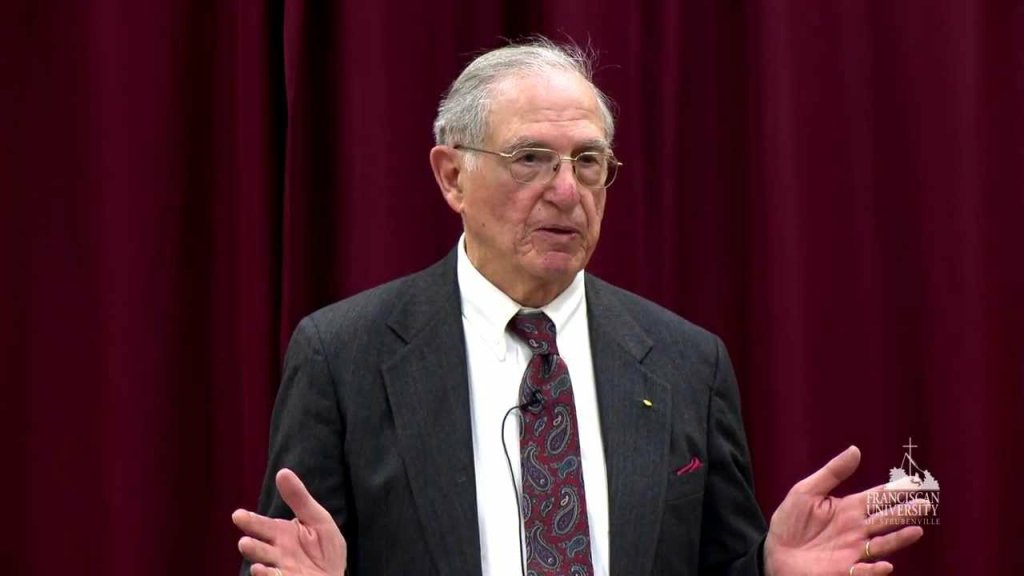
About James Likoudis
James Likoudis, recent recipient of an honorary doctoral degree from the Sacred Heart Major Seminary (2020) is a Catholic writer and apologist. He is author of 4 books dealing with Eastern Orthodoxy: Ending the Byzantine Greek Schism, The Divine Primacy of the Bishop of Rome and Modern Eastern Orthodoxy, Eastern Orthodoxy and the See of Rome, and Heralds of a Catholic Russia. His The Pope, the Council, and the Mass (coauthored with the late Kenneth Whitehead) remains an important correction against extreme traditionalism.
— See Traditional Catholic Ecumenism
— Michael Davies on the Liturgical Changes of Vatican II
EWTN COMMENTARY: The longtime theologian and historian died Sept. 3, 2024 at the age of 95.
Philip Blosser and Andrew Likoudis
The Catholic Church lost one of its most courageous and articulate defenders in James Likoudis, who died Sept. 3 at the age of 95.
A revered historian, apologist and educator, Likoudis devoted his life to explaining the teachings of the Catholic Church on a wide range of issues from Vatican II and the papacy, to defending marriage and the family against the assaults of secularism and the sexual revolution, and, most significantly, bridging the divide between Catholicism and Eastern Orthodoxy.
His death marks the end of a profound journey of faith, a life of unwavering commitment to the truth, and an unyielding commitment to defending the Catholic Church from the erosion of her teaching.James Likoudis.(Photo: Courtesy photo)
As president of Catholics United for the Faith (CUF), a lay organization founded in 1968, Likoudis became a leading voice in defending Church teachings, particularly those articulated in Pope St. Paul VI’s encyclical Humanae Vitae. His tireless efforts to uphold Catholic sexual morality and the magisterium’s authority led him to travel and lecture worldwide, engaging audiences with his depth of knowledge and unwavering commitment.
Born in 1928 to Greek immigrants in Lackawanna, New York, Likoudis’ upbringing began in the Greek Orthodox Church. However, he experienced a profound intellectual transformation at the University of Buffalo’s Newman Club, where he encountered the writings of St. Thomas Aquinas, Christopher Dawson and other Catholic luminaries. Likoudis converted to the Catholic faith in 1952. This marked the beginning of his lifelong mission, much like his hero St. Leopold of Castelnuovo, to foster unity between the Catholic and Orthodox Churches.
Likoudis’ contributions as a scholar and author were vast, including his renowned works Ending the Byzantine Greek Schism and The Divine Primacy of the Bishop of Rome and Modern Eastern Orthodoxy. These books, celebrated for their depth and clarity, addressed theological and historical challenges with the goal of reuniting the two great Christian traditions. He completed this trilogy on the Byzantine tradition with Eastern Orthodoxy and the See of Peter: A Journey Towards Full Communion (2006). Likoudis’ impact on Catholic ecumenism was recognized in 2002 when he received the Blessed Frederick Ozanam Award for Catholic Social Action from the Society for Catholic Social Scientists, and in 2020 he was awarded an honorary doctorate of divinity by Sacred Heart Major Seminary.
His most celebrated book, The Pope, the Council, and the Mass: Answers to Questions the Traditionalists Have Asked, co-authored with Kenneth Whitehead, was a powerful defense of the Second Vatican Council and the liturgical reforms of Pope St. Paul VI.James Likoudis speaking to students in a class.(Photo: Courtesy photo)
Likoudis’ impact extended well beyond his writings. As the president of CUF and Morality in Media (now the National Center on Sexual Exploitation), he vigorously defended the Church’s teachings on family, morality and religious liberty. His tireless efforts in campaigns such as the successful challenge against the problematic Christ Among Us catechism led to direct action by Cardinal Joseph Ratzinger and the Congregation for the Doctrine of the Faith, cementing his role as a steadfast guardian of orthodoxy.
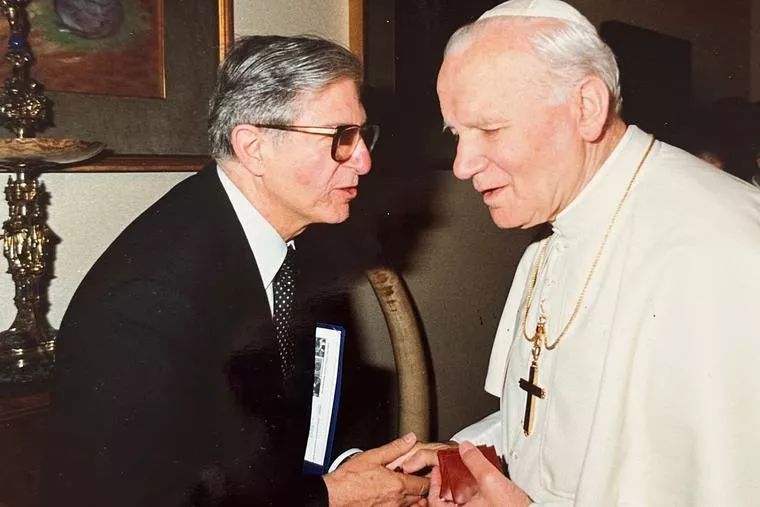
During these excursions to the Vatican, he had the opportunity several times to present Pope St. John Paul II with his books, and he also had a chance to meet Mother Teresa, who later endorsed a book Likoudis contributed to with the Catholic philosopher Dietrich von Hildebrand.
Throughout his career, Likoudis’ voice was characterized by both courage and clarity, following in the tradition of his favorite theologian, St. Thomas Aquinas. 2He consistently articulated a vision of faith that upheld the dignity of the human person, the sanctity of family and the authority of the Church. For this reason, Likoudis, representing CUF, was invited to the Vatican by Cardinal Alfonso López Trujillo, president of the Pontifical Council for the Family, to a meeting that led to the foundational document, “Truth and Meaning of Human Sexuality: Guidelines for Education within the Family.”
Alice von Hildebrand, wife of Dietrich, reflecting on thinkers who shaped her understanding, counted Likoudis among those she most admired and respected, underscoring his influence among the brightest Catholic minds of the past century.3
Scott Hahn, another longtime friend of Likoudis, described him as a mentor who provided essential guidance, saying, “I have been working in the Catholic world for almost four decades now, but I’ve known few people who have such a passion for the apostolate and for Christian unity.”
Similarly, Mike Aquilina observed, “James Likoudis really does occupy a singular place in the literature of his time; faithful, yet not crazy. I think a good many people appreciate him for his careful judgments about the postconciliar situation as it was developing. Very few people got it so right.” These accolades capture the heart of Likoudis’ legacy: a brilliant mind, deeply committed to the truth, whose work has illuminated the path for countless Catholics.
Jeffrey Mirus, founder of CatholicCulture.org and an influential voice in Catholic media, also credited Likoudis as a crucial mentor during his formative years.
“James Likoudis was one of several mentors from whom I was privileged to learn when I was struggling to become more effective in defending and advancing the Catholic faith in my 20s,” Mirus said. “Likoudis was already established as a proponent of authentic Catholic renewal, a leading opponent of sex education in schools, and a champion of the magisterium.”
Likoudis was not only a distinguished theologian but also a dynamic figure in public life. He ran as a mayoral candidate in his hometown, Watkins Glen, and spent more than two decades as a social studies teacher to high-school students and a history and government instructor at the Franciscan minor seminary, St. John’s of the Atonement, as well as at Rosary Hill College in upstate New York.
In recognition of his efforts against the moral decline in media, he was awarded the Morality in Media award alongside Mother Angelica while living in Buffalo. Likoudis’ influence extended into the public eye, with appearances on popular programs like Geraldo and The Phil Donahue Show as well as on EWTN. He was also a frequent debater in packed town halls, engaging educators and the public in discussions that drew crowds lined up out the door, cementing his reputation as a tireless advocate for truth and morality.
Likoudis’ dedication to Catholic teaching was not limited to the theoretical; it was deeply personal. His marriage to Ruth, which lasted 71 years, was a testament to the faith and family values they cherished. Together, they raised six children and were blessed with 35 grandchildren and 44 great-grandchildren, creating a legacy that extended far beyond the written word. His personal journey and family life reflected the very principles he defended in the public sphere.
Likoudis leaves behind a profound intellectual and spiritual legacy that will continue to inspire generations of Catholics. His life reminds us that the pursuit of truth, guided by courage and clarity, is a noble and necessary endeavor. His warm sense of humor and engaging personality made him a beloved figure within the Catholic community. Whether through his leadership at CUF or his tireless advocacy for Catholic unity and fidelity, Likoudis remains a shining example of unwavering dedication to the Church, a beacon of hope for those navigating the complexities of faith in the modern world.
May his soul rest in the peace of Christ, and may his work continue to bear fruit in the life of the Church. Likoudis’ funeral Mass is scheduled for 10 a.m. at Assumption Grotto, Detroit, on Sept. 14.
Andrew Likoudis is an entrepreneur and studies business and communication at Towson University in Baltimore. He is the president of the Likoudis Legacy Foundation. He is the editor of six books on the papacy and ecclesiology.
Philip Blosser, Ph.D., is professor of philosophy at Sacred Heart Major Seminary. His most recent publication is a translation of a German work by H. G. Stoker entitled Conscience: Phenomena and Theories (Notre Dame, 2018).
MORE INFO:
The Likoudis Legacy Foundation, established in honor of James Likoudis aims to continue his work by promoting scholarly research, digital media, and initiatives that uphold his commitment to theological orthodoxy and unity in the Church. To support or learn more about the foundation’s mission and projects, please visit likoudislegacy.com.

 Catholic Critique