
Has Oxford Awakened from its Wokeness? Not Yet.
“Oxford University is one of the oldest and most prestigious universities in the world. It was founded in the 11th century, and its history is closely linked to the history of Christianity in England. At the time of its founding, the university was primarily a religious institution, and its purpose was to train clergy.
During the 16th century, Oxford was a center of the English Reformation, and the university played a crucial role in shaping the Anglican Church. Some of the most famous religious scholars in history, such as John Wycliffe and Thomas Cranmer, studied at Oxford.
Over time, Oxford became less exclusively religious, and by the 19th century, it was known primarily as a secular institution. However, religion still played a significant role in the life of the university, and many of its traditions and customs are rooted in its religious past…
The founding of Oxford University and its early religious ties
Religious origins: Founded in the 12th century, Oxford University’s earliest colleges were established to educate the clergy. Religious studies were at the core of its curriculum, and the university’s governance was closely tied to the church.
The role of monastic orders: The establishment of Oxford’s first colleges, such as University College and Balliol College, was sponsored by monastic orders. The religious orders maintained control of the colleges until the 16th century.
Reformation: During the 16th century, the English Reformation brought significant changes to the university’s religious affiliations. Many of the colleges became Anglican, and religious studies were replaced with secular subjects.
The Oxford Movement: In the 19th century, the Oxford Movement sparked a renewed interest in traditional Christian theology. This movement influenced the establishment of new colleges, such as Keble College and Pusey House, which emphasized the study of theology.
Despite these changes, religion has remained an integral part of Oxford’s history and identity. Today, the university continues to uphold its heritage while also embracing a diverse range of academic and religious perspectives. — Christian Educators Academy
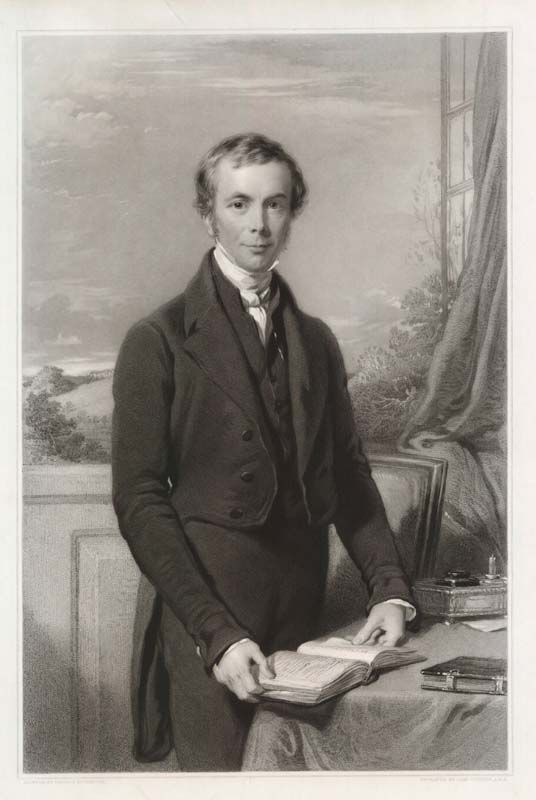
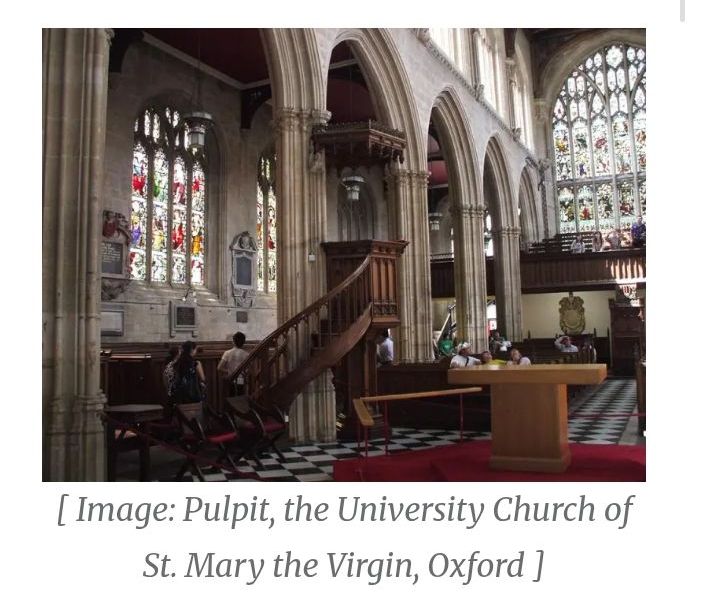
John Keble, on 14 July 1833, preached a sermon at the University Church of St Mary the Virgin, Oxford, entitled “National Apostasy.”
By Posted by jbpauley on July 14, 2022, AIG
It is an assize sermon, which Hugh Adlington describes as a preaching sub-genre that reflects on the interrelation of justice administration and religious tenets. (Hugh Adlington, “Restoration, Religion, and Law” in The Oxford Handbook of the Early Modern Sermon [Oxford University Press, 2011]). Newman identified this particular assize sermon as the moment at which the Oxford Movement was launched. (You can find the sermon here.)
On this anniversary of the beginning of the Oxford Movement, I commend to your reading and reflection this excellent reminder—from our own Fr. Steve Lambert Rice, Obl.S.B.—of this important moment in Anglican-Patrimonial history.
At least two points worth considering:
The spiritual health of the Church isn’t a matter of waiting for the institution to set things right but for each individual Christian—recognizing our common identity as the Body of Christ, of course—to respond to the call to discipleship.
Individual responsibility also rests with every individual who claims the Anglican Patrimony. This responsibility includes understanding what that patrimony is and what it is not.
As for basic Christian discipleship, here is a passage from Fr. Steve’s piece that reminds us how relevant Keble’s Assize Sermon still is.
“Nations, and by-extension individuals, find justification for throwing off the yoke of Christ and the demands of discipleship. We look to threats outside and threats within to abandon godly principles (sound familiar?). We then blame government or religion for our ills and never ourselves. We rationalize and excuse every decision and act. We become so tolerant that we believe nothing and we persecute those who believe in the name of inclusion (oh my goodness!). This rebellion moves from individuals to public officials. The officials begin to attack Christ by attacking His Church, beginning with apostolic authority – bishops. This attack will come in the name of popularity and expediency.”
On the point of what the patrimony is and isn’t, consider the following:
“The Catholic Revival in the Church of England had nothing to do with gin, lace, and backbiting, as is often caricatured. Yes, elaborate ritual and church building followed in the next generation, but this was a logical development of the belief that the Church is not the same as the Post Office. The Holy Eucharist is the source and summit of our lives and not the same as chicken tetrazzini at the weekly Rotary Club. The development of ritual and devotion was the servant, the handmaid, to the truths Keble turned our minds to 185 years ago.”
Some critics of the Anglican Patrimony’s place in the Catholic Church charge members of the Ordinariates with being affected and too focused on “fuss and feathers.” Such statements are sweeping generalizations, of course. But those of us who come from the Anglo- Catholic tradition (to use the term in its broadest sense) know that such charges are not without some merit.
The antidote to this fuss-and-feathers enervation is simple, I suggest: be knowledgeable—prayerfully knowledgeable—about our roots. For example, by being informed about what the Oxford Movement really was (and what it wasn’t), we can be inspired by the same ideals that fostered, in the 19th-century Church of England, a re-discovery of the transformative power of the liturgy—a power so vibrant and pure that those foundational years of the Oxford Movement had nothing in them of aestheticism or ritual as a mere art form.
Moreover, by rediscovering the Oxford Movement, we can rediscover—along with Keble, Newman, Pusey, and others—the vibrant witness of the Church of the Patristic era. The Oxford Movement’s project of making the writings of the Church Fathers available in English translations was not for the sake of abstruse scholarship. It’s too easy to think of the Oxford Movement as a mere exchange of high ideals in the Common Room of Oriel College. But as of July 1833, Keble, Newman, Pusey, and the others embarked upon lives of sacrifice. All of them destined for comfortable livings in the CofE, they knew that Keble’s Assize Sermon would put those comfortable, predictable futures in jeopardy.
What inspired them in this course of action was the power of the writings of Sts. Augustine, Jerome, Ambrose, Athanasius, and many other towering intellects fired by holy wisdom. This same fire can burn away affectations and rubricist legalism that can sadly make the fuss-and-feathers charge stick. Continue …
And Today. The most woke universities — ranked
18 Jan 2023, by Christina Attrah. Studentbeans.com
“… We’ve got 137 universities ranked so you can see which are the most woke universities. Plus you can see where your university appears on the woke scale.
Starting with the Top Ten followed by the link to the rest in ranking:
University of Cambridge: 2.38
University of Oxford: 1.96
University of Bristol: 1.81
University College London: 1.63
Newcastle University: 1.62
SOAS, University of London: 1.6
University of East Anglia: 1.56
University of Warwick: 1.51
Durham University: 1.49
University of Exeter: 1.42
See Oxford University LGBTQ+ Society
Navigating Oxford University as a Christian: A Student’s Story
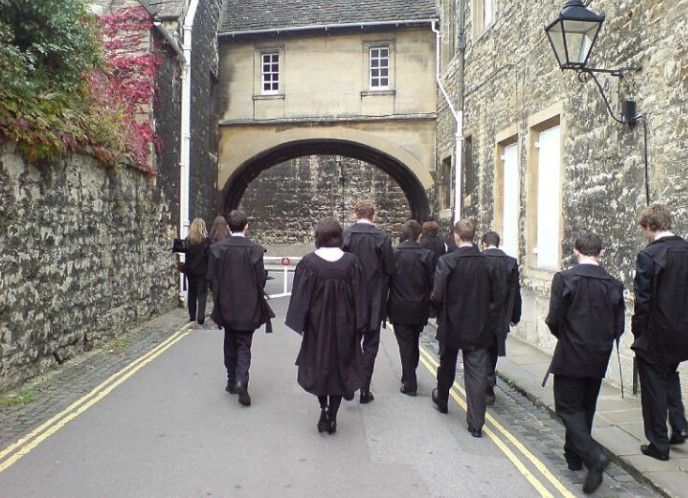
“We have a tutorial system here,” the student explained. “It’s why people want to come to Oxford—why I love Oxford. Rather than only having big lectures, you will also have one-on-one time with your tutor and three to five other people. It’s a time where you discuss, and things will obviously get quite intense. In studying literature, especially, there are always going to be things coming up that I don’t agree with, and things to do with Christianity.”
Many of these things, she explained, are unbiblical ideas presented as fact—for instance, the false idea that God’s character changes from being judgmental in the Old Testament to merciful in the New Testament.
“In a situation where it is quite a closed environment and you are expected to share your views,” she said, “it can be difficult to say what you want to say and to express what you believe in a context where your tutor is supposed to be your super and supposed to be intellectually superior. When you start expressing your views, you are seen as intellectually inferior.”
“I can see how that would add an extra layer of pressure to conform,” I said. As I described in *Prepare to Thrive*, the powers
of authority and conformity pack a wallop of a persuasive punch, with messages sounding true simply because they’re stated by authority figures in a setting where everyone seems to agree. Christians must be prepared to face these challenges, recognizing that the ultimate authority is not a human figure or a crowd consensus, but the Word of God.
Q: “On the positive side,” I continued, “what have you found encouraging about being a Christian student here?”
“I think something I’ve found is that actions speak volumes,” she replied. “And what you don’t do speaks volumes as well.”
By staying out of the party scene, for instance, this student had become known as a trustworthy person to whom others could turn for help or advice.
How to Navigate the Challenges
“What would your advice be to another Christian student?” I asked.
“I’d say that establishing a routine straightaway is really important,” she answered, “and by routine, I mean making sure that you are always spending time with God at some point in the day. Because with any university, you’re under so much pressure and facing so many constant deadlines that it can be so easy to push those [spiritual] things aside—especially when you’re sleep-deprived.”
“Totally,” I replied. Students I’d interviewed in multiple other countries had also emphasized the importance of keeping strong spiritual foundations—maintaining a daily personal walk with God fueled through prayer, Scripture, and worship.
“I definitely know that I’m not perfect in that respect yet,” the student continued, “but I’ve always found that I am so much happier, so much more at peace, so much less stressed within my own heart and within my own mind when I know that I have spent time in the morning or in the evening—preferably both—spending time with the Lord and committing things to him in prayer. My mom always says,
‘Fit everything else around your walk with God, rather than fitting your walk with God around everything else.’”

